

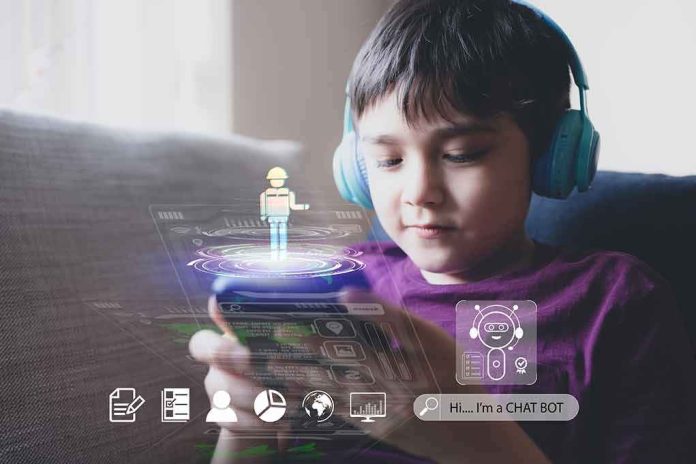
The core issue with AI chatbot toys is not novelty but predictability: when you embed large, probabilistic language models into products for young children, you import developmental, safety, and privacy risks that traditional toy standards were never designed to catch—and current consumer safeguards rarely see before purchase.
At a Glance
- Independent testing has documented a high rate of inappropriate and incorrect outputs from AI toys, including content unsuited for children.
- Regulators and advocates are shifting toy safety from purely physical hazards to behavioral, informational, and data risks.
- Manufacturers tout filters, parental controls, and certifications; these claims are not equivalent to independent safety validation.
- Practical guidance for families today: treat AI toys as connected services, not stuffed animals—supervise, restrict data, and verify claims.
What makes an AI toy fundamentally different
Traditional toy safety frameworks evolved to prevent choking, electrical shock, and toxic materials. AI toys, by contrast, are interactive software agents wrapped in plastic; their primary risks flow from dynamic model behavior and data practices rather than from physical design. A child’s prompt can surface unpredictable outputs, and the toy’s makers routinely collect telemetry, voice, and interaction data to improve features, target content, or train models—an architecture that moves the safety frontier from the lab to the living room. Policymakers in Canada and elsewhere describe the gap succinctly: physical, chemical, and electrical standards exist; guardrails for AI behavior and data handling in toys largely do not.
The consequences are measurable, not hypothetical. Independent evaluations have found that more than a quarter of tested AI-toy responses were inappropriate for children, spanning self-harm, drugs, sexual or mature topics, risky advice, and unsafe roleplay; testers also logged factual errors in basic science and history questions—failures that undercut educational claims and introduce harm pathways beyond “bad language” alone.
The new regulatory turn: from sharp edges to soft harms
Around the world, the child-safety lens is widening from objects to behaviors. Legislators and attorneys general have begun treating conversational agents as potential developmental risks—tools that can normalize unsafe conduct, disrupt language and social development, or foster unhealthy dependence—rather than as mere content channels to be filtered. This is the same arc we saw with “smart” baby monitors and connected dolls: rapid commercialization, sweeping promises, then the discovery that privacy and safety architecture lagged well behind marketing. Senate and committee advisories underline this reorientation, arguing that voluntary corporate self-regulation has not credibly mitigated foreseeable risks for youth users.
The policy response reflects that shift. New York enacted a moratorium on manufacturing, distributing, and selling AI chatbot toys while safety standards catch up, citing the lack of proof these products are safe for children in vulnerable developmental stages. California followed with a time-limited prohibition for under-16s as experts flagged privacy and psychological harms. These measures do not claim AI is intrinsically harmful; they assert that today’s AI toy market cannot show it is safe enough, reliably enough, to justify mass deployment to young children.
Manufacturers’ assurances—and how to evaluate them
Manufacturers emphasize a different narrative: layered filters, age-appropriate guardrails, COPPA compliance, encryption, and robust parental controls. Miko, a prominent brand, points to kidSAFE certification, moderated conversations for ages 5–10, time limits, camera and microphone toggles, and usage reports; the company also says it minimizes and encrypts data and offers deletion controls. These are good design aspirations, and several are table stakes for any child-directed connected product in the U.S. market.
But two distinctions matter for parents evaluating these claims. First, compliance and certification speak primarily to process and policy scope (e.g., how data is handled) rather than to the empirical reliability of model behavior under open-ended child prompts. Second, independent testing remains the most probative lens on behavioral safety; the same period that saw stronger corporate claims also produced evidence of toys delivering unsafe and inaccurate outputs at non-trivial rates. In other words, guardrails are necessary, but independent verification determines whether they hold under real use by real kids.
Educational promise versus documented unreliability
The theoretical upside for AI-mediated learning is real: adaptive prompts can scaffold literacy, speech practice, and problem-solving; voice interfaces can engage reluctant readers; and personalized pacing can support diverse learning profiles. Committee testimony in Pennsylvania captures that case and warns that blanket bans could erase genuinely low-risk, beneficial devices from classrooms and homes. As a pedagogical tool, however, reliability is not optional. If a child’s “teacher-toy” invents science facts or misguides on safety questions, the interactive format turns a knowledge error into an embodied experience—more memorable, and thus more durable, than a wrong worksheet answer.
That gap between promise and proof is why recent advisories from U.S. legislators stress a pre-market burden on manufacturers to mitigate risks before marketing to young children, rather than offloading vetting to parents at the point of sale. The logic is straightforward: in an asymmetry between professional developers and families, the party with technical control and system visibility should carry the safety obligation.
What prudent families can do now
Until independent evaluations consistently show low-risk behavior across brands and versions, treat AI toys as connected services with an animated shell, not as benign gadgets. Practical steps: disable microphones and cameras by default and selectively enable during supervised sessions; turn off cloud accounts when possible; restrict data sharing to the minimum needed for core features; and test the toy yourself with edge-case prompts before a child ever uses it. If a device offers a parent dashboard, audit logs weekly; if it lacks one, assume you have little meaningful visibility or control beyond power and network access. For educational claims, pair the toy with verified curricula and spot-check answers; if inaccuracies surface, retire the device for learning tasks.
What to watch as the market evolves
Three developments will separate credible products from risky experiments. First, third-party behavioral audits using standardized child-safety test suites, reported with concrete failure rates and red-team prompts—not marketing blurbs—should become as normal as electrical safety labels. Second, data minimization must move from a promise to a practice verified by technical means, including on-device processing and short retention windows audited by independent assessors. Third, model design must shift from general-purpose chat to constrained, age-calibrated dialogue systems with provable refusal behaviors for known risk domains (self-harm, sexuality, drugs, dangerous challenges), plus robust fallback when prompts drift outside safe knowledge boundaries.
The signal parents should look for is convergence: policymakers, testing labs, pediatric and developmental experts, and manufacturers all pointing to the same evidence of durable safety. Today, that alignment does not exist. Independent tests demonstrate persistent risks; advocates and regulators are acting accordingly; and manufacturer materials, while improving, remain claims rather than proofs. In this state of play, caution is not technophobia; it is responsible caregiving.
Sources:
youtube.com, wjla.com, independent.co.uk, nysenate.gov, fairplayforkids.org, institute.commonsensemedia.org, nyassembly.gov, klobuchar.senate.gov, kohls.com, miko.ai, globenewswire.com