

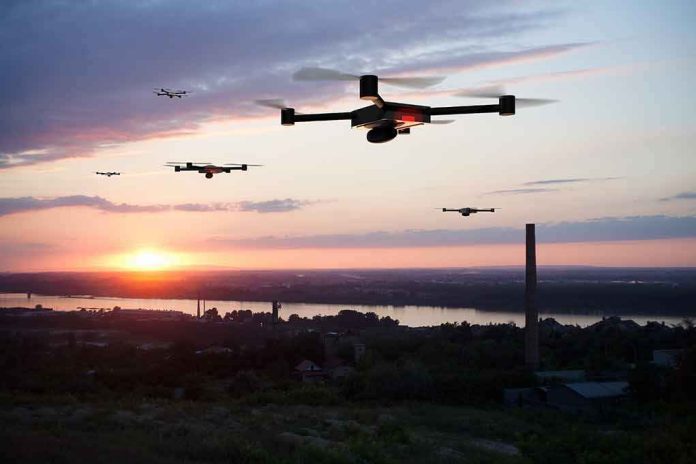
Autonomy at combat speed is no longer a science project; in recent Air Force trials, mission-grade software coordinated multiple uncrewed aircraft and took real-time tasking from a fighter in the air—exactly the behavior Collaborative Combat Aircraft will need to be useful on day one.
At a Glance
- Shield AI’s Hivemind executed manned–unmanned teaming by taking directives from an airborne F-22 pilot and translating them into autonomous CCA actions.
- The software also coordinated multiple CCA aircraft in formation and beyond-visual-range counter-air maneuvers—an Air Force first for the program.
- These events fit a proven development arc: flight demonstrations prove technical possibility; acquisition requires reliability, human control, survivability, and sustainment evidence.
- U.S. policy and international norms continue to emphasize meaningful human control and rigorous testing as autonomy moves from trials to fielding.
What, precisely, was achieved in the latest CCA autonomy trials
Shield AI reported two linked milestones within weeks: first, an F-22 pilot issued high-level directives that Hivemind converted into executable behaviors on a Collaborative Combat Aircraft (CCA); second, Hivemind coordinated multiple CCAs to fly in formation and conduct collaborative beyond-visual-range (BVR) counter-air maneuvers. Both events occurred in late October at the Nevada Test and Training Range and were characterized by the Air Force as firsts for the CCA program’s autonomy track. The mechanics matter: the human commanded intent, not stick-and-rudder inputs; the autonomy stack handled flight, coordination, and tactical maneuvering consistent with BVR doctrine.
Why that matters is straightforward. CCA is not a drone program bolted to fighters; it is a doctrine shift that assumes uncrewed teammates will extend sensing, magazine depth, and decision advantage in contested airspace. To be operationally relevant, these aircraft must accept commander’s intent in flight, deconflict among themselves, and execute time-critical tasks at machine speed without saturating the pilot’s workload. The October demonstrations targeted precisely those attributes and—per Air Force-aligned reporting—were executed using mission autonomy software now selected as a provider to the CCA enterprise.
How the autonomy works: intent translation, distributed coordination, and BVR behaviors
Mission autonomy packages like Hivemind fuse three layers. At the bottom is flight autonomy—keeping the aircraft within performance envelopes and airspace constraints. Above that sits collaborative autonomy—formation keeping, sensor tasking, and collision avoidance across multiple vehicles. At the top is tactical autonomy, which maps a commander’s directive (e.g., sanitize a sector, hold a line abreast, prosecute a track file) into maneuver plans that respect rules of engagement and deconfliction. In the October trials, the F-22 supplied intent; Hivemind handled the rest, including coordinating geometry for BVR-relevant behaviors, which prize timeline control, emissions discipline, and sensor–shooter pairing over visual dogfighting.
Notably, Air Force sources and Shield AI describe the test environment as using constructive (virtual) threats and high-level tasking rather than live missile shots; that is normal for early autonomy workups, where the objective is decision logic and team coordination, not end-to-end kill chains with expendable weapons. The Air Force has made clear that CCA’s value will come from exactly these machine-speed, multi-ship actions knitted to human command.
How we got here: from surrogate targets to missionized CCA
Autonomy programs in U.S. naval and air forces have progressed through surrogate platforms and staged mission elements for years. The Navy’s BQM-177A target drone has doubled as an autonomy research aircraft, hosting Hivemind for multi-vehicle flights and manned–unmanned teaming scenarios with virtual command assets—an approach that reduces cost while instrumenting complex behaviors before migrating to mission aircraft. That lineage fed the Air Force’s CCA workups, where semi-autonomous aircraft and autonomy stacks matured in parallel and then in combination—culminating in the October CCA formation and BVR maneuvering trials attributed to Hivemind.
Institutionally, the Department’s AI strategies have shifted from boutique prototypes to competitive mechanisms aimed at iterative discovery and scaling of AI-enabled concepts of operation. This is visible in the way CCA autonomy is being trialed: frequent flight events, rapid software updates, and aggressive push toward human-on-the-loop tasking from operational aircraft, not just ground stations.
Where the real work remains: reliability, human control, and integration at scale
Flight demonstrations are necessary but insufficient. To buy, field, and trust CCA autonomy at scale, the Air Force needs evidence across several pillars: statistical reliability across environments; robust human-machine interfaces that keep pilots in control of lethal effects; survivability of both the aircraft and the command-and-control links; and sustainment pathways that make software updates, verification, and cybersecurity routine. Independent CCA analysts and official messaging have been blunt that flight tests alone do not equal readiness; doctrine, training, maintenance, and policy must mature in lockstep.
Those imperatives align with international and humanitarian law frameworks emphasizing meaningful human control and rigorous weapons review. United Nations expert processes and the International Committee of the Red Cross have highlighted the testing and evaluation obligations for autonomous functions, especially in realistic, variable conditions; the burden is to demonstrate that identification, selection, and engagement behaviors remain within human-defined bounds and can be audited, validated, and governed over a system’s life cycle. For CCA, that translates into clear human authorities for target designation and weapons employment, transparent autonomy modes, and training that ensures pilots can command, override, or disengage autonomy under stress.
#19 Shield AI says Hivemind flew multiple Air Force CCAs as a coordinated team for the first time
Industry · Government/Military · UAV (CCA), autonomy, software (AI) · Industry/Research
Shield AI says that on Oct. 26 its Hivemind autonomy enabled multiple Air Force CCAs to fly…
— AUTOWAR25 (@AUTOWAR25) November 9, 2026
What it means for future air combat
The October milestones compress the distance between concept and capability: an in-cockpit commander issuing intent to a team of autonomous aircraft that then coordinate themselves to prosecute a BVR-relevant task. Technically, it validates autonomy that can handle multi-ship coordination while respecting fighter timelines. Operationally, it points to a near-term CCA that extends sensor reach, complicates adversary targeting, and preserves crewed fighters for decision and weapons employment rather than routine perimeter tasks. Strategically, it underscores a procurement truth: software is the center of gravity. Aircraft will vary, but the mission autonomy and its integration with human command will determine who gains the decisive tempo advantage.
The acquisition path from here is disciplined and known: broaden scenarios, introduce live and contested elements, instrument failure modes, and harden the training and sustainment spine that turns impressive test cards into everyday squadron practice. The Air Force has already signaled that CCA is about seamless integration with crewed fighters to extend reach, awareness, and survivability; the latest demonstrations show how that promise is being realized in the cockpit and in the air.
Sources:
defensedaily.com, shield.ai, navalaviationnews.navy.mil, navair.navy.mil