

Impeachments of Cabinet officers are vanishingly rare; anchoring one in war-powers law raises a sharper question still: not whether a policy was wise, but whether a secretary helped wage a war that Congress never authorized and, under statute, ordered to end.
The Short Version
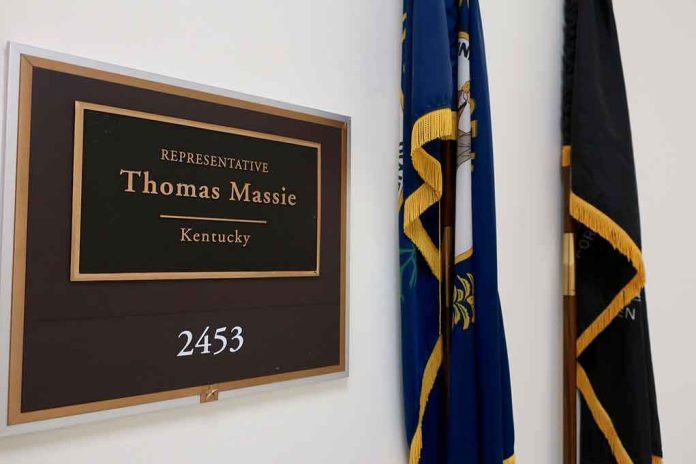
- Rep. Thomas Massie introduced a 34-page resolution with eight articles to impeach Defense Secretary Pete Hegseth, centering on alleged War Powers Resolution violations tied to the Iran war.
- The core legal theory is specific: Hegseth allegedly continued hostilities without a declaration of war, statutory authorization, an attack on the United States, or an imminent threat, and after Congress directed withdrawal.
- The resolution also alleges abuses beyond Iran war powers, including unlawful operations in Yemen and Venezuela and other misconduct; these claims remain unadjudicated allegations.
- Hegseth and President Trump defend the war as necessary to prevent an Iranian nuclear weapon and credit it with protecting U.S. and allied lives.
What is actually on the table: a statute-driven impeachment theory
Massie’s move is not a messaging one-off; it is a formally filed impeachment resolution organized around eight articles that can be read as two clusters: a war-powers indictment and a suite of alleged abuses of authority beyond Iran. The backbone is the War Powers Resolution (WPR). Article I reportedly charges that Hegseth continued the Iran war absent any of the statute’s three recognized predicates: a declaration of war, specific statutory authorization, or a national emergency created by attack on the United States or its forces. Article II links conduct to Congress’s asserted exercise of its withdrawal power under Section 5(c), alleging hostilities continued after a concurrent resolution directing removal (identified as H. Con. Res. 86). Article III advances a timing theory under the WPR’s 60-day clock (plus a potential 30-day withdrawal period), alleging the department treated mandatory termination as discretionary.
Beyond war powers, additional articles reportedly allege unlawful or abusive authority across disparate theaters—civilian-casualty disregard, targeted killings of suspected drug traffickers, the seizure of Venezuela’s Nicolás Maduro and Cilia Flores without legal authority, and unauthorized operations in Yemen—painting a portrait of overreach rather than a single policy dispute. Procedurally, contemporaneous coverage describes the resolution as 34 pages with eight articles, introduced with expectations of support from Democrats and a subset of Republicans—an unusual cross-factional alignment in a body typically allergic to impeaching sitting Cabinet officials.
How the War Powers Resolution frames the charge
To grasp why these articles matter, recall how the WPR is supposed to work. Passed in 1973 after a generation of unauthorized escalation in Southeast Asia, it attempts to reinsert Congress into decisions to sustain hostilities. The statute’s Section 2(c) tries to box executive discretion to three lanes—declaration, specific authorization, or emergency from attack—and its 60/90-day clock is designed to convert short-term initiative into long-term legislative accountability. The Congressional Research Service’s synthesis is clear on that core structure: the president may introduce forces into hostilities only under those predicates; sustained operations without authorization are supposed to terminate when the clock runs out. That is the legal fulcrum Massie’s first three articles lean on.
Two additional moves sharpen the knife. One is the Section 5(c) concurrent-resolution mechanism—Congress asserting it ordered withdrawal. Courts have ducked the WPR’s hardest questions and practice has been messy—executive lawyers narrow “hostilities,” Congress often funds while objecting, and deadlines slide in the fog of ceasefires and “support” missions. But if the factual record shows prolonged kinetic operations without authorization, after the statutory clock and after a concurrent resolution to withdraw, the legal claim is not amorphous; it’s testable against text and dates.
The counter-case: necessity, success, and commander-in-chief latitude
Hegseth and President Trump have answered on policy and performance, not primarily on statutory parsing. They describe the Iran war as a courageous, necessary campaign to ensure Iran never acquires a nuclear weapon, with clear objectives—dismantling missile and naval capabilities—and with tangible defensive returns: missiles and drones intercepted, American and allied lives protected. Trump has repeatedly rated Hegseth’s performance as “very good” and worth continuing notwithstanding political costs, arguing he would make the same decision again because preventing a nuclear-armed Iran is non-negotiable.
There is a legal gloss sprinkled in that defense: reporting attributes to the administration the view that WPR deadlines did not apply given a ceasefire—an oft-invoked executive theory that “hostilities” ended, clocks paused, or operations fell below the threshold that triggers termination. Historically, such arguments have found tactical traction because Congress rarely forces a showdown and courts rarely intervene. As a matter of constitutional practice, executive unilateralism has expanded by exploiting ambiguity and dispersing decisions across agencies; as a matter of positive law, the WPR’s clocks and predicates still say what they say. The impeachment test is whether the facts fit the statute’s boxes.
Where the evidence is strong—and where it is thin
Two things are solid. First, a specific, introduced impeachment resolution exists, anchored in named statutory provisions and organized around dated clocks and an identified withdrawal directive; this is not just a cable hit but a bill of particulars that can be cross-checked against congressional records and War Powers reports. Second, the counter-position is on record in Hegseth’s and Trump’s own words: necessity, success, and a willingness to bear political costs for strategic ends.
What is not established in the available public record are the underlying operational facts necessary to decide the legal counts: the precise start dates of “hostilities” for WPR purposes, the text and legal effect of H. Con. Res. 86, the content of presidential War Powers submissions, and whether any ceasefire or mission-redefinition actually reset the statutory clock. Nor does the record separate, with documentary clarity, the secretary’s personal role from presidential direction and combatant command execution—essential for assigning individual impeachment culpability. On the broader non–war powers allegations (Venezuela seizures, Yemen operations, civilian casualties, alleged retaliation against Sen. Mark Kelly), the reporting cites the resolution’s summaries rather than independent investigative files or sworn testimony.
Impeaching a Cabinet secretary over war powers would be institutionally momentous
Cabinet impeachments are nearly unheard of; William Belknap’s 1876 case over pay-for-posts stands alone in the canon. Using impeachment as the vehicle to litigate war powers would mark a different kind of confrontation—Congress asserting that statutory limits are not precatory but enforceable against named officers who help carry out unauthorized hostilities. The constitutional logic is coherent: the House’s investigative and impeachment powers are how it can police adherence to its own war-making prerogatives when courts abstain and appropriations are too blunt an instrument. Whether it is prudent is a political question; whether it is constitutional turns on the familiar standard of “high crimes and misdemeanors,” which has always included abuses of official power rather than only indictable crimes.
If pursued, the Senate trial would force a factual record: War Powers submissions, operational timelines, legal opinions from the Office of Legal Counsel and Defense Department, and evidence on compliance with any withdrawal directive. That would move the dispute from rhetoric to dates and documents—a healthy shift for a domain long ruled by elastic practice rather than enforceable law.
BREAKING: THOMAS MASSIE TAKES A MAJOR STEP AGAINST PETE HEGSETH, FILING ARTICLES OF IMPEACHMENT THAT COULD SHAKE UP WASHINGTON.
— James 🇺🇸 (@Realcoinforge) November 7, 2026
How to read the next phase
Set aside the electoral noise and focus on three verifiable questions: When did U.S. forces enter “hostilities” for WPR purposes in Iran, and what exactly did the president report to Congress? Did both chambers adopt H. Con. Res. 86, in what terms, and with what asserted legal effect? After 60 days (or 90 with withdrawal), did operations that qualify as hostilities continue without specific authorization, or were they paused, recharacterized, or reduced below the statutory threshold? The answers, not the slogans on either side, determine whether the core articles hold water.
Sources:
massie.house.gov, okcfox.com, whas11.com, cbsnews.com, abcnews4.com, stripes.com, inquirer.com, nytimes.com, rmb.reuters.com, edition.cnn.com, yahoo.com, war.gov, academic.oup.com, constitution.congress.gov, history.house.gov