

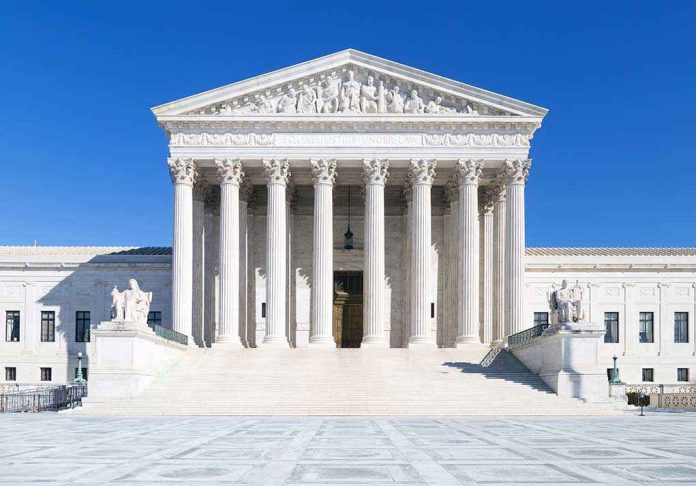
The Dobbs draft leak was not simply a media scoop; it was a direct rupture of the Supreme Court’s deliberative seal, the rare boundary that makes confidential candor possible among nine life-tenured judges. What followed—the Court’s exhaustive but inconclusive internal probe and a later federal grand-jury inquiry—illustrates a harder truth: the breach was obvious, but proving who crossed the line and whether a crime occurred remains unusually difficult.
At a Glance
- The leak was authenticated and unprecedented in kind: a near-final draft opinion published before decision day.
- The Court’s investigation was extensive but identified no leaker and found no evidence of outside intrusion.
- Justice Alito says he has a “pretty good idea” who did it, while conceding the proof falls short of naming anyone.
- A reported federal grand-jury probe marks an escalation, but its legal theory and targets remain undisclosed.
What the Court actually established—and what it did not
The Supreme Court treated the Politico publication of the Dobbs draft as a grave institutional breach and responded accordingly. The Marshal’s investigation canvassed access to the draft, collected sworn statements, and combed digital trails. Investigators conducted 126 formal interviews of 97 employees, required affidavits under penalty of perjury, and examined phone, email, printing, and access records. The public report affirmed the document’s authenticity and underscored how widely the draft circulated inside chambers—80 individuals had access to an electronic copy—but concluded that, on a preponderance standard, it could not identify who disclosed the draft or how it reached the press.
Two negative findings matter. First, investigators reported no forensic evidence that a Court employee emailed the draft outside the building, though record-keeping limits meant they could not categorically rule that out. Second, they found no evidence of an outside cyber intrusion; while not “absolutely” excluding a hack, the inquiry saw no suggestion of improper external access. In short, the leak most plausibly came from within, by someone with legitimate access, yet the available logs, devices, and interviews did not yield a culprit.
Why this leak was different from earlier Supreme Court disclosures
Information has escaped the Court before—19th-century cases saw outcome tips leak to newspapers; there were 1970s disclosures about Roe’s internal handling—but the Dobbs episode stands apart in form and consequence. What was published was not rumor, vote-count whispers, or a fragment of deliberation; it was a nearly complete draft majority opinion, months before the Court announced judgment. That distinction matters. A full draft lets outsiders reverse-engineer internal dynamics, track edits across circulation rounds, and attempt to influence the process midstream in ways stray gossip never could. Scholars and practitioners widely describe the Dobbs leak as institutionally unprecedented for that reason, even while acknowledging a longer, rarer lineage of Supreme Court leaks.
Inside any appellate court, confidentiality is the precondition for iterative reasoning: the ability to float tentative arguments, test them against colleagues’ counterpoints, and abandon lines of thought without reputational penalty. By puncturing that privacy, the Dobbs leak plausibly chilled candor and fostered suspicion. Justice Alito put it bluntly: it “created an atmosphere of suspicion and distrust.” That is not proof of criminality; it is a description of institutional cost—one the Court’s own report essentially corroborates by detailing the breadth of its inquiry and the narrowness of its findings.
Alito’s “pretty good idea” and the limits of suspicion
In the aftermath, Justice Alito stated that he had “a pretty good idea” who was responsible but distinguished that belief from proof strong enough to name a person publicly. That is a critical line. Courts do not name suspects on hunches, and internal confidence does not substitute for evidence that satisfies a legal standard. The Marshal’s report, after months of work, reached the same procedural bottom line: no single individual could be identified by a preponderance of the evidence. Taken together, Alito’s remark and the report support two propositions at once—investigators and at least one justice arrived at serious suspicion focused inside the Court, and the evidentiary record fell short of attribution.
Why is that gap so hard to close? Because the mechanics of opinion drafting—controlled circulation, shared access, and routine cross-chambers exchange—create a large pool of legitimate handlers. If the ultimate transfer occurred via an unlogged screenshot, a personal device outside institutional controls, a physical printout, or a second-degree handoff, conventional forensics will struggle. Sworn denials compound the difficulty: without a confession or a dispositive digital artifact, the inquiry runs on inferences, and responsible investigators stop where proof does.
From internal probe to grand jury: what escalation can and cannot do
Years later, reporting indicated that federal prosecutors convened a grand jury, issued subpoenas to people who worked at the Court during the relevant period, and sought testimony and records. As described, that is a jurisdictional and institutional escalation: grand juries can compel reluctant witnesses, test prior sworn statements, and obtain materials the Court chose not to release. But escalation is not the same as clarity. Public accounts have not identified a charged offense, a named target, or the specific statute at issue—whether the focus is the leak itself, false statements to the Marshal’s team, obstruction, or unauthorized computer access remains unstated in the public record.
The legal terrain is genuinely ambiguous. Leaking a nonclassified government document is not categorically criminal. Prosecutors would need a fit between facts and law: perhaps theft or conversion of government property if a physical document was wrongfully taken; perhaps the Computer Fraud and Abuse Act if someone exceeded authorized access; or false-statements charges if a witness lied to federal investigators once the matter crossed that line. Each theory turns on facts not publicly available. Until those surfaces—in an indictment, a declination memo, or unsealed filings—the grand jury’s significance is procedural power, not proof of outcome.
The Justice Department Moves Forward with Grand Jury Investigation into Dobbs Leak https://t.co/xyv9o7gZTk
— LionTC (@LionTCMan) November 7, 2026
Where reasonable disagreement lives—and where it does not
There is no reasonable dispute about the core events: the draft was authentic; the publication preceded the Court’s judgment; the Marshal’s team investigated extensively; the report reached no attribution; no evidence of an external hack emerged; and Justice Alito has private confidence short of proof. The disagreements are about meaning. One camp views the inability to name the leaker as evidence of institutional failure, perhaps warranting congressional oversight or independent forensics. Another cautions that, given the Court’s unique status and the legal ambiguity around leaks, the costs of external compulsion could exceed the benefits—especially if the federal theory ultimately rests on ancillary crimes rather than the disclosure itself. Both positions are coherent. Neither is refuted by the record we have.
What accountability could credibly look like
If the goal is institutional repair more than retribution, three paths are available. First, transparency calibrated to security: a redacted release of the Marshal’s investigative archive—interview memoranda, access logs, print records, and device forensics—would let outside experts assess method and gap without exposing operational details. Second, evidence discipline around public suspicion: if a justice holds a “pretty good idea,” preserving the underlying basis in a confidential, reviewable form—dates, documents, corroboration—ensures the government can test it against other evidence without converting intuition into reputational harm. Third, durable prevention: modern document security practices (tighter print controls, immutable access logs, compartmentalization during circulation) and clear ethical rules specific to the Supreme Court’s internal work product would narrow opportunity and clarify consequences for future breaches.
The lasting stakes
Courts do their best work when the justices can change their minds in private and explain themselves in public. The Dobbs leak collapsed that sequence. The internal investigation put a boundary around rumor—it told us what did not happen—while leaving the public without a name, a motive, or a clean legal story to teach in civics class. A grand jury can compel answers that institutional deference could not; it cannot conjure a crime where Congress has not written one or manufacture proof where none exists. That is the sober center of the Dobbs leak saga: an undeniable breach, a limited evidentiary record, and an institutional choice between more force and more light.
Sources:
zerohedge.com, whitehouse.senate.gov, npr.org, abajournal.com, nytimes.com, thedailybeast.com, americamagazine.org, cnn.com, courthousenews.com, nationalreview.com, preview.scotusblog.com