

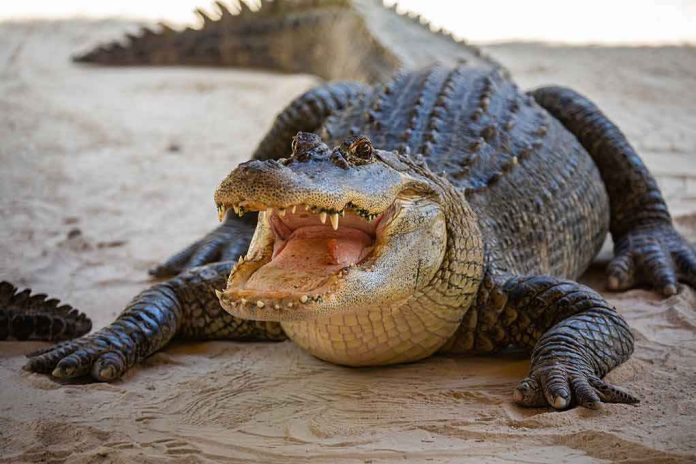
When an alligator hits from close quarters, seconds decide everything: who sees it first, who reacts, and whether someone on scene knows how to stop arterial bleeding long enough for help to arrive.
At a Glance
- A 58-year-old swimmer, identified as Dina Spann, suffered catastrophic injuries in an alligator attack on the Silver River near Ocala.
- Eyewitnesses described the alligator charging and rescuers applied a makeshift tourniquet before pulling swimmers to safety.
- Spann’s right arm was amputated below the elbow and part of a finger on her left hand was lost, according to consistent family and media accounts.
- Florida officials later removed a nearly 10-foot alligator believed to be involved; the capture followed standard nuisance-response practice.
What Happened on the Silver River
The core facts are clear. On August 8, in the Silver River corridor near Ray Wayside Park in Marion County, an alligator surged toward a group in the water and struck 58-year-old Dina Spann, leaving injuries that witnesses and 911 callers immediately understood as life-threatening. Eyewitness John Gamache, approaching in a boat, saw the alligator’s head “way above the water and going full speed” toward the swimmers; the severity of the aftermath was unmistakable, with bones exposed and heavy bleeding. As others maneuvered people out of the river, Gamache improvised a tourniquet with rope to slow the hemorrhage until professional responders could take over.
Multiple 911 calls capture the chaos and the gravity of the moment. One caller told dispatchers an alligator had bitten a woman and that her arm was “dangling off,” while another caller said, with stark finality, “Her arm is gone”. The descriptions on scene and in subsequent reporting align on the outcome: Spann lost her right arm below the elbow and part of a finger on her left hand, injuries her family later described publicly and that appeared in follow-on coverage as her recovery progressed.
Rescue, Response, and the Alligator Removal
The rescue sequence mattered. In freshwater attacks that shear or crush limbs, survival often depends on bleeding control before EMS arrives. A properly placed tourniquet—commercial or improvised—can maintain perfusion long enough for transport; that appears to have been the case here, as boaters stabilized Spann while clearing others from the strike zone. The day after the attack, Florida wildlife officials captured and removed a 9-foot, 8-inch alligator from the Silver River, identified in reports as the animal believed to have injured Spann. That phrasing is standard: unless investigators recover direct forensic links—such as matching bite dimensions on wound photographs to a specific dentition pattern or stomach-content evidence—agencies usually stop short of absolute attribution while still acting to neutralize the suspected threat.
Florida’s nuisance-alligator response follows a well-worn playbook. When a large alligator is implicated in an attack or exhibits behavior that threatens people, pets, or property, the Florida Fish and Wildlife Conservation Commission (FWC) deploys contracted trappers under its Statewide Nuisance Alligator Program. Animals over four feet are generally considered for removal when they present a risk. Depending on condition and circumstances, captured gators may be euthanized or placed with licensed facilities; public safety is the governing priority across those decisions.
Risk, Behavior, and Why This Kind of Attack Happens
Florida’s data anchor the rarity and the pattern. Across recent decades, the state has averaged about eight unprovoked bites per year serious enough to require professional medical treatment. For a resident, the annual risk of serious injury from an unprovoked alligator bite has been estimated at roughly one in 3.1 million—a low-probability event in a state with millions of people living alongside prime alligator habitat. Even so, when bites occur, they tend to be severe: adult alligators deliver immense bite force coupled with a rotary “death roll,” creating crush injuries and traumatic amputations.
Activity at the moment of contact is a decisive variable. A 2023–2024 line of research, summarized by Florida media and academic outlets, concluded that the vast majority of recorded human–alligator incidents followed some degree of human inattention or risky behavior immediately beforehand; one synthesis put the figure at 96 percent. The work classifies risk tiers for activities—wading, swimming, retrieving pets near the waterline, or approaching basking animals—based on historical case patterns, not moral judgment. The practical takeaway is blunt: water that looks placid can still conceal a submerged, motionless ambush predator within a few feet of shore.
The Silver River Setting: Rules, Wildlife, and Common Misreadings
Silver River is a classic spring-fed system: clear water, vegetated margins, and abundant cover where alligators can hold tight to current seams and wait. Kayakers and boaters often assume high visibility equals high safety; it does not. Alligators exploit angles, not just distance—vegetation, glare, and submerged structure shorten reaction time dramatically. Whether a specific reach is formally posted against swimming can matter for citations or park management, but it does not change the animal’s calculus. If you are in the water, you are in the food web.
Misreadings compound risk. Feeding habituates alligators, eroding their avoidance of humans and drawing them to predictable shoreline spots—boat ramps, culverts, backyard seawalls. Warm, drought-pressed months further concentrate both prey and predators into tighter water, increasing encounter rates. These dynamics, observed repeatedly in Florida’s incident record and reflected in FWC guidance, explain why officials preach the same discipline every season: keep pets on short leashes away from the water’s edge, give every gator space, and assume any body of water in alligator country can hold one today even if it did not yesterday.
Lessons Carried Forward
The Spann attack underscores three durable lessons for anyone on Florida waters. First, the presence of rescuers who can improvise hemorrhage control changes outcomes; a $30 commercial tourniquet in a dry bag is as essential on a canoe trail as a spare paddle. Second, the activity you choose sets the baseline risk: paddling above deep water is not the same as swimming near emergent vegetation, and dusk is not the same as midday. Third, the management response you see—rapid incident reporting, targeted removal of large alligators, and conservative public language about attribution—reflects institutional muscle memory built over decades: protect people first, communicate what is known, and remove the animals most likely to repeat dangerous behavior.
Sources:
facebook.com, wfmd.com, orlandosentinel.com, nypost.com, foxbangor.com, us.headtopics.com, news.com.au, myfwc.com