

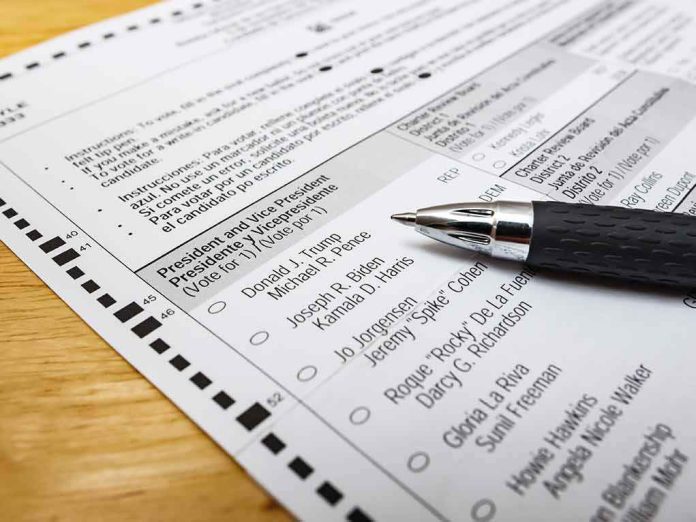
Enforcement actions are clearest when they move from sweeping numbers to named cases; here, the federal government stepped past rhetoric to bring 28 criminal complaints in California — a concrete set of alleged illegal registrations and votes by lawful permanent residents — while simultaneously litigating over a larger, unverified list of roughly 20,000 likely noncitizen registrants.
The Short Version
- Justice Department charged 28 identified lawful permanent residents in California with federal election offenses; 11 were arrested.
- All 28 are alleged noncitizens; federal law bars noncitizens from registering and voting in federal elections.
- These cases are linked by DOJ to a broader list of about 20,000 likely noncitizen registrants derived from government data matching.
- California officials dispute the usability and evidentiary rigor of that larger list, underscoring a long-running clash over database matches versus verified status.
What the federal cases actually allege
The government’s anchor claim is not a spreadsheet; it is 28 criminal complaints naming specific defendants and charging discrete conduct — fraudulent voter registration, illegal voting, and false statements on naturalization applications. Justice Department materials state that 11 defendants were arrested and all 28 were charged, with potential penalties up to five years’ imprisonment for the false-statement counts. The department explicitly describes each defendant as a lawful permanent resident, not a U.S. citizen, a status that confers work and residence privileges but not the franchise in federal elections.
Mechanically, these filings tend to follow a pattern familiar to election-fraud prosecutions: an allegedly false attestation of citizenship on a voter registration form; subsequent appearance in voter history records; and, in some cases, parallel sworn answers in a naturalization application that conflict with the registration or voting record. The government’s charging theory thus rests on more than mere presence on a list; it alleges acts — registrations, ballots cast, and sworn statements — that are provable, if true, with documents and testimony in court.
The larger 20,000-name dispute and how the list was built
Running alongside the individual cases is a broader federal lawsuit against California. DOJ says it compared California voter-registration files with federal immigration data, identified “more than 20,000” people it believes are likely noncitizens, and provided the names to state officials. When California did not act on the list as requested, DOJ sued, seeking to prevent tabulation of ballots associated with listed individuals until eligibility could be verified.
Critically, the government describes these 20,000 as “likely” noncitizens — a probabilistic classification — and has not published the underlying records, matching rules, or an audited error rate. Still, DOJ ties the 28 charged individuals back to this pool; contemporaneous reporting quotes federal officials confirming that the charged defendants were among the approximately 20,000 names supplied to the state, establishing a connective tissue between the criminal cases and the civil litigation.
Where the disagreement is real — and why it persists
California’s election leadership does not accept the list as dispositive. Secretary of State Shirley Weber has said the federal government did not provide evidence sufficient to substantiate that roughly 20,000 names belong to noncitizens, calling the file too thin to support investigative action. Her office and outside experts warn that matching incomplete voter records to immigration databases can generate false positives, particularly for naturalized citizens whose federal status updates lag behind state files.
This conflict fits a well-worn pattern. In many states over the past decade, preliminary database matches have yielded large counts of “potential” noncitizens; subsequent case-by-case verification typically whittles those figures down once naturalization dates, name and date-of-birth variants, and data-entry errors are reconciled. The underlying reality can contain both truths: a small, prosecutable subset of improper registrations and votes, and a much larger list whose error rate dominates until verified through authoritative records.
🚨 BREAKING: Federal agents pounded on the door of a Belizean national at 6AM in California this morning for voter fraud, and he walked out ARRESTED — NYP
And he's NOT the only target.
This comes MERE DAYS after Trump DOJ said CA is IGNORING ~20,000 likely noncitizen voters in…
— 🇺🇸🍩 JULIE DONUTS 🍩🇺🇸 (@_imJuliedonuts1) October 20, 2026
Mechanism and evidentiary standards: lists versus cases
Two very different evidentiary postures are at play. A screening list is a lead generator — it is designed to be overinclusive, to surface candidates for review. A criminal complaint, by contrast, marshals documentary proof sufficient to clear probable cause and, eventually, persuade a jury beyond a reasonable doubt. The DOJ’s approach in California uses both instruments: a bulk match to prompt administrative verification and courtroom charging documents to address instances where, the government says, the paper trail is already conclusive enough to prosecute.
The legal stakes diverge accordingly. Using a list to set aside ballots pending verification implicates voter-protection rules and federalism boundaries; using sworn forms, voter-history records, and interview statements to prove a single defendant registered or voted illegally fits comfortably within traditional federal prosecutions. The former raises process concerns; the latter stands or falls on the evidence for each named person. That is why the 28 cases matter: they move this controversy from inference to alleged acts that can be adjudicated.
What the known facts support — and what remains unproven
There is firm ground to assert three things. First, DOJ has brought 28 cases against identified lawful permanent residents for alleged illegal registration and, in some instances, voting; those charges are on the public record, and 11 arrests have occurred. Second, the federal government generated a list of roughly 20,000 people it believes are likely noncitizens by comparing voter files with federal immigration databases and delivered it to California, then sued when state officials declined to use it as directed. Third, DOJ officials link the charged defendants to that broader list, showing the screen did surface at least some prosecutable matters.
What is not established by the public record is that all, or even most, of the 20,000 are ineligible registrants who voted. The government itself uses qualified language; it has not disclosed person-level validation, match criteria, or an error audit. California officials, meanwhile, have not disproven the entire set; they have challenged its utility and demanded stronger evidence before taking action that could affect ballots. Until a joint, record-level verification occurs, the systemic question — the true size and character of the pool — remains open.
Implications for election administration
Two practical lessons emerge. First, the integrity of voter rolls and the protection of eligible voters both depend on disciplined data governance. Cross-jurisdiction data matching should be accompanied by clear confidence thresholds, transparent criteria, and fast, documented pathways to validate citizenship with authoritative records — especially naturalization data that changes status over time. Second, communications precision matters. When officials publicize a “likely” figure, the qualifier must travel with the number; otherwise, the public hears proof where there is probability, and distrust grows.
Going forward, the productive path is not another press conference; it is a protocol. A court-supervised process can let state officials, federal agencies, and county registrars compare the list against authoritative immigration records and voter histories, preserve privacy with controlled access, and publish an error rate with documented dispositions. The 28 prosecutions will proceed on their own evidentiary tracks. The broader policy question — how to maintain accurate rolls without chilling eligible participation — deserves the same evidentiary rigor.
Sources:
pjmedia.com, justice.gov, usatoday.com, inquirer.com, politico.com, courthousenews.com