

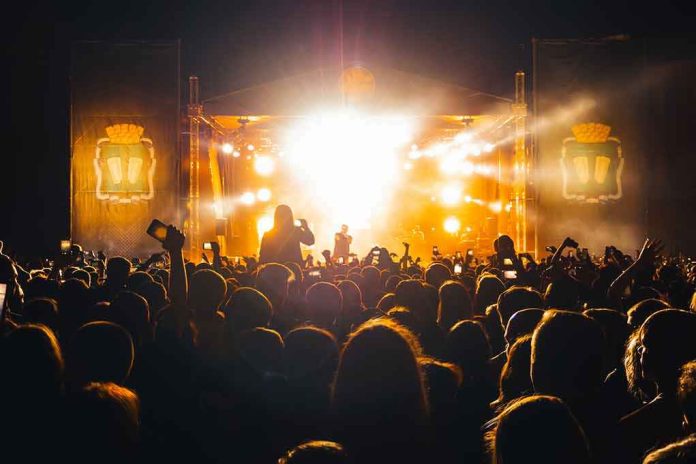
On a stage that has recently become a proving ground for the boundaries of artistic speech, Zach Bryan turned a wardrobe choice into the night’s headline: he performed at Robert Kraft’s Gillette Stadium wearing a black shirt that read “Free Palestine.”
At a Glance
- Bryan wore a “Free Palestine” shirt during the first of two shows at Gillette Stadium in Foxborough, Massachusetts.
- Video from the concert shows the slogan clearly; CBS Boston reported additional text—“An Appeal to Heaven”—and a pine tree emblem below it.
- Members of Bryan’s band appeared in similar shirts, signaling a coordinated choice rather than a stray accessory.
- The gesture landed amid ongoing debate over political expression on privately controlled stages, following Robert Kraft’s high-profile dispute over Macklemore’s appearances.
What Happened: A visible, deliberate message on a high-profile stage
During his Friday performance at Gillette Stadium, Bryan appeared in a black cutoff T-shirt that read “Free Palestine,” a detail captured across multiple crowd videos and confirmed by national and local outlets. CBS Boston’s broadcast added specificity: the shirt also bore the words “An Appeal to Heaven,” accompanied by a pine tree logo—an icon historically associated with early American revolutionary flags and, in recent years, varying strains of civic and religious symbolism. Several bandmates wore similar shirts, reinforcing that the moment was staged, not incidental.
The venue—home to the New England Patriots and owned by Robert Kraft—matters because the message did not arrive in a vacuum. Only weeks earlier, reported pressure surrounding rapper Macklemore’s pro-Palestinian comments had scrambled his role on Ed Sheeran’s stadium dates, with Kraft’s position and Gillette’s booking posture at the center of the controversy. That recent history ensured Bryan’s shirt would not read as generic merch; it would read as speech on contested ground.
Why the venue context sharpened the moment
Stadiums sit at the junction of mass culture and private control. Artists know the scale of the platform; owners know they curate the environment. That friction is why political expression at concerts repeatedly becomes a flashpoint. The Macklemore episode was an immediate precursor—a dispute in which the artist’s “Free Palestine” advocacy collided with stadium gatekeeping and tour logistics, producing a de facto test of how much message a venue would tolerate before drawing a line.
Legally, the First Amendment limits government restrictions on speech, not a private venue’s discretion. Analysts who parsed the Macklemore case emphasized that a privately owned stadium is generally not obligated to provide a platform for any particular viewpoint—a point often misunderstood when culture-war arguments leap straight to “censorship.” In practice, that means the power to book, disinvite, or pressure a tour is real, and so is an artist’s counter-power to make the message unavoidable once on stage.
What the shirt communicated—and what it did not
“Free Palestine” is not a neutral phrase; it functions as a compressed political statement whose meaning is debated across contexts. In the entertainment arena, it has become a prominent marker of solidarity with Palestinians amid war and humanitarian crisis—and, to some audiences, a provocation. Attaching “An Appeal to Heaven” beneath it layered in a second rhetorical tradition: a reference that has ranged from early American republican ideals to various modern appropriations. Whatever the interpretive variations, the total effect from the pit view was plain: Bryan displayed a pro-Palestinian message, legibly and continuously, in a venue closely associated with a recent crackdown on that same message.
As of the reporting available, Bryan did not pause the show to explain the shirt or anchor it to a specific grievance, leaving the symbolism to do the talking. That restraint matters only insofar as it cordons off speculation; the visible facts stand on their own and are widely documented. The concert, the words on the garment, the location, the timing—those are established.
How we got here: a short history of message, stage, and control
Modern stadium touring concentrates leverage. A handful of promoters and venue owners oversee the biggest rooms, while a handful of artists can sell them out. When an artist’s political message collides with an owner’s threshold for controversy, two forms of power confront each other: the cultural capital of a star and the gatekeeping authority of private property. The Macklemore–Gillette dispute made that collision explicit, with public statements from the venue side asserting a duty to maintain a “welcoming environment” and to reject what they characterized as unacceptable speech; the tour’s logistics then adjusted accordingly.
Bryan’s choice can be read within that lineage of performers using nonverbal signals—shirts, backdrops, drumhead decals—to inject politics without stopping the music. Such cues are hard to preempt without policing wardrobe in ways that can quickly appear heavy-handed, and they scale virally because fans record them from every angle. The network effect—dozens of phone clips reinforcing the same frame—creates a durable evidentiary record and, just as important, a narrative consensus.
I've always liked Zach Bryan. I think he's a great songwriter and a great singer however, wearing a free Palestine shirt at his concert last night I will probably never listen to his music again.
— michelle smith (@michell60016558) October 3, 2026
What it means going forward: the incentives around symbolic speech
Symbolic speech at scale is sticky precisely because it is hard to sanction without escalating the story. If a venue intervenes, the act becomes a censorship narrative; if it doesn’t, the message rides the headliner’s platform to millions via feeds and press roundups. For artists, the cost-benefit calculus has shifted: a T-shirt can set the terms of coverage more efficiently than a speech from the mic. For venues, quietly shaping the bill beforehand may feel safer than reacting in real time to a visible, broadcast-friendly slogan.
Expect more of this, not less. The precedent from this episode is functional, not legal: a major artist can deliver a pointed political signal inside a privately controlled room, and—absent pre-show constraints—it will propagate. The Macklemore dispute clarified the perimeter of venue discretion on the booking side; Bryan’s appearance inside the same building clarified how, once the lights go down, control over the show’s semiotics largely belongs to the person with the guitar and the cameras on them.
Bottom line
The facts are straightforward and well-documented: Zach Bryan wore a “Free Palestine” shirt—augmented with “An Appeal to Heaven”—at Gillette Stadium; parts of his band matched him; the audience and the internet saw it from every angle. In a stadium already central to a recent clash over the same message, that visual was the point. The modern arena show is not only a concert; it is a stage-managed media event in a private space. Bryan used that event to make his message unmissable—and ensured the venue’s recent history was part of how it would be understood.
Sources:
facebook.com, nbcnews.com, edition.cnn.com, thewrap.com, cbsnews.com