

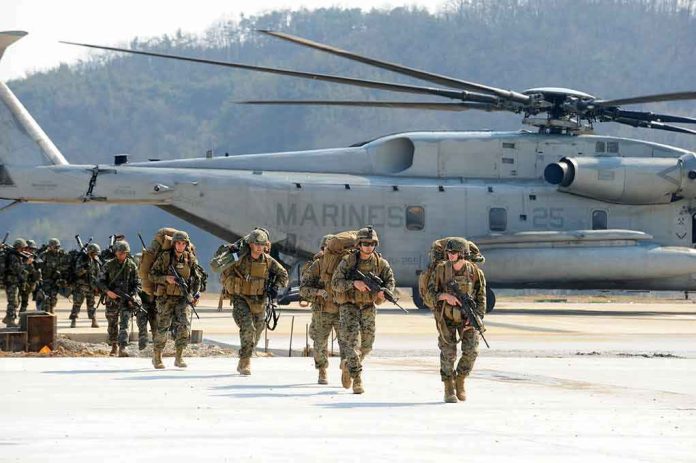
America’s 23-year military chapter in Iraq closed with a defined operational finish: the last U.S. troops departed Erbil Air Base, concluding the coalition’s anti-ISIS mission and shifting the U.S.–Iraq relationship from wartime coalition to a bilateral security partnership.
At a Glance
- President Trump publicly announced the departure of the last American forces from Iraq as the final troops left Erbil Air Base.
- Pentagon statements described an “orderly departure,” marking the end of the coalition’s 12-year mission against ISIS in Iraq.
- The drawdown capped a phased timeline that included Iraq’s 2021 end to coalition “combat” roles and a 2024 U.S.–Iraq transition plan.
- Going forward, Washington and Baghdad pivot to a bilateral security relationship focused on training, intelligence, and counterterrorism support.
What conclusively ended: mission, footprint, and the Erbil hinge point
The endpoint is operationally specific and publicly documented: U.S. forces completed their departure from Erbil Air Base in northern Iraq, the final hub of the coalition presence. Pentagon and CENTCOM communications characterized the move as an “orderly departure,” underscoring a deliberate, planned extraction of personnel and equipment rather than a hasty redeployment. That departure closed a 12-year coalition mission focused on the Islamic State group—known operationally as Operation Inherent Resolve’s Iraq line of effort—while placing day-to-day security responsibilities squarely with Iraqi forces, including the Peshmerga in the Kurdistan Region.
The end state was announced at the political level and corroborated at the military-operational level: President Trump stated the last American forces were leaving, and U.S. officials confirmed the Erbil stand-down as the closing act of the anti-ISIS mission in Iraq. The convergence of a head-of-state statement, base-level completion reporting, and CENTCOM’s framing of an “orderly” conclusion leaves little ambiguity about what happened and when.
How we got here: the phased pathway from combat to exit
American force levels in Iraq have repeatedly moved through negotiated thresholds—combat to advise-and-assist to residual presence to exit—each re-labeled by policymakers as a withdrawal, transition, or mission shift. The latest cycle follows that pattern. In 2021, Iraq declared that the international coalition’s “combat mission” had ended, formalizing a shift to advising and enabling Iraqi forces. In 2024, Washington and Baghdad articulated the pathway to wind down the coalition mission entirely and transition to a normal bilateral defense relationship. By September 2026, the remaining U.S. contingent consolidated at Erbil completed the final lift. Political rhetoric tends to flatten these phases; the operational record shows a staircase, not a cliff.
Crucially, ISIS’s territorial defeat reduced the logic for a persistent coalition posture inside Iraq’s sovereign bases. What remained were advising nodes, intelligence fusion, and episodic support—functions Iraqi security forces could increasingly assume. The coalition’s job in Iraq was not to run Iraqi security indefinitely but to create the conditions for the Iraqis to run it themselves. As those conditions matured, a planned, base-by-base drawdown became feasible and—by late 2026—complete.
What “leaving Iraq” means in military practice
Public phrases like “last forces” can obscure the mechanics. Militaries exit in echelons: sensitive gear first, then bulk equipment, then rear elements, with host-nation transfer, contracting close-out, and authority handbacks along the way. Erbil functioned as the coalition’s final aggregation point; its closure is the practical indicator that the force presence tied to the anti-ISIS coalition mission has ended. That does not foreclose future U.S.–Iraq cooperation—train-and-equip programs, intelligence liaison, joint exercises—but it does draw a bright line under the continuous coalition troop presence that began in 2014 to dismantle ISIS’s caliphate.
The Pentagon’s “orderly departure” language matters. It implies not just people boarding aircraft, but a property and accountability regimen: inventories reconciled, sensitive systems retrograded or demilitarized, and host-nation transfers documented. After Afghanistan’s chaotic exit, planners in Iraq engineered sequencing to avoid stranded materiel or security vacuums. The reporting that all forces and equipment left Erbil aligns with that disciplined logistics arc.
The policy arc: from emergency coalition to normal state-to-state security ties
The coalition’s original mandate was existential: stop ISIS from overrunning Iraqi territory and threatening the region. As Iraqi forces grew more capable—integrating counterterrorism units, federal forces, and Kurdish Peshmerga formations—the coalition’s role narrowed to advisory and precision enablers. The 2024 U.S.–Iraq plan translated that reality into a political timetable, and the 2026 Erbil departure executed it. The follow-on framework is bilateral: fewer boots, more liaison; fewer joint raids, more institutional capacity-building and intelligence exchange. That’s how emergency coalitions end—by handing the keys back to the sovereign host.
For Washington, the strategic logic endures: maintain counterterrorism reach without large garrisons, support a sovereign Baghdad that can resist coercion, and keep channels open to the Kurdistan Region. For Baghdad, the incentives are similar but sovereignty-first: reduce the optics and frictions of foreign troops while preserving access to training, technology, and intelligence that help contain ISIS remnants and other non-state threats. Both sides can pursue those aims through standard defense cooperation instruments rather than a wartime coalition command.
What changes on the ground—and what does not
The most visible change is physical: no more coalition formations operating from Iraqi bases. Iraqi commanders now own the calendar for counter-ISIS sweeps, border interdiction, and militia management, calling for targeted support through bilateral channels when needed. The less visible continuity is the network: intelligence pipelines, military-to-military relationships, and sustainment of Iraqi units trained over a decade. Counterterrorism is not a switch; it is a graph of risk that ebbs and flows with local governance, economic pressure, and regional interference. Ending the coalition mission in Iraq acknowledges that the graph can be managed locally, with U.S. support at arm’s length rather than arm-in-arm.
The historical through-line—and why semantics always become strategy
Every U.S. drawdown in Iraq has generated semantic friction—withdrawal versus transition, combat end versus mission end—because labels signal ownership and risk. But the empirical test is simple: which flag flies over the base and who patrols the street the next morning. With Erbil vacated and the coalition mission concluded, that test now has a clear answer. The political announcement, the military logistics, and the host-nation posture all point in the same direction: the Iraq war chapter that required a standing U.S.-led force is over; what follows is state-to-state security cooperation calibrated to Iraqi lead and Iraqi sovereignty.
Sources:
youtube.com, pbs.org, npr.org, yahoo.com, reuters.com