

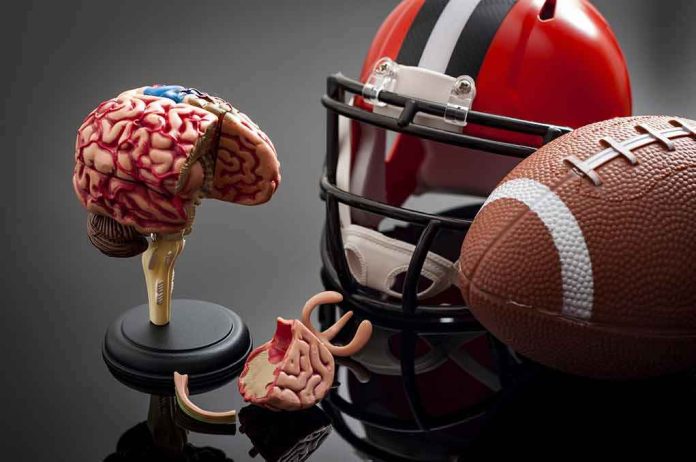
The most durable takeaway from two decades of neuropathology is now stated with unusual clarity: among former NFL players who died between 2016 and 2021, at least one in four had chronic traumatic encephalopathy (CTE) at autopsy—a conservative floor derived from the largest death cohort yet examined.
The Short Version
- A BMJ-published analysis identified 878 former NFL players who died from 2016–2021; 235 donated brains were examined, 215 had CTE, and the authors set a minimum prevalence of 24.5% across the full death cohort.
- The 24.5% figure is a deliberately conservative lower bound; it assumes none of the unexamined brains had CTE, so the true rate is likely higher.
- This approach differs from earlier “brain bank” headlines by anchoring the estimate to a complete death cohort, not only to self-selected donations.
- Prior research consistently shows a strong association between higher levels of football exposure and CTE risk, supporting biological plausibility and dose-response patterns.
What the new estimate actually measures—and why its construction matters
The study assembled a roster-level census of former NFL players who died in a defined five-year window (2016–2021), then identified which of those decedents’ brains were donated for neuropathological evaluation. Among the 235 donated brains from that 878-person death cohort, 215 were diagnosed with CTE—91.5% within the examined subset. The authors then imposed the most conservative assumption feasible in epidemiology: treat every unexamined brain as if it were CTE-free. Applying that extreme constraint to the entire death cohort yields a minimum prevalence at death of 24.5%—a lower bound, not an extrapolation, and certainly not the ceiling.
Why this design choice matters is straightforward. Traditional brain-bank studies are unavoidably enriched for suspected disease because families donate when symptoms raise concern; those samples can describe pathology but not population prevalence. By starting with the entire death cohort and only then mapping the autopsy results back to that denominator, the analysis converts a selected sample into a credible floor for the broader group. It cannot tell us the exact true prevalence in all former NFL players; it does tell us the minimum among those who died in that period was one in four, and that is a clinically and publicly meaningful benchmark.
How this fits with the arc of CTE research
CTE is a progressive neurodegenerative disease marked by a characteristic pattern of tau protein deposition around small vessels at the depths of cortical sulci; it is currently diagnosed definitively only at autopsy. Early high-signal studies, including a 2017 JAMA clinicopathological series, reported CTE in 110 of 111 former NFL players who had donated their brains—findings that were mechanistically illuminating but methodologically non-representative by design. The newer minimum-prevalence approach sits downstream of that work: it accepts selection bias in donations, then neutralizes it by treating every non-donated case as disease-free, ensuring the estimate cannot overstate the burden.
Parallel lines of evidence reinforce plausibility. A pooled analysis adjusting for selection bias found college and professional play carried roughly 2.4–2.5 times the risk of CTE diagnosis versus high school exposure, signaling a dose gradient with level of play. Exposure reconstructions that translate seasons and positions into estimated head-impact counts have shown that every additional 1,000 head impacts raises the odds of CTE and, separately, the odds of severe-stage disease—another dose-response pattern difficult to ascribe to artifact.
What is new relative to the “brain bank” era
The headline is not “90%+ of donated NFL brains show CTE”—that has been established repeatedly in donated cohorts. The new information is the anchoring denominator: all former NFL players who died over five seasons, not just those whose families sought autopsy. Within that full cohort, the conservative lower bound is 24.5%. Because the bound is built by assuming that none of the unexamined decedents had CTE, it is highly likely the true prevalence at death for that period is higher, not lower. Multiple independent outlets converged on this same framing and figure, underscoring that this is not a one-off reading of the paper but the plain arithmetic of its method.
This reframing answers a recurrent critique of CTE reporting—that selection into brain banks inflates apparent rates—by declining to extrapolate at all. It trades precision for certainty: we do not know the exact prevalence, but we know the minimum across the entire death cohort. When the floor is already one in four, the risk signal no longer hinges on contested assumptions about who donates.
Mechanism, exposure, and why the number is consequential
The mechanism linking repetitive head impacts to CTE is biologically coherent. Subconcussive and concussive blows generate shear forces that disrupt axonal integrity and microvasculature, setting off inflammatory cascades and pathological tau aggregation. Over years, this manifests as the perivascular, sulcal-depth tau pattern that defines CTE neuropathology. The practical correlate is cumulative exposure: more seasons, more snaps, more contact-practice periods, and certain positions—linemen, linebackers, tight ends—accumulate far more head impacts than others, which is why dose-response appears both across and within levels of play.
Against that background, a one-in-four minimum at death among recent NFL decedents is not an isolated statistic but the population-scale reflection of the same physics and pathology documented case by case. It elevates the discussion from “are there many cases in donated brains?” to “what fraction of the league’s alumni carried definitive neuropathology at life’s end?”—a shift with implications for pension planning, clinical monitoring of retirees, and youth-sport risk communication.
New study finds at least 1 in 4 former NFL players who died between 2016–2021 had CTE. Researchers call the rate “alarmingly high,” noting the true prevalence may be even higher.
Sources:⁰The New York Times – https://t.co/JDbCBNCklJ⁰NPR – https://t.co/CuqVsPFYgl— Aftab Khan, MD (@aftab_usa) August 25, 2026
What this does and does not tell us about risk going forward
Three boundaries are worth keeping clear. First, the estimate applies to former NFL players who died between 2016 and 2021; it is not a statement about living players or about all eras equally. Second, CTE remains a postmortem diagnosis; we cannot yet identify every case in life with clinic-ready specificity. Third, the 24.5% figure is a floor under conservative assumptions, not the precise prevalence. Those caveats acknowledged, the study’s architecture and the broader literature’s dose-response patterns both point in the same direction: CTE is a common outcome of career-level American football exposure, and risk scales with cumulative head impacts.
What responsible stakeholders can do with a conservative floor
Policy and practice should move on two tracks. For prevention, continue to drive down head-impact exposure—limit full-contact practice, adopt position-specific technique reforms, and iterate helmet and rule changes that measurably reduce impact counts without distorting the sport’s integrity. For accountability and care, treat the floor as a planning parameter: resource longitudinal follow-up for retirees, fund independent neuropathology and imaging to accelerate in-life diagnostics, and align disability and mental health benefits with the demonstrated burden of disease. The science has progressed from alarming case series to cohort-anchored bounds. The prudent response is no longer to debate whether the signal exists; it is to manage a risk whose minimum size we now understand.
Sources:
insiderpaper.com, bumc.bu.edu, bu.edu, pmc.ncbi.nlm.nih.gov, espn.com, essentiallysports.com