

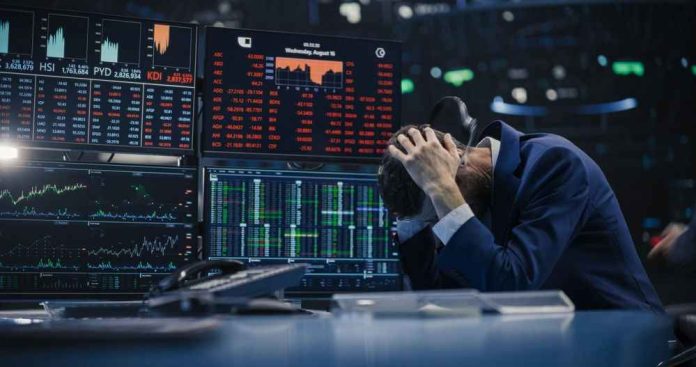
When a single theme meets extreme leverage, time compresses: what looks like a decade-long bet can implode in days. The collapse of Situational Awareness — a hedge fund built on concentrated, levered wagers across the AI compute chain — is a textbook case study in how market reversals, margin mechanics, and crowded positioning can turn paper wealth into forced liquidations at speed.
The Short Version
- Situational Awareness grew to roughly $45 billion before a sharp AI-stock reversal triggered margin calls and a fire sale of public positions.
- The fund’s portfolio value fell about 67% in July, and assets shrank to around $10 billion after Citadel purchased the bulk of its listed equity book.
- High leverage and concentration converted a drawdown into a liquidity crisis, echoing familiar hedge fund blow-up mechanics.
- The episode illustrates how crowded momentum trades in semiconductors and AI infrastructure can unwind violently when funding fragility meets factor reversal.
What actually happened: the sequence and the scale
Situational Awareness entered the summer as one of the most-watched AI-focused funds, having expanded rapidly on the back of a powerful rally in semiconductors and compute infrastructure. In late July, that momentum snapped. The fund’s portfolio value fell about 67% in the month, according to an investor letter cited by Reuters, as losses on AI-linked equities cascaded through its financing lines and risk limits. With margin calls intensifying, the firm moved to exit its public stock exposures; Ken Griffin’s Citadel agreed to buy the bulk of those listed positions, leaving Situational Awareness at roughly $10 billion in assets, down from around $45 billion at peak size earlier in the summer. CNBC and other outlets likewise reported that the fund was forced to sell essentially all public holdings amid mounting losses and compulsory de-risking.
There was nothing mysterious about the proximate cause. The fund’s strategy leaned heavily into the AI infrastructure trade — long semiconductors and related compute beneficiaries, with shorts in areas seen as secularly challenged by AI — and it did so with substantial leverage. When the factor regime turned and semiconductors slipped into a sharp drawdown, losses were amplified; financing haircuts and daily marks translated price declines into collateral shortfalls, which forced selling into a deteriorating tape. That feedback loop is the core mechanical truth of leveraged equity portfolios when the crowd heads for the same exit at once.
Mechanics of a modern blow-up: leverage, concentration, and liquidity
Hedge fund failures rarely invent a novel way to go under; they reprise a small set of mechanisms with new characters. Leverage and margin calls sit near the top of that list. A retrospective catalog of fund blow-ups places leverage/margin-call dynamics alongside concentration as a leading cause, precisely because borrowed money turns volatility into a solvency question when asset prices gap lower and lenders tighten terms or pull financing. Situational Awareness followed that script. A concentrated, theme-driven book in semiconductors and associated names meant portfolio volatility clustered in a single factor. When that factor reversed, the drawdown was not a diversified setback — it was a single large shock transmitted across most of the exposures at once.
The next step is purely mechanical. Prime brokers mark positions to market daily; margin requirements ratchet higher as volatility rises and prices fall. That raises the amount of cash or collateral the fund must post to keep its leverage constant. If the manager cannot post fresh collateral quickly enough, the prime broker reduces credit, forcing the fund to sell what it can sell — typically the most liquid holdings — even when those are also down. Selling into weakness depresses prices further, raising margin needs again. This is how a 10% move in a benchmark can become a 50% drawdown in a leveraged, concentrated book, and how 50% can become terminal if financing evaporates.
The market backdrop: a crowded AI trade meets factor reversal
July’s reversals were not idiosyncratic to one fund. Across the industry, technology-focused hedge funds posted their worst month on record, with a JPMorgan-linked analysis citing the unwind of crowded tech trades as a primary driver; more diversified multi-strategy firms fared better but were still nicked by the reversal. Goldman Sachs’ prime brokerage desk had warned that AI and momentum exposures were heavily crowded — code for the sort of one-way positioning that tends to unwind quickly when leadership stumbles. Momentum factors in U.S. technology sold off sharply in a compressed window, exacerbating P&L volatility for managers whose books were tilted in the same direction.
Semiconductors, the fulcrum of the AI supply chain, bore the brunt. A sharp pullback from late-June highs pushed the Philadelphia Semiconductor Index into a short, technical bear market, compressing a lot of embedded optimism about future compute demand into a fast de-rating of near-term multiples. In that context, the best defense is diversification and modest gross exposure; the worst is a levered concentration in precisely those names everyone else owns.
Citadel’s role: a balance-sheet solution to a funding problem
The denouement was familiar to veterans of past deleveragings. When a fund’s financing margin reaches its limit, the solution is often a transfer of risk to a better-capitalized shop that can warehouse the positions without forced selling. Citadel stepped in to acquire the bulk of the public equities book from Situational Awareness, a transaction reported across major outlets and framed explicitly as a stabilizing move amid a distressed unwind. This type of deal is less about an opportunistic punt on a few chip stocks and more about scale: absorbing a large notional book at negotiated pricing, then distributing or hedging it across a deep, multi-strategy platform with tight risk systems and cheap financing. It is the institutional antidote to a margin spiral.
That rescue does not erase losses already incurred by the original holder, and it does not vindicate the initial concentration. It simply halts the forced-selling loop by moving exposure to a platform structured to carry it. In the process, it underscores an unglamorous truth: risk management and access to stable funding are as much edge as a correct thesis.
Where the strategy failed: thesis risk versus funding risk
It is tempting to frame this episode as “wrong on AI.” That is not necessary to explain what happened. A manager can be broadly right about secular demand for compute and still go out of business if funding vanishes mid-journey. The failure modes here were principally about portfolio construction — leverage, concentration, and the absence of robust hedges that behave in stress. Shorting legacy software against longs in semiconductors is not a hedge if both legs are subject to the same macro shocks and liquidity dynamics. Nor is buying index protection a panacea when single-name dispersion explodes and the underlier hedges do not reprice in line with the book’s realized path. When the trade is essentially one factor — “AI momentum” — both sides can move against you at once.
The July letter’s reported 67% drawdown speaks to path dependency as much as to endpoint valuation. With sufficient leverage, a moderate volatility regime change is enough to trigger margin spirals even if, years later, the original thesis proves directionally correct. Long-Term Capital Management learned that in 1998; Archegos learned it in 2021; Situational Awareness learned it in 2026. The common denominator is not the sector — it is the funding model.
Leopold Aschenbrenner’s Situational Awareness fund had over 56% of its portfolio in just two stocks, Sandisk and Micron, at the end of June.
Both fell sharply in July, along with other concentrated AI bets, triggering a near collapse and forcing a bailout deal with Citadel… pic.twitter.com/ZTtecT9DoE
— kristen shaughnessy (@kshaughnessy2) August 17, 2026
Comparative context: not an isolated storm
The broader hedge fund landscape in July reflected the same forces, just less extremely. Industry aggregates showed technology-heavy managers down double digits for the month ex-Situational Awareness, while the overall hedge fund industry was still positive year-to-date — a reminder that the factor shock was sharp but survivable for diversified shops running lower leverage and tighter risk budgets. The lesson is not that AI is uninvestable; it is that the structural features of the position — crowdedness, balance-sheet fragility, and liquidity profile — determine survivability when the tide runs out.
For allocators, this is the point of due diligence that matters most. Many passed on the fund earlier in its ascent because they could not underwrite the risk infrastructure or leverage assumptions at scale. Those who did invest effectively underwrote a path-dependent financing bet alongside the AI thesis. In exchange for extraordinary upside in calm seas, they accepted the possibility of capsizing when the weather turned.
Practical takeaways: how to avoid dying on the way to being right
First, treat leverage as a scarce resource. It should be deployed against diversified, independently funded exposures, not concentrated factor bets with correlated liquidity. Second, design hedges for stress realism, not spreadsheet neatness. A hedge that pays in theory but starves you of cash precisely when prime brokers demand it is not a hedge; it is a false comfort. Third, model crowding explicitly. If your longs are the same names sitting at the top of every prime brokerage “most owned” list, assume exit liquidity will be thinner than it appears and margin terms will tighten faster than expected when the factor turns.
Finally, cultivate balance-sheet optionality. The firms that buy from fire sellers are diversified, multi-pod platforms with stable financing and industrial risk controls; the firms that sell are often brilliant, thematically correct stock pickers who forgot that financing is a first-order input. The delta between those two operating models is not intellect — it is institutional architecture.
The enduring lesson
Situational Awareness did not collapse because AI evaporated as an idea. It collapsed because a crowded, levered, one-factor book hit a routine-yet-violent drawdown and met the hard edge of funding math. The specifics — the names, the precise multiple of leverage, the buyer of the residual book — will fade. The structure will not. If you manage money in cyclical innovation themes, your thesis can survive a bear market; your capital structure often cannot. Build for that, or the next reversal will teach the same lesson again.
Sources:
nypost.com, cnbc.com, wsj.com, nytimes.com, fool.com, forbes.com, whalesbook.com