

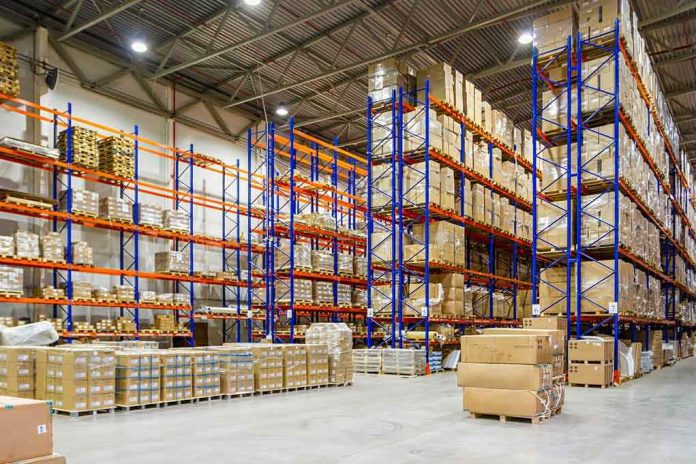
Ukraine’s sustained drone campaign against Wildberries logistics hubs is best understood as a deliberate strike on Russia’s economic nervous system: a bid to degrade dual-use supply chains, impose widespread logistical friction, and raise the domestic cost of war by turning the country’s biggest e‑commerce network from an asset into a liability.
At a Glance
- Ukrainian officials publicly frame Wildberries warehouses as dual-use logistics nodes moving sanctioned electronics and gear useful to Russia’s military; Russia and the company deny it.
- A weeks-long sequence of attacks damaged or destroyed substantial warehouse capacity, disrupting distribution and inflicting losses on thousands of sellers across Russia.
- Satellite analysis corroborates large-scale physical destruction across multiple sites, consistent with a coordinated campaign rather than isolated incidents.
- The central unresolved issue is legal: when, exactly, a civilian megawarehouse becomes a lawful military objective, and how to weigh expected military advantage against foreseeable civilian harm.
What Ukraine is targeting when it hits Wildberries hubs
Wildberries operates the largest retail logistics footprint in Russia: vast, high-throughput distribution centers that feed a dense mesh of regional depots and pickup points. Warehouses of this class are not simply storage; they are automated sortation engines that compress delivery times across a continental-scale market. Reuters reporting places these facilities at the core of a platform that serves tens of millions and anchors a sprawling ecosystem of small merchants; when these sites go dark, stock is destroyed, delivery SLAs slip, and the ripple effects compound through sellers who rely on the network’s speed to reach customers nationwide.
Kyiv’s theory of the target is straightforward. First, large civilian logistics nodes can be dual-use in wartime because the same fast-moving rails that move sweaters and smartphones can also move quadcopter components, navigation gear, comms equipment, and tactical kit. Second, the more integrated and efficient the platform, the more damage you inflict—in time, cost, and substitution friction—by disabling a handful of its biggest hubs. Ukrainian officials and advisers have repeatedly argued that Wildberries’ network has served this dual-use role and that striking it pressures Russia’s war economy and logistics simultaneously.
A campaign, not a one-off: what the record shows
Multiple independent reports document a sustained series of attacks, night after night, across several regions, beginning in mid-July. By early August, Reuters tallied at least 20 Wildberries warehouses struck, with fires and operational disruptions acknowledged by local governors and the company itself—evidence that goes beyond adversarial claims to include on-the-record confirmations of impacts on specific facilities.
Satellite analysis adds a second layer of verification. Reuters cited imagery indicating roughly 1.18 million square metres of Wildberries warehouse space damaged or destroyed by early August—more than a fifth of total capacity—while other open sources published matching before-and-after views of heavily damaged hubs. Taken together, these visuals corroborate a campaign hitting the largest, most consequential nodes, consistent with an intent to impair throughput at system scale rather than to generate sporadic headlines.
Economic shock as a lever of coercion
When an ultra-lean logistics network loses major hubs, the losses propagate quickly: stock burns, orders pile up, returns spike, and seller churn accelerates. Reuters reporting describes tens of thousands of small businesses facing losses amid destroyed inventory and severed distribution lanes; the network’s resilience is not infinite, and concurrent strikes drive substitution to slower, costlier options that do not fully restore pre-strike service levels. That effect is precisely what coercive air campaigns seek: inflationary pressure, delivery uncertainty, and a growing distinction between what the state promises and what citizens actually experience.
There is also a resource trade. Russia’s air defenses cannot be everywhere; each additional class of soft, high-impact targets demands more interceptors, more decoys, more sensors, and more guard shifts. For an attacker with relatively low-cost, attritable one-way attack drones, igniting highly flammable warehouse contents can produce outsized damage without needing to penetrate hardened military-industrial facilities. It is a cost-imposition logic as old as strategic bombing, executed with modern precision and tempo.
Where the legal and moral argument actually sits
The law of armed conflict turns on two interlocking tests. An object is a military objective only if, by nature, location, purpose, or use, it makes an effective contribution to military action, and if its destruction offers a definite military advantage under the circumstances. Even then, proportionality bars attacks where expected civilian harm would be excessive relative to that advantage. Being economically important or politically symbolic is never, on its own, enough to cross that threshold.
On the evidence available to the public, Ukraine’s case is asserted rather than fully documented: reporters cite Ukrainian claims that the hubs handled drone and navigation components, but no open manifest records, contractor testimonies, or declassified targeting packets have been published that tie specific warehouses, on specific nights, to identifiable military consignments. That evidentiary asymmetry is common in modern strikes, but it does leave an unresolved question: which of the many sites hit were actually being used in a way that conferred a concrete, near-term military advantage to disable at that moment? Civilian casualties reported after several strikes, including worker deaths and injuries, underscore why that question is not academic—it bears directly on distinction and proportionality analyses.
The counter-claim: terrorism or dual-use logistics?
Wildberries’ founder, Tatyana Kim, has condemned the strikes as “acts of terrorism,” arguing the campaign is aimed at civilians and intended to sow panic. Russian officials have echoed that line, and domestic criminal cases have been opened on terrorism grounds. Those statements establish the company’s and the state’s political and legal posture, and they are bolstered by the undeniable fact of civilian harm at some sites. What they do not do, however, is refute the dual-use allegation with specific, sourced evidence about what these warehouses were handling for whom, and when.
In weighing the two narratives, the stronger factual spine in open sources remains: repeated strikes acknowledged by officials and the company; satellite-verified destruction at scale; and Ukraine’s plainly articulated coercive strategy aimed at logistics. The unresolved core is not whether the attacks happened or whether they caused broad civilian economic harm—they did—but whether each target met the legal definition of a military objective at the time of attack, and whether anticipated military advantage justified the human and economic cost.
Russian Offensive Campaign Assessment, August 16, 2026
August 16, 2026Key Takeaways
Ukrainian forces have struck seven of Wildberries’ 10 largest logistics centers since July 2026 as part of the ongoing Ukrainian strike campaign aimed at degrading the Russian defense industrial… pic.twitter.com/eUXafE7GWw— Omar Fundora (@TheTrue2) August 17, 2026
How to read effects without over-claiming
Strategically, the warehouse war is part of a larger pattern: Ukraine has tried to degrade Russia’s oil processing, rail nodes, depots, and now consumer logistics; Russia has executed parallel campaigns against Ukrainian energy grids and distribution hubs. These are mirror-image plays against the opponent’s capacity to sustain operations at scale. What we can say with confidence is that attacks on Wildberries have disrupted commerce across multiple regions, imposed losses on sellers, and forced costly defensive and logistical adaptations. What remains to be quantified—by independent supply-chain analyses rather than wartime rhetoric—is how much these disruptions have translated into measurable degradation of Russian military capacity versus primarily civilian commerce.
For readers who want to track this rigorously, look for four kinds of evidence over time. First, declassified or leaked shipment records tying specific hubs and dates to defense procurement flows. Second, intercepts or sworn testimony from logistics staff or vendors describing military-directed handling or priority movements. Third, geospatial forensics that match pre-strike inventories to post-strike debris indicating military-relevant stocks. And fourth, longitudinal delivery-time and substitution data that reveal whether military units experienced persistent delays or shortfalls traceable to these particular disruptions. Those are the artifacts that convert a plausible dual-use theory into a documented case.
What it means going forward
This campaign shows how twenty-first-century wars exploit the frailty of just‑in‑time economies. The most efficient civilian networks become the softest strategic targets; the very properties that delight consumers—speed, density, automation—turn into vulnerabilities under sustained precision attack. If Ukraine keeps tempo and Russia cannot fully harden or disperse capacity, the attacker’s cost curve can remain advantageous. But as the strikes continue, the legal and diplomatic ledger also grows: absent public proof of concrete military use on a site-by-site basis, scrutiny will focus on proportionality each time civilian workers die and livelihoods burn.
The blunt truth is that both the strategic logic and the legal debate can be true at once. The strikes can be operationally rational within a coercive strategy and still legally contentious when aimed at largely civilian logistics. The outcome—on the battlefield, in Russian public sentiment, and in international fora—will hinge less on slogans and more on what hard evidence eventually surfaces about what these warehouses were moving, for whom, and when.
Sources:
feedpress.me, reuters.com, businessinsider.com, bbc.com, newsukraine.rbc.ua, facebook.com