

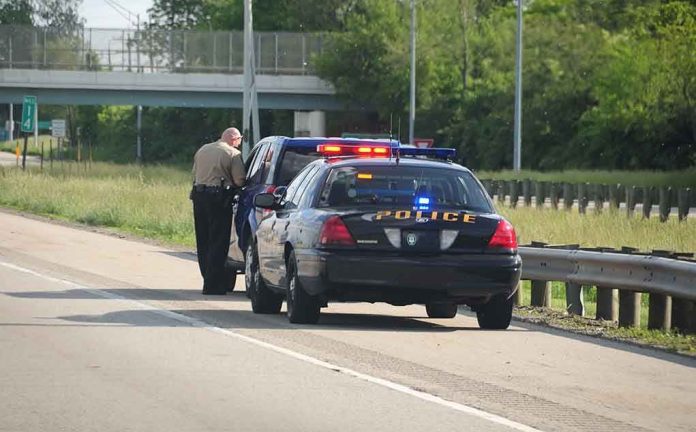
Ending a vehicle pursuit quickly is not merely tactical theater; it is the decisive risk-control variable. When deputies use a Grappler device to pin a fleeing car’s rear wheel and drag the vehicle to a controlled stop, they compress a volatile, open-ended chase into a brief, containable incident—protecting bystanders, officers, and, often enough, the suspect who created the danger in the first place.
At a Glance
- Grappler systems are designed to end pursuits by mechanically disabling the fleeing vehicle’s drive wheel, allowing a controlled stop at low closing speeds.
- Agencies deploying the device describe it as a safer alternative to extended high-speed chases and force options like PITs at freeway velocities or roadblocks.
- Recent deployments show the tool works across varied contexts—stolen vehicles, reckless DUI, armed suspects—when timing, spacing, and training are aligned.
- The broader pursuit policy literature underscores why such tools matter: chases carry outsized fatality risks and demand structured limits, supervision, and post-incident review.
What the Grappler actually does—and why its mechanism matters
The Grappler Police Bumper is an intervention system mounted to the front of a patrol vehicle. At the moment an officer achieves a safe, close following position, a high-strength nylon tether is projected under the fleeing car’s rear bumper to entangle a rear tire. Once the line cinches, the suspect vehicle’s wheel can no longer rotate freely; torque loads into the tether, decelerating and redirecting the car as the pursuing unit bleeds speed and angles to a shoulder. In practice, that yields a brief, forceful transition from flight to stop—without the lateral instability of a high-speed PIT or the long-run unpredictability of a chase weaving through traffic. Agencies adopting the system describe it, with some justification, as a way to swap minutes of rolling risk for seconds of managed deceleration.
Mechanism is not trivia here. Pursuit injuries and fatalities often arise from uncontrolled energy—speed, cross-traffic conflicts, and abrupt driver inputs under stress. A tactic that arrests rotation at the drive wheel, rather than inducing a spin or waiting for attrition (fuel, tires, luck), changes the physics of the stop. Successful uses in Florida and the Pacific Northwest, captured on agency and media videos, show deployments concluding in seconds once positioning is obtained, with suspects taken into custody before the situation deteriorates into collisions or foot pursuits across traffic lanes.
How agencies are using it: patterns from real deployments
Departments employing the Grappler emphasize a specific operational cadence: slow the chase when feasible, coordinate units to set up the capture car, create a narrow, predictable window for the snag, and immediately transition to a controlled stop. Clark County, Washington, for example, equipped multiple patrol units and framed the device as a way to “safely and effectively bring high-speed pursuits to a swift and controlled stop”—language that reflects both intent and after-action experience. In Hillsborough County, Florida, deputies ended a pursuit within moments once the capture unit was in position, citing reduced danger to the driving public after the suspect refused to yield. Training videos and practitioner briefings reinforce the importance of patience over adrenaline: the device is potent but unforgiving if mistimed, so officers are taught to wait for spacing, sightlines, and traffic gaps that protect everyone involved.
Video-documented stops also highlight operational boundaries. Heavier trucks, lifted suspensions, or aggressive braking can complicate a clean tether; in such cases, agencies cycle to other tactics (aviation tracking, spike strips, Tactical Vehicle Intervention, or terminating and re-engaging later). The point is not that the Grappler is universal—it isn’t—but that it expands the menu of lower-risk options and shortens the duration of the most hazardous phase: high-speed flight amid uninvolved motorists.
Why ending pursuits faster is a public-safety imperative
Pursuits are among the most dangerous things police do. The U.S. recorded 4,415 pursuit fatalities from 2017 to 2021, with a statistically significant rising trend; that burden falls on suspects, passengers, bystanders, and officers alike. Decades of research and policy guidance from the National Institute of Justice and allied bodies converge on the same themes: write restrictive policies, emphasize supervision, train decision-making under stress, and prefer alternatives that cap exposure time—aviation surveillance, coordinated containment, and, where appropriate, mechanical intervention tools that curtail speed and distance.
Within that framework, the Grappler is best understood as a risk-abatement tool, not a trophy catch. It does not change when a pursuit is justified; it alters how, once a decision to pursue is made and a suspect continues to flee recklessly, officers can resolve the event without stacking up risk with every passing mile. Properly used, it enforces the policy goal the literature keeps repeating: limit the window in which bad outcomes can occur.
Policy, training, and the review loop that keeps tactics honest
Effective pursuit programs live or die on governance, not gadgets. Agencies that use the Grappler inside robust policies—clear initiation thresholds, supervisor control, and termination criteria—report deployments followed by formal reviews that examine both the pursuit decision and the chosen intervention. Riverside County, for instance, publicly underscored routine post-pursuit reviews to ensure alignment with policy and to evaluate the “effectiveness of any pursuit intervention tactic” used—an accountability loop aligned with national guidance that prizes after-action learning as a driver of safer future decisions.
Training completes the triad. Officers need repetition on spacing, approach angles, and abort criteria. They also need the judgment to hold fire when conditions are wrong, because the device’s value is inseparable from restraint. Agencies that treat the Grappler as one option in a layered playbook—paired with spike strips, air support, or tactical disengagement until conditions improve—tend to show quieter, shorter pursuits and fewer secondary incidents. Field reports and practitioner media point to that pattern: deployments often end within seconds when done by trained units who engineered the moment, not chased it.
Where it fits among other pursuit interventions
No single tactic suits every roadway, vehicle, or suspect behavior. PIT maneuvers excel at modest speeds on open roads but grow perilous as velocity rises; spike strips bleed speed and can be laid ahead of a fleeing car but take setup and can strand vehicles in awkward positions; aviation units shrink urgency by tracking suspects until ground units can stop them safely—but aircraft are scarce. The Grappler’s niche is the controlled, forward-contact capture that prevents a spin and anchors the suspect car to the officer’s front end—a geometry that, when executed correctly, harvests momentum and funnels the stop into a shoulder or median with minimal lateral sweep. Several agencies explicitly position the device as a way to avoid high-speed PITs, a trade that aligns with current risk-management thinking.
Cost and logistics matter, too. Installation and net replacements are not trivial expenses, and only a subset of fleet vehicles tend to be equipped at any given time; that reality encourages policy that reserves deployments for the highest-risk flights—felony eluding, DUI at speed, wrong-way driving, or known violent felonies—where the marginal safety gain is greatest.
What started as a reckless driving call quickly escalated into a serious threat to public safety. The driver—linked to multiple hit-and-run collisions and believed to be experiencing a significant mental health crisis—reached speeds exceeding 80 mph, repeatedly entered oncoming…
— HTH ✨🌏🏠 (@HotTakeHome) August 15, 2026
The bottom line: justified when the flight creates the hazard
When a driver transforms a traffic stop or reckless driving call into a rolling public-safety threat—accelerating through traffic, blowing signals, going wrong-way—the state’s interest in a prompt, controlled stop is at its apex. In those circumstances, deputies using a Grappler to end the pursuit and take the driver into custody are acting squarely inside contemporary pursuit doctrine: shorten the chase, bound the energy, and reduce the number of variables that can kill someone who never chose to be part of the event. The evidentiary record from agency statements, on-record reporting, and use-of-force governance points in the same direction: this is not a silver bullet, but it is a disciplined tool that, in trained hands and under sound policy, tilts outcomes toward safety more reliably than letting a desperate driver write the next page.
Sources:
jsonline.com, nationaltoday.com, katu.com, cbs12.com, yahoo.com, hoodline.com, academic.oup.com, journals.sagepub.com, digitalcommons.csp.edu