

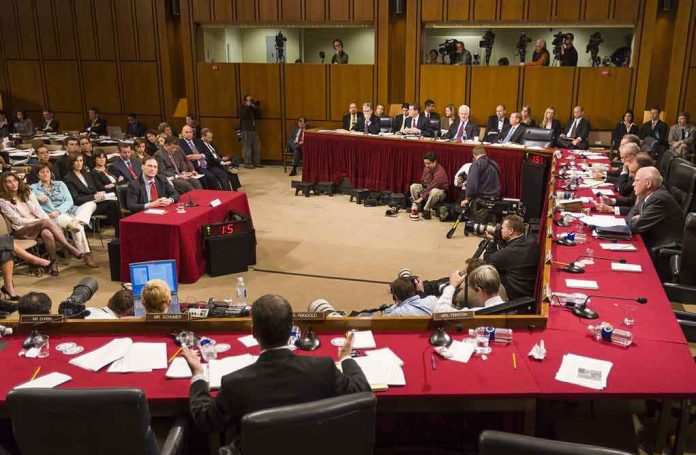
President Trump’s fight over Todd Blanche’s attorney general nomination has become a revealing test of Senate leverage: a single Republican holdout can force the White House to rewrite language, abandon a favored policy vehicle, and still face a separate set of conditions on independence, January 6, and survivor outreach. What looks like a confirmation skirmish is really a contest over whether a Justice Department nominee can be boxed into written commitments before he ever reaches a floor vote.
Key Points
- Senator Thom Tillis has withheld support for Blanche unless the administration meets his conditions on the Justice Department settlement language and related oversight concerns.
- The immediate choke point is procedural: a “no” from one Republican on the Senate Judiciary Committee can stall advancement when Democrats are expected to oppose en bloc.
- Tillis has also attached political and moral conditions to the nomination, including a hard line on January 6 and a demand that Blanche meet with Jeffrey Epstein survivors.
- The dispute is larger than Blanche himself; it reflects a recurring Senate pattern in which confirmation battles become proxies for fights over DOJ independence, executive accountability, and the boundaries of presidential power.
Why the Blanche fight matters
The central fact is simple: Todd Blanche’s path to attorney general is being held up by Thom Tillis, and Tillis is using that leverage to demand concrete changes rather than vague assurances. Reporting across several outlets says the core dispute involves the Justice Department’s proposed “anti-weaponization” fund and related tax-audit language tied to Trump’s IRS settlement, with Tillis insisting on formal, written clarity before he votes yes. That is not a symbolic objection. In a narrowly divided Judiciary Committee, one Republican objection can be enough to derail advancement, which is why the holdout has real institutional force.
The practical consequence is that Blanche is not merely being judged on résumé or loyalty. He is being asked to prove, in writing, that he will not preserve a controversial fund or leave open the possibility of reviving it later. Tillis has told reporters the parties are still “trying to finalize the language,” which is the language of negotiation, not open rebellion. But the substance of the negotiation is unmistakable: the committee fight is about whether the Justice Department can be used to ratify a political settlement that other Republicans see as too generous, too opaque, or too vulnerable to misuse.
The specific conditions Tillis has put on his vote
Tillis’s position has not been static; it has hardened in stages. Earlier in the process, he signaled that any nominee who excused the January 6 attack on the Capitol was effectively disqualified in his view. He later added a separate condition that Blanche meet with survivors of Jeffrey Epstein before Tillis would support moving the nomination out of committee. By late July, the focus had shifted again to the settlement architecture itself, especially the proposed fund and the audit-immunity language that would shelter Trump and his family from further tax scrutiny.
That sequence matters because it shows Tillis is not issuing a single protest vote; he is drawing a layered set of red lines around the office of attorney general. He has framed one line around historical accountability, one around victim engagement, and one around institutional independence. In other words, he is treating the nomination as a test of whether Blanche can serve as a conventional attorney general rather than as a legal instrument of the president’s political and personal interests. That is a classic Senate confirmation posture, but here it is sharpened by the proximity of a committee vote and the absence of spare Republican votes.
What Trump’s pressure campaign changes — and what it does not
President Trump’s threat to pull Blanche’s nomination does not erase Tillis’s leverage; if anything, it exposes how little room the White House has once a committee Republican decides to extract concessions publicly. News reports say the administration was still negotiating with Tillis and Cornyn aides as the vote approached, which suggests the threat is being used as a bargaining tactic, not as a clean break from the process. The White House can try to pressure holdouts, but pressure alone does not manufacture committee votes when the arithmetic is tight.
At the same time, the standoff should not be overread as proof that Blanche is doomed. Some reporting suggests insiders believed Tillis might eventually come to yes if the language was cleaned up, and Tillis himself has spoken in terms of drafting rather than principle-strike rejection. That distinction is important. It means the fight is less about a permanent ideological rupture than about whether the administration will make the concessions Tillis needs in order to protect himself politically while still permitting the nomination to advance. Confirmation politics often works that way: public firmness, private negotiation, then a carefully worded deal if one can be reached.
Republican Senators Thom Tillis and John Cornyn are “dug in” against the nomination of Todd Blanche to be Attorney General.
Both lawmakers are explaining why they are holding out on Capitol Hill Thursday as President Trump threatens to withdraw Blanche’s nomination until the two… pic.twitter.com/x1PfhbrK0j
— The National Desk (@TND) July 31, 2026
The deeper pattern behind this nomination
Blanche’s standoff fits a familiar Senate pattern. When the majority is narrow, a single committee Republican can gain outsized power by converting a policy dispute into a procedural bottleneck. That is especially true in justice nominations, where the nominee’s view of prosecutorial independence, January 6, and the political use of law enforcement are all loaded questions rather than neutral résumé items. The result is that the nominee becomes a proxy for a much larger argument about what the Justice Department is supposed to be.
In this case, the broader argument is about whether the department is expected to stand apart from presidential grievance or help operationalize it. The proposed fund, described by critics as an anti-weaponization vehicle, became the focal point because it symbolized that tension: a settlement linked to Trump’s IRS fight, a compensation structure for alleged victims of government abuse, and a tax-audit provision that Republicans like Tillis and Cornyn wanted narrowed or eliminated before they would move ahead. That is why the standoff drew attention well beyond committee procedure. It speaks to the old Washington truth that the real battle is often over the language, because the language determines who can do what later.
What to watch next
The near-term question is whether the administration supplies the written assurances Tillis has demanded and whether those assurances are specific enough to resolve the fund and audit-language dispute. If they are, the nomination can move; if they are not, the committee road remains blocked. The longer-term question is whether Blanche would, if confirmed, operate as an independent attorney general or as the custodian of a politically charged bargain that Republican skeptics already believe needs tighter guardrails. That is why this fight has lasted: it is not about one vote in isolation, but about what that vote would authorize.
Sources:
foxnews.com, nytimes.com, pbs.org, thehill.com, newrepublic.com, punchbowl.news, youtube.com, cnn.com, thefederalist.com, independent.co.uk, facebook.com