

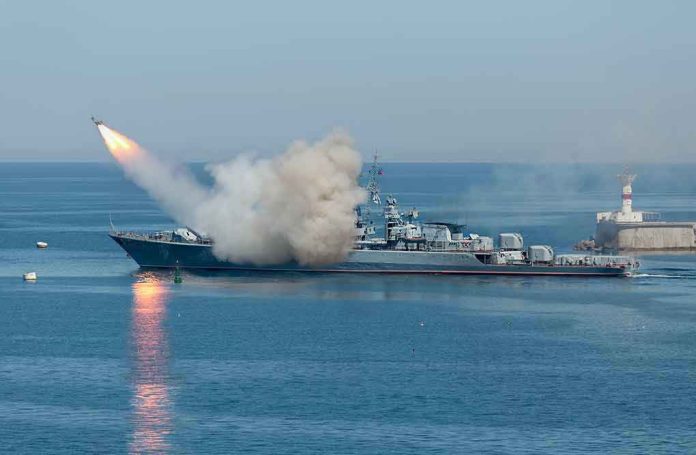
Russia’s struggle to power its newest frigates is a textbook example of how inherited industrial interdependence can turn into a strategic vulnerability the moment politics break the supply chain.
Key Points
- For decades, Russia relied almost entirely on Ukrainian-made gas turbines for major warships; when cooperation collapsed in 2014, new frigates were literally left without engines.
- The Admiral Gorshkov-class (Project 22350) frigates were designed around Ukrainian turbines, forcing Russia to halt or slow construction while it tried to develop indigenous power plants from scratch.
- Russia’s engine problem was eventually mitigated through NPO Saturn’s new M90FR-based plants and an import-substitution drive, but only after years of delay and disrupted naval modernization.[1][3]
- The episode illustrates a broader post-Soviet pattern: once-integrated defense industries become liabilities when geopolitical ruptures sever access to critical subsystems.[3][16]
How Soviet-Era Integration Created a Hidden Naval Vulnerability
The propulsion crisis that hit Russia’s frigate program after 2014 did not come out of nowhere; it was the delayed consequence of the way the Soviet Union built its military-industrial complex. Under Soviet planning, specialized plants across the union were assigned narrow, critical roles—one republic would make gas turbines, another high-end electronics, another hull structures—and the whole system functioned as a single integrated supply chain. Zorya‑Mashproekt, based in Mykolaiv in what is now Ukraine, was the Soviet center of naval gas turbine design and production, supplying essentially all large warship gas turbines for the Soviet fleet.[2][8]
When the USSR broke apart, Russia inherited the bulk of the fleet and the design bureaus, but not the factories; those stayed with the new independent states. Moscow chose continuity over disruption, maintaining extensive military‑technical cooperation with Ukrainian industry rather than immediately duplicating its capabilities at home.[2][3] For roughly two decades this looked economical and pragmatic. Russian ship designs, including new frigates and other surface combatants, continued to specify Ukrainian propulsion units as though the industrial union still existed.[2][8]
Project 22350: A New Frigate Built on Old Dependencies
The Admiral Gorshkov-class—Project 22350—is the flagship of Russia’s effort to field a modern, multi‑role ocean‑going frigate with stealth shaping, advanced sensors, and vertical launch cells for long-range cruise and anti‑ship missiles.[3][8] Severnoye Design Bureau produced the design, and Severnaya Verf in St. Petersburg took on construction at an estimated cost of about $250 million per hull.[3]
Crucially, the class was conceived around propulsion plants from Zorya‑Mashproekt. The first two ships, Admiral Gorshkov and Admiral Kasatonov, were fitted with Ukrainian gas turbines before the political rupture, locking in that dependency at the heart of Russia’s premier surface combatant.[1][3][8] As long as Ukrainian engines kept arriving, the arrangement was invisible. Only when the flow stopped did the risk become visible—and acute.
2014: Annexation, Embargo, and Engine-less Ships
Russia’s annexation of Crimea in 2014 turned a technical dependence into a geopolitical liability overnight. In response, Ukraine terminated military‑technical cooperation with Russia and refused further deliveries of military equipment, including naval gas turbines.[1][3] The effect on shipbuilding was immediate and tangible. New frigate hulls laid down after the first pair found themselves literally without engines; their machinery spaces sat empty while Moscow scrambled for a replacement.[1][2]
Defense analysts tracking Russian ship programs noted that several ongoing classes were “deeply affected” by the loss of Ukrainian turbines. Three Project 11356M frigates, for instance, were left without propulsion plants and ultimately earmarked for sale to India once it became clear that alternative engines would not arrive in time.[2] For Project 22350, the picture was similar: two hulls had already received Ukrainian turbines, but subsequent ships could not move forward beyond a certain stage of construction. The propulsion question was not an abstract vulnerability; it froze concrete steel in shipyards.
Designing Engines From Scratch: NPO Saturn’s Task
Unlike diesel engines, for which Russia had at least partial domestic capacity, modern naval gas turbines are sophisticated, high‑temperature machines that demand advanced materials, precision manufacturing, and extensive testing before they can be trusted at sea. In 2014 Russia did not produce suitable large marine gas turbines at all.[1][3] The government therefore turned to NPO Saturn, an engine manufacturer in Rybinsk better known for aircraft powerplants, and tasked it with developing a new line of naval gas turbines from scratch.[1][3]
Open sources describe Saturn’s assignment in stark terms: it had to create “high‑tech engines from zero,” including the M90FR turbine and associated gearboxes, and integrate them into complete power plants for frigates and other ships.[1][2] Early forecasts suggested these engines might become available around 2017–2018, with fully equipped ships commissioned from about 2020.[3] In other words, Russia faced a multi‑year gap in which hulls could be laid down and partially outfitted, but not completed, because their propulsion systems simply did not exist domestically yet.
From Halts and Delays to ‘Import Substitution’
Russian commentary on the Navy in the mid‑2010s reflected the depth of the disruption. Analysts described both frigate lines—the Gorshkov-class and the 11356-series—as delayed while awaiting future indigenous turbine production, and noted that some ships sat alongside with unfinished machinery spaces that could not be completed until domestic engines arrived.[3][2] The episode fed into wider critiques of “Soviet disease,” a term used to describe Russia’s tendency to field many small classes of ships in limited numbers, rather than large series of a few standardized types.[3] Without reliable engines, ambitious modernization plans for the surface fleet stalled.
In parallel, Moscow launched a broader “import substitution” program: a concerted effort to replace foreign—and especially Ukrainian—components with Russian-made equivalents across defense projects.[2][3] For naval propulsion, that meant accelerating Saturn’s work, investing in United Engine Corporation, and restructuring supply chains so that future warships would depend on domestic plants. By 2017, officials were publicly touring Saturn’s facilities; United Engine’s leadership and senior officials told press that “the problem of dependence on Ukrainian engines” had been resolved in principle as prototypes entered testing.[2]
Official Claims of Resolution vs. Practical Timelines
By 2018, Russian officials were ready to declare victory. Deputy Prime Minister Yuri Borisov announced that Ukrainian power plants in air and naval systems had been replaced and that “the issue of Ukrainian import replacement was closed.”[1][2] He and other officials highlighted new frigates using the M55R power plant—a combined gas‑and‑diesel configuration with Russian‑made engines—as evidence of progress.[1]
Those statements are significant, but they do not erase the multi‑year disruption that preceded them. The fact that NPO Saturn successfully brought turbines like the M90FR into production and that subsequent Project 22350 hulls—six out of eight in one 2021 count—would carry Russian-made engines demonstrates real industrial adaptation.[1] Yet public reporting and program histories still describe substantial delays between initial plans and actual commissioning for ships caught in the transition period, even if precise month‑by‑month slippage is not fully documented in open sources.[3][8]
Where the Evidence is Strong—and Where It Is Thin
On the central point, the evidence is clear and uncontested: Russia’s modern frigate program depended on Ukrainian gas turbines; the 2014 rupture cut off that supply; and several ships were left without engines, forcing a pause while domestic alternatives were developed.[1][2][3][8] The first two Gorshkov-class frigates, equipped before the cutoff, are the exception that proves the rule. They show that Russia could complete ships as long as Ukrainian turbines arrived on schedule—and that it could not when those engines disappeared.
What the open record does not fully quantify is the exact delay for each individual hull. Analysts and official statements acknowledge “problems” and “threats,” and program summaries point to commissioning forecasts that slipped into the 2020s, but detailed construction logs comparing planned and actual delivery dates remain sparse.[1][3][8] Similarly, while Russian officials claim the engine issue was effectively resolved by 2018, hard technical data—such as independent performance audits comparing new M90FR-based plants to the original Zorya units—have not been widely published. The broad trajectory is well supported; the fine‑grained timeline is less so.
Admiral Gorshkov/INS Vikramaditya refit: Russian carrier deal cost ballooned from $1B to $2.33B, engine failed during sea trials, years of delay pic.twitter.com/ZU5AKqsCRM
— Swara Mehta (@swaramehtaa) June 23, 2026
Engines, Sanctions, and the Broader Pattern of Interdependence
It would be a mistake to treat the turbine crisis as a purely Russian industrial failure. The underlying vulnerability was structural: a legacy of a union‑wide division of labor that left post‑Soviet states deeply intertwined in defense production. Research on defense technology interdependence has long pointed out how difficult it is to “nationalize” complex military supply chains once they have been distributed across borders.[16] In Russia’s case, that interdependence extended beyond turbines to diesel engines, electronics, and other subsystems, some sourced from Western firms that later fell under sanctions.[3][2]
The lesson is not that Russia is uniquely inept at building warship engines, but that any state inheriting an integrated industrial system faces acute risks when political relations with key suppliers collapse. The relative ease of cooperation in the 1990s and early 2000s encouraged Russian planners to treat Ukrainian subsystems as effectively domestic. Only when annexation and war made that assumption untenable did the true cost of dependence become visible—in idle hulls, delayed frigates, and emergency import‑substitution drives.
What This Episode Signals for Future Naval Power
Today, Project 22350 frigates with Russian-made engines are entering service and more hulls are under construction, including upgraded variants designed to carry hypersonic Zircon missiles.[5][1] On the surface, the crisis has been “resolved”: the Navy has propulsion solutions, and the shipyards are again cutting steel with a degree of confidence about what will go into their machinery spaces. Yet the episode has lasting implications.
First, it demonstrates that industrial resilience is as central to naval power as hull numbers or missile inventories. A fleet built on foreign engines is only as reliable as the politics that keep those engines flowing. Second, it shows how long it takes to close such a gap. Even for a major power with deep engineering capacity, fielding competitive gas turbines required years of focused investment and political will—and those years coincided with a period when modernization plans had to be scaled back or reshuffled.
Finally, the frigate story is a cautionary tale beyond Russia. Any navy relying on critical propulsion or combat systems sourced abroad must ask, now rather than later, what happens if those suppliers turn off the tap. Russia’s answer involved idle warships and accelerated domestic development. Other states, watching from the outside, can treat this not as schadenfreude but as an early warning of how quickly yesterday’s efficient interdependence can become tomorrow’s strategic liability.
Sources:
[1] Web – Russia Designed a Powerful New Warship, Then Couldn’t Build It, …
[2] Web – Russian Navy’s Project 22350 Frigates To Be Equipped With …
[3] Web – Admiral Gorshkov-class frigate – Wikipedia
[5] Web – Admiral Gorshkov Class (Project 22350 Class) Russian Frigate – ODIN
[8] Web – The 3rd Russian Navy Admiral Gorshkov-class (pr. 22350) frigate …
[16] Web – Strategic Analysis: Impact of Technology on Conduct of Warfare