

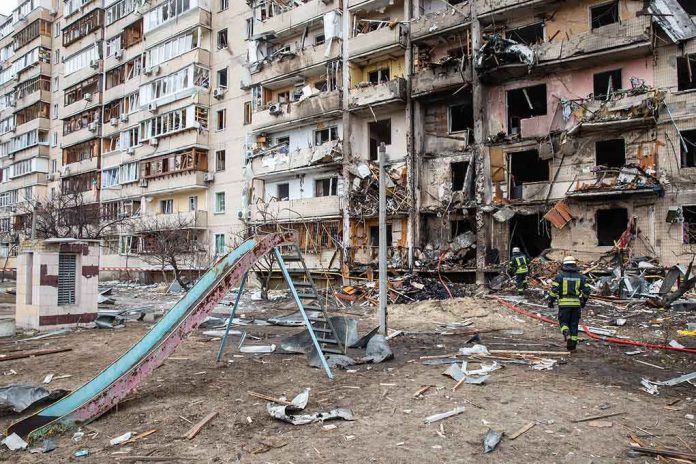
Drone strikes on Zaporizhzhia are not isolated battlefield events but part of a sustained pattern in which Russian forces repeatedly hit clearly civilian areas, producing civilian-only casualty lists that are extremely difficult to reconcile with lawful targeting under the laws of war.
Key Points
- Multiple independent reports over time attribute repeated deadly drone strikes on Zaporizhzhia’s residential districts to Russian forces, with casualty profiles dominated by civilians, including children.[1][7][8][17]
- In incident after incident, the objects destroyed are apartment blocks, private homes, shops, markets and civilian cars, with no credible evidence of nearby military objectives that would explain the pattern as collateral damage.[1][8][10]
- UN bodies, Human Rights Watch and other monitors have already documented a broader nationwide pattern of Russian drone attacks deliberately or recklessly targeting civilians, describing some as war crimes and even crimes against humanity.[19][21]
- Russian official narratives generally either ignore these specific Zaporizhzhia attacks or frame their wider campaign as strikes on military and energy infrastructure, but they have not provided concrete contrary evidence for these particular civilian hits.[13][20]
Zaporizhzhia’s Drone Strikes: What We Actually Know
When you strip away the rhetoric on both sides and look only at documented events, a clear picture emerges: Zaporizhzhia city has been subjected to a series of Russian drone attacks that repeatedly land on unmistakably civilian locations — residential buildings, shops, markets, bus stops — and the people who die or are wounded are overwhelmingly ordinary residents rather than combatants.[1][7][8][17] These are not conjectural single incidents; they form a pattern over months and years.
One detailed example: a Russian drone strike on a residential district of Zaporizhzhia killed two people and wounded 24 others, according to the regional military administration head Ivan Fedorov, who reported the figures on his official Telegram channel.[1] The drone hit a neighborhood of homes; casualties were people in their houses, not on a military site. A few days earlier, another Russian drone attack on the city killed a 44‑year‑old woman and injured 11 others, damaging a residential building and public transport.[1] A separate strike destroyed a private home and damaged nearby buildings, killing three civilians identified only by age — 26, 50, and 62 — again with no suggestion they were fighters.[13]
How the Strikes Work on the Ground
The mechanics of these attacks also matter. Russian forces are using both larger one‑way attack drones (often Shahed‑type systems supplied by Iran or domestically produced equivalents) and smaller quadcopter‑style systems. These drones can be guided with considerable precision, particularly in urban settings, and they are not blind area‑bombardment weapons in the classical artillery sense. That precision cuts both ways: it allows militaries to avoid civilians when they choose to, but it also allows them to hunt individuals or specific civilian objects when that is the intent.[19][21]
In Zaporizhzhia, Ukrainian authorities describe drones slamming directly into apartment blocks, collapsing stairwells and setting upper floors on fire, with residents pulled from under rubble.[16][18] Video and still imagery from multiple outlets show fires in multi‑story residential buildings, rows of burned‑out cars, and destroyed market stalls.[8][14] These effects are consistent with drones being flown into concentrated civilian structures rather than, for instance, hitting a discrete military warehouse located deep inside a civilian neighborhood. The casualty lists reinforce that reading: two 18‑year‑olds killed and at least 20 people injured, including four minors, after a high‑rise, shops, and parked vehicles were hit in a single attack.[17] In another case, at least five people died and three were injured when drones ignited stalls at a city market.[14]
Attribution: Who Is Firing the Drones?
Across the incidents compiled here, attribution to Russian forces is consistent and comes from a variety of sources: Ukrainian regional authorities, Ukraine’s State Emergency Service, international wire agencies such as Reuters, and broadcasters including Africanews, Euronews and others.[7][8][14][18] These outlets cite named Ukrainian officials, primarily Governor Ivan Fedorov and local emergency services, who describe the strikes as Russian and provide details on the number of drones, impact locations, and casualties.
Russia itself has not publicly claimed responsibility for individual Zaporizhzhia events like the residential‑block collapses, nor has it presented alternative theories such as Ukrainian air defenses causing the damage. In some broader communications, the Russian Defense Ministry frames ongoing aerial operations as strikes on defense industry facilities, drone infrastructure, transport hubs and other military‑linked targets.[3] But there is no specific counter‑narrative for the cases where apartment buildings, private homes, and markets are visibly in ruins and the dead are civilians by every available account.[8][13][17]
Deliberate Targeting vs. Collateral Damage
Under international humanitarian law, the critical distinction is whether civilians were deliberately targeted or harmed incidentally during attacks on a legitimate military objective. Not every civilian casualty is automatically a war crime; but deliberate or indiscriminate attacks on civilians or civilian objects are. The Zaporizhzhia record has to be read against this legal background.
Some incidents could theoretically be explained as collateral damage if a genuine military target were co‑located with civilian structures. Modern urban warfare is full of messy examples where even best‑effort targeting goes wrong. Yet, so far, publicly available reporting on these Zaporizhzhia strikes does not identify such military targets at or adjacent to the impact points — instead, it repeatedly cites ordinary residential areas, a bus station, a clinic, markets, and city streets.[1][4][8][14] When drones repeatedly hit precisely those kinds of locations, and when there’s no corroborated evidence of military assets there, the collateral‑damage explanation becomes progressively harder to sustain.
The Broader Pattern: Drones Against Civilians Across Ukraine
What truly shifts the evidentiary balance is how well Zaporizhzhia fits into a wider, independently documented pattern of Russian drone use against civilians. Human Rights Watch, after months of fieldwork in Kherson, concluded that Russian forces carried out at least 45 deliberate drone attacks on civilians and civilian objects between June and December 2024, causing almost 500 civilian injuries and around 30 deaths.[19] These included strikes on healthcare facilities and essential services, and HRW assessed them as serious violations of the laws of war and, taken together, apparent crimes against humanity.[19]
Similarly, the UN’s Independent International Commission of Inquiry on Ukraine found that Russian forces used short‑range drones to target civilians and civilian objects over a 300‑kilometre stretch of front‑line provinces, pursuing victims on foot and in vehicles and even attacking ambulances and fire engines bearing distinctive markings.[21] The Commission concluded that the circumstances of these drone attacks showed an intention to kill, harm and destroy civilians and their infrastructure.[21] While those findings focus on regions like Kherson, Dnipropetrovsk and Mykolaiv, they describe a doctrine of drone employment — hunting people, hitting homes and rescue services — that closely resembles what is now recorded in Zaporizhzhia.
Russian Counter‑Narratives and Their Limits
Where Russia has advanced a clear counter‑narrative around Zaporizhzhia, it has usually concerned different kinds of targets: the nuclear power plant at Enerhodar and energy infrastructure, rather than the city’s residential districts. Russian state nuclear agency Rosatom, for example, described a fiber‑optic guided drone hitting the turbine hall at unit six of the Zaporizhzhia nuclear power plant and characterized it as a “targeted attack” on nuclear facilities, attributing responsibility to Ukraine.[USER SOCIAL TRANSCRIPT 1] Ukrainian authorities denied this and asserted compliance with international humanitarian law. That exchange demonstrates how fiercely contested attribution can be around high‑profile strategic targets, and how both sides use drone incidents for narrative warfare.
But that kind of dispute has not materialized around the city‑center strikes on homes and markets. In those cases, Russian channels tend either to remain silent or to fold them into a generic description of strikes on “military infrastructure” without demonstrating that such infrastructure was present at the specific locations that burned.[3][13] In contrast, Ukrainian accounts of those same incidents are granular: street addresses, building types, ages of victims, video from the State Emergency Service showing rescues and body recovery.[1][8][17] On evidentiary grounds, that asymmetry is significant.
Zaporizhzhia in the Wider Air War
Zaporizhzhia’s ordeal is also part of a larger Russian air and missile campaign that mixes military and civilian targets. On some nights, Russia has launched hundreds of drones and dozens of missiles across Ukraine, with Ukrainian air defenses intercepting the majority but still leaving enough “leakers” to cause considerable harm.[20] In one large‑scale assault, authorities reported nearly 700 drones alongside various missiles, resulting in at least 16 deaths and over 100 injuries nationwide, with documented damage to apartment blocks, private homes, hotels, gas stations and shopping centers.[20]
Regionally, Zaporizhzhia has seen periods of especially intense drone activity. Local reports describe nights with more than 700 individual attacks — combining drones, artillery, and rockets — across the city and surrounding district, leaving dead and injured residents and more than 150 recorded instances of property destruction.[10] Other nights saw at least 13 drones used specifically against the regional center, causing what officials called “widespread destruction.”[6] These figures are consistent with independent datasets tracking civilian harm in Ukraine, which show repeated clusters of incidents in the city and its environs.[28]
This is what the site of the Russian attack on Zaporizhzhia looks like now.
As a result of a drone strike on the residential sector, one woman was killed, and three people were injured. An 11-year-old boy is among the victims. pic.twitter.com/jx6lsqcgZ5— Hope For Ukraine (@hopeforukraine) June 22, 2026
What the Evidence Supports About Intent
Intent is always the hardest element to prove in any alleged war crime; militaries rarely admit to targeting civilians as such. Instead, investigators look for patterns, choice of weapons, target selection, and behavior before and after strikes. In Zaporizhzhia, the recurrent choice to use precision‑capable drones and glide bombs on clearly civilian objects, the lack of visible military payoff, and the broader documented practice of using drones to terrorize civilians in other regions together support an assessment that many of these attacks are at best recklessly indifferent to civilian life and at worst deliberately aimed at civilians.[19][21][23]
International monitors have already drawn that conclusion for other areas of Ukraine. The UN’s commission has stated that certain Russian drone attacks amount to crimes against humanity of murder and war crimes of attacking civilians.[21] Human Rights Watch has described Russian drone attacks in Kherson as part of an apparent strategy “whose primary purpose has been to spread terror among the civilian population.”[19] Given how closely the Zaporizhzhia strikes resemble those documented campaigns — both in methods and in human impact — it is reasonable, on the evidence currently available, to place them in the same category of unlawful attacks on civilians.
Why This Matters Beyond One City
For residents of Zaporizhzhia, the stakes are immediate: whether it is safe to sleep through the night, whether their children can ride public transport or visit a market without being in the crosshairs of a drone operator dozens of kilometers away. For the rest of the world, these attacks are a test of whether the legal constraints on warfare that were painstakingly built over a century — from The Hague and Geneva conventions to the Rome Statute — still have teeth when confronted with cheap, ubiquitous unmanned systems.
The evidence to date supports a clear conclusion: Russian forces have repeatedly conducted drone strikes in Zaporizhzhia that hit civilians and civilian objects, in a way that fits into a larger, independently documented pattern of unlawful drone use elsewhere in Ukraine. The law will eventually catch up through investigations and prosecutions; the record of what happened in Zaporizhzhia, and why it was not an accident, is already being written.[19][21][23]
Sources:
[1] YouTube – WARNING: GRAPHIC CONTENT – Deadly Russian strikes hit Ukraine’s …
[3] YouTube – Russian Drone Attack Leaves Two Dead in Ukraine’s Zaporizhzhia
[4] YouTube – Zaporizhzhia Suffers Major Attack As Drones Kill Civilians, Injures …
[6] Web – One killed in Russian drone strike on Ukraine’s Zaporizhzhia – Yahoo
[7] Web – An overnight Russian drone strike on Zaporizhzhia killed one …
[8] Web – Russian drone attack on Zaporizhzhia home kills one, injures seven
[10] Web – Russian Drone Hits Zaporizhzhia Residential Area, Killing 2 and …
[13] Web – Russian drone attack on Zaporizhzhia kills 1, injures 14
[14] Web – Russian drone strike kills at least three in Ukraine’s Zaporizhzhia …
[16] Web – Russian drone strikes hit Zaporizhzhia, killing at least 5 …
[17] YouTube – Deadly Russian Drone Strike Hits Zaporizhzhia
[18] Web – Russian drone strike on Zaporizhzhia kills 2, injures at least 20, …
[19] YouTube – Russian Drone Strike Hits Zaporizhzhia, Injures Civilian | News9
[20] Web – Ukraine: Russia Using Drones to Attack Civilians
[21] Web – Heavy Russian assault targeting civilian areas kills 16 in Ukraine
[23] YouTube – Ukraine: Civilians hunted and bombed by Russian drones | #HRC60
[28] Web – Russian Firepower Strike Tracker: Analyzing Missile Attacks in Ukraine