

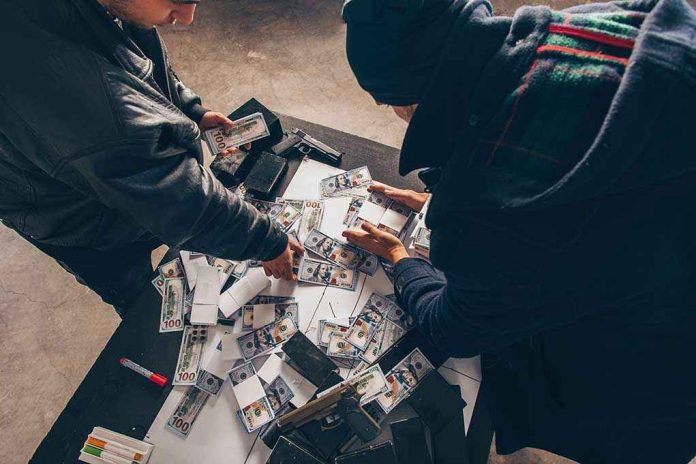
Two Chinese nationals allegedly spent nearly a decade moving cartel cocaine and fentanyl money across four countries, and the method they used is so sophisticated it barely leaves fingerprints.
Story Snapshot
- Ruhuan Zhen and Hongce Wu were indicted in the Eastern District of Virginia for conspiring to launder drug proceeds for the Sinaloa Cartel and the Cartel de Jalisco Nueva Generacion, known as CJNG.
- The alleged scheme ran from November 2016 to April 2025, spanning the United States, Mexico, Latin America, and China.
- Prosecutors say the operation used mirror transfers, overseas bank accounts, encrypted communications, and trade-based money laundering to move and conceal cartel cash.
- A related Drug Enforcement Administration press release tied more than $50 million in drug proceeds to a broader network connecting Sinaloa Cartel associates with Chinese underground money exchanges.
How Chinese Underground Banking Became the Cartel’s Best Friend
The core problem every drug cartel faces is not making money. It is making that money disappear into the legitimate financial system. Bulk cash is heavy, traceable, and dangerous to move. Chinese underground banking networks, sometimes called Chinese money laundering networks by the Drug Enforcement Administration (DEA), solve that problem elegantly. Instead of physically shipping cash, brokers on opposite sides of a border settle debts through offsetting ledger entries, trade invoices, and mirror transfers that leave almost no traditional wire trail. The DEA’s 2025 National Drug Threat Assessment identifies this method as a structural feature of transnational drug finance, not an isolated tactic.
The indictment against Zhen and Wu, unsealed in the Eastern District of Virginia, charges conspiracy to launder monetary instruments, conspiracy to aid and abet narcotics distribution, and conspiracy to operate an unlicensed money transmitting business. That combination of charges signals that federal prosecutors built a layered evidentiary case rather than relying on a single transaction to make their argument. The alleged conspiracy ran for nearly a decade, which means investigators had years of financial activity to reconstruct before presenting the case to a grand jury.
Operation Fortune Runner Connects the Dots Between Two Worlds
The broader investigation, dubbed Operation Fortune Runner by the Department of Justice (DOJ), produced a superseding indictment involving 24 defendants and allegations that more than $50 million in drug proceeds flowed between Sinaloa Cartel associates and Chinese underground money exchanges. The Virginia case against Zhen and Wu appears to be a component of that larger architecture, though the public record does not yet isolate precisely which transactions or dollar amounts are attributed specifically to these two defendants versus the broader network.
Prosecutors allege the co-conspirators operated throughout the United States, Mexico, Latin America, and China, laundering proceeds from the import and sale of illegal narcotics including cocaine and fentanyl. The methods described, mirror transfers designed to circumvent serial-number verification systems, encrypted communications apps, and trade-based schemes, reflect the kind of operational security that takes years to develop and maintain. This was not opportunistic crime. If the government’s allegations hold up, it was a professional financial services operation built specifically to serve cartel clients.
What the Indictment Proves and What It Does Not
An indictment is a charging document, not a verdict. The public record available here consists largely of DOJ and DEA press releases and media summaries rather than the underlying filing itself. No defendant admissions, cooperating witness testimony, or specific transaction records have surfaced publicly to confirm the individual money trail connecting Zhen and Wu to specific cartel cash deposits. The $50 million figure cited in the DEA press release pertains to the broader Operation Fortune Runner network, and the exact share attributable to these two defendants remains unclear from what is publicly available.
An indictment returned in the Eastern District of Virginia was unsealed yesterday charging Ruhuan Zhen and Hongce Wu, both Chinese nationals, with conspiracy to commit money laundering in connection with transnational criminal organizations, including the Sinaloa Cartel and the… pic.twitter.com/oWxRed5Pf1
— Criminal Division (@DOJCrimDiv) May 22, 2026
That said, the government’s charging decision carries weight. Federal prosecutors in the Eastern District of Virginia do not typically seek grand jury indictments on multiple conspiracy counts spanning nearly a decade without substantial investigative support. The breadth of charges, the length of the alleged conspiracy, and the named cartel affiliations suggest the DOJ believes its evidentiary package is solid. Both defendants are reportedly at large, which means adversarial testing of the government’s case has not yet begun. Until it does, the full picture remains incomplete, but the structural pattern the government describes, Chinese financial brokers serving as the laundering layer between cartel cash and clean money, is thoroughly documented by the DEA as a real and persistent threat to American communities absorbing the downstream damage of fentanyl and cocaine trafficking.
Sources:
[1] Web – Two Chinese nationals charged in US drug cartel money-laundering …
[2] Web – Sinaloa Cartel and Chinese Criminals Join Forces to Launder …
[3] Web – Federal Indictment Alleges Alliance Between Sinaloa Cartel and …
[4] YouTube – DOJ: Chinese Nationals Helped Launder Cartel Funds
[5] YouTube – #CitizenTarget. US accused two Chinese nationals of money …
[6] Web – Federal Indictment Alleges Alliance Between Sinaloa Cartel and …
[7] Web – Members of Transnational Money Laundering Organization …
[8] Web – How Chinese Networks Are Using U.S. Banks to Launder Drug …
[9] Web – [PDF] 2025 National Drug Threat Assessment – DEA.gov