

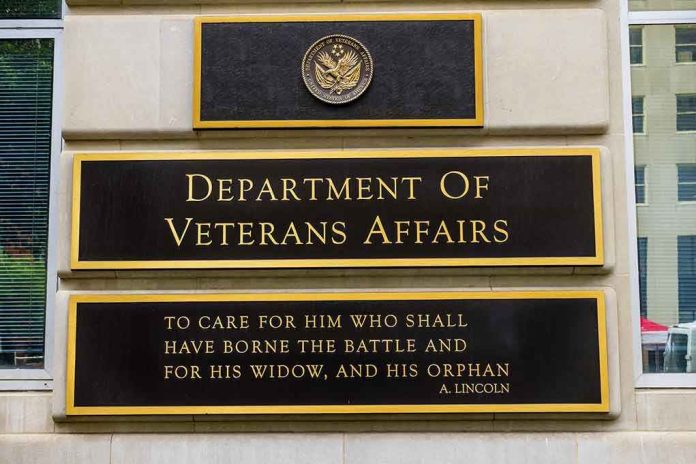
A $441.2 billion federal agency is asking for even more money—while basic accountability questions about what veterans actually get for that spending still hang in the air.
Quick Take
- The available research supports a detailed look at the VA’s 2026 budget request, but it does not document the claimed “private project” comparison.
- The VA’s 2026 budget request totals $441.2 billion, described as about a 10% increase in the research provided.
- The request includes major funding for health care, facility upgrades, and Electronic Health Record (EHR) modernization.
- Because the “private project” details are missing from the research set, readers should treat the comparison claim as unverified here.
What We Can Verify: The VA’s 2026 Budget Request Is Massive
The provided research centers on the Department of Veterans Affairs’ 2026 budget request, pegged at $441.2 billion, with multiple write-ups describing it as roughly a 10% increase. The same research notes $165.1 billion for health care, described as a 17% increase. Those toplines matter because they define the scale of federal involvement in veterans’ care—and the size of the taxpayer commitment.
The $441 Billion VA System Still Can’t Do What One Private Project Just Didhttps://t.co/j2yyt6Mbsi
— RedState (@RedState) March 20, 2026
The VA’s public-facing budget materials and summaries also point to targeted line items that often drive frustration among veterans: long timelines, patchwork systems, and reforms that never seem to fully land. In the research set, the request includes billions aimed at infrastructure repairs and “modernization,” which signals that core facilities in the system still require substantial catch-up spending rather than routine maintenance.
Health Care Spending Rises Again—But Outcomes Aren’t Addressed in This Research Set
The research provided highlights $165.1 billion allocated for VA health care in 2026, described as a 17% increase. That kind of expansion suggests the agency anticipates sustained demand and higher costs, whether from staffing, benefits utilization, or care delivery. What’s not included in the supplied sources is any hard, apples-to-apples performance comparison tied to the user’s headline premise—so this article cannot responsibly claim the VA “can’t do” a specific task.
For conservative readers focused on limited government and competent stewardship, the key issue is not whether veterans deserve resources—they do—but whether Washington is proving it can convert rising budgets into predictable, timely service. The budget summaries referenced here outline initiatives (including mental health and homelessness efforts), but they do not provide the missing comparative evidence about a particular private project outperforming the VA.
EHR Modernization: Billions More for a System That Still Isn’t Fully Modernized
Multiple items in the research describe continued spending for Electronic Health Record modernization, including a figure of $3.495 billion. Big IT projects are exactly where taxpayers have learned to be skeptical: money flows, deadlines slip, and the system remains fragmented. The supplied documents and summaries indicate the VA continues to prioritize EHR modernization, but the research packet does not include concrete benchmarks in the “private project” claim to measure whether this spending is closing gaps.
The constitutional concern here is indirect but real: when federal agencies expand budgets without clear, measurable outcomes, the result is often pressure for still more centralized control rather than accountability. Conservatives generally want veterans served effectively, but they also want programs run transparently and within guardrails—especially when the funding levels are large enough to crowd out other priorities or justify additional bureaucratic reach.
Facilities, Repairs, and Modernization: Another Sign of Backlog and Deferred Maintenance
The research also cites $4.8 billion for facility modernization and repairs. That figure is a reminder that the VA’s physical footprint—clinics, hospitals, and support facilities—still requires significant investment. Facility repairs are not glamorous, but they often track directly to patient experience and safety. The sources provided do not indicate whether this is sufficient to clear backlogs, only that the request again commits billions to the problem.
One practical takeaway is that “more money” and “modernization” remain recurring themes. If the system were running smoothly, modernization would look like incremental improvement, not repeated high-dollar rescue packages. Still, without the missing private-sector comparator described in the user’s premise, the best-supported conclusion from this research set is narrow: the VA is requesting a very large 2026 budget and allocating major sums to health care, facilities, and IT.
What’s Missing: The ‘Private Project’ Claim Can’t Be Verified From Provided Research
The user’s topic frames a direct contrast—“The $441 Billion VA System Still Can’t Do What One Private Project Just Did”—but the research included here explicitly states that the search results did not contain the identity of the private project, what it accomplished, or how the VA failed at the same task. That means any strong claim about incompetence relative to a specific private initiative would be speculation, and it would not meet a factual integrity standard.
If readers want a decisive conclusion about the comparison, the missing details are essential: the project name, the deliverable, cost, timeline, verification, and a like-for-like definition of “success.” Until that evidence is supplied, the only responsible story is the one supported by the documents: the VA’s budget request is enormous, and it includes large increases and major modernization spending that will merit ongoing oversight from Congress and the public.
Sources:
Historic VA Budget for 2026: More Health, More Benefits, Fewer Employees
Strategic Briefing: The 2026 Veteran
VA Budget 2026: PACT Act, EHR, Homelessness
Veterans’ Independent Budget seeks to address VA funding shortfalls
2026 Volume 2: Medical Programs
2026 Budget Highlights (Complete)
2026 Volume 5: Information Technology Programs and Electronic Health Record Modernization