

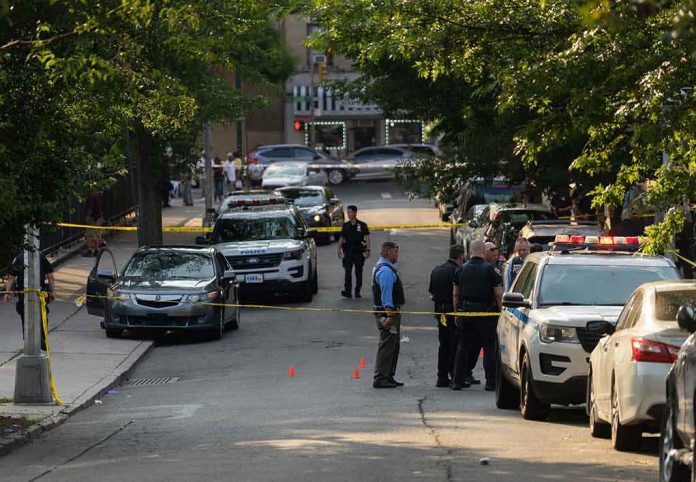
A man once convicted of trying to kill police allegedly opened fire on Cambridge commuters five years later, raising hard questions about how a known violent offender was back on the street with a rifle.
Story Snapshot
- Authorities identified the Memorial Drive gunman as Tyler Brown, previously convicted for firing at Boston police in 2020 and sentenced in 2021. [3]
- Witnesses and officials reported multiple vehicles and buildings struck as Brown allegedly fired numerous rounds before being shot and taken into custody. [1]
- A parole officer reportedly sought a welfare check earlier that day after Brown made suicidal statements, indicating recent supervision activity. [1]
- Open questions persist about Brown’s release timeline, compliance with mandated treatment, and how he obtained a rifle post-conviction.
What Happened on Memorial Drive
Police and local reports say Tyler Brown, 46, opened fire on Memorial Drive in Cambridge on May 11, striking passing vehicles and nearby buildings before a Massachusetts State Police officer shot and subdued him. Initial accounts describe more than a dozen rounds, with evidence markers and bullet impacts scattered along the roadway as investigators processed the scene. At least two people were reported injured, and Brown was transported to a hospital after being struck by police fire during the response. [1]
Local coverage indicates that when officers arrived, Brown allegedly continued to fire, escalating risk to bystanders and first responders until officers ended the threat. Official statements from the Middlesex County District Attorney’s office focused on the immediate public safety response and the status of victims, while withholding broader commentary on Brown’s history. Subsequent reporting identified Brown as the suspect, with prior violent offenses involving gunfire at law enforcement in Boston several years prior. [1]
The Known Criminal History and 2021 Sentence
Court records and the Suffolk County District Attorney confirm Brown pleaded guilty in 2021 to armed assault with intent to murder and related charges after firing at Boston Police Department officers in 2020. The District Attorney’s office stated Brown discharged significantly more shots than responding officers during that incident. The plea resulted in a state prison sentence of five to six years, followed by probation and mandated mental health treatment, according to contemporaneous reporting and official statements. [3]
The sentence length and structure place Brown among defendants who avoid trial through negotiated pleas, which can reduce exposure to longer terms. However, the publicly available record does not clarify how much of the five to six year term Brown served, what precise conditions governed his supervision upon release, or what risk assessments were performed prior to the 2026 incident. Without those documents, firm conclusions about leniency or compliance cannot be drawn. [3]
Supervision, Welfare Check, and System Questions
On the day of the shooting, local reporting indicates a parole officer sought a welfare check after Brown made suicidal statements, suggesting active monitoring of his case. An officer safety bulletin reportedly warned that Brown had been seen on a video call with what appeared to be an assault-style rifle. Boston police attempted to locate him hours before the Cambridge gunfire, raising questions about the speed of interagency coordination and the limits of preventive action once a firearm is already in play. [1]
Authorities have identified the suspect involved in Monday’s Cambridge, Massachusetts shooting as 46-year-old Tyler Brown.
Two people suffered life-threatening injuries after Brown allegedly opened fire with an assault-style rifle on Memorial Drive before being shot by a state… pic.twitter.com/HPJgr4WFbk
— NV Intel™ (@nvintel) May 12, 2026
Three issues now dominate the policy conversation. First, the release timeline remains opaque: it is not clear whether Brown left custody through parole, good-time credits, or sentence completion. Second, mandated mental health treatment was part of his sentence, but public information does not show whether he participated consistently or exhibited warning signs earlier than the day of the shooting. Third, investigators have not publicly detailed how Brown obtained a rifle despite his prior felony conviction, which would have barred lawful purchase under state and federal law. [3]
Why Both Sides See a System Failure
Residents across the political spectrum see a familiar and frustrating pattern when a person with a documented violent past returns to the community and allegedly commits a serious offense. Critics focused on public safety argue that a five to six year term for shooting at police was too light and failed to incapacitate a high-risk offender. Reform advocates counter that supervision responded quickly to a mental health crisis, and that unpredictable spirals can outrun any practical surveillance. Both readings are shaped by incomplete public records. [3]
For families stuck in traffic on Memorial Drive, the debate is not abstract. People want to know whether sentencing policies, parole decisions, and mental health conditions were matched to the known risks in Brown’s past case, and whether information sharing could have moved faster once a weapon was allegedly displayed. Until authorities release time-served data, supervision logs, and a firearm trace, the line between individual breakdown and institutional failure will remain contested but unresolved. [1]
What to Watch Next
Investigators will likely publish an initial incident timeline, which could clarify the window between the reported welfare check and the first shots in Cambridge. Public records requests to the Massachusetts Department of Correction, the Massachusetts Parole Board, and the Middlesex and Suffolk County prosecutors may confirm the legal basis for Brown’s release and his compliance history. A firearm trace by the Bureau of Alcohol, Tobacco, Firearms and Explosives could reveal how the rifle changed hands and whether trafficking or theft played a role. [1]
Sources:
[1] Web – 7NEWS Sources: 2 people shot on Memorial Drive in Cambridge
[3] Web – Man Who Fired at Police Sentenced to Prison