

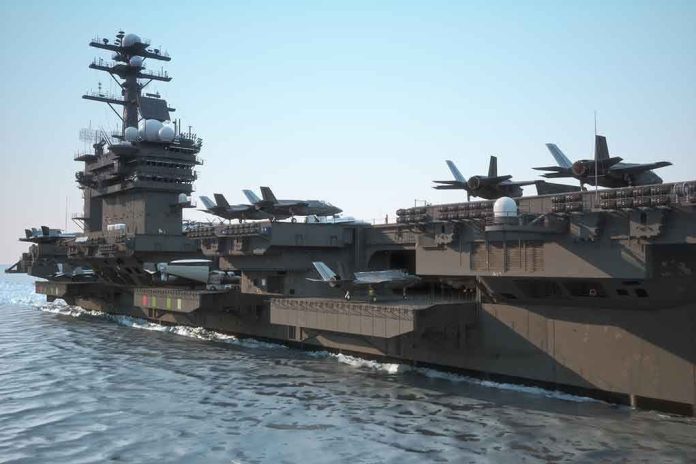
President Trump’s administration has orchestrated a strategic military shift, expanding the F-15EX Eagle II program, which promises to secure America’s air superiority and bolster defense capabilities.
Story Highlights
- The F-15EX program expands from 98 to 129 jets, with a $3 billion budget allocation.
- Reequipping the Michigan Air National Guard with F-15EXs marks a key transition.
- The F-15EX serves as a cost-effective complement to the F-35 and F-22.
- The expansion preserves the industrial base while addressing fighter fleet shortages.
Expansion of the F-15EX Fleet
The U.S. Department of Defense’s FY2026 budget proposal under the Trump administration expands the F-15EX Eagle II program. This strategic move increases the planned fleet from 98 to 129 aircraft, with a budget allocation of $3 billion. This expansion aims to bolster the Air Force’s capabilities amid shifting air combat priorities, focusing on non-stealth missions where the F-15EX excels. The transition of the Michigan Air National Guard from A-10s to F-15EXs exemplifies this initiative.
The F-15EX program is highlighted as a cost-effective solution to complement more advanced stealth fighters like the F-35 and F-22. With a payload capacity of up to 12 AMRAAMs, the F-15EX leverages its 4th-generation strengths in range and rapid upgradability. These attributes are crucial for maintaining air superiority and addressing the current fighter fleet’s shortages. By preserving the industrial base and offering an operationally efficient alternative, the F-15EX ensures the U.S. military remains robust and prepared for future challenges.
Modernization and Strategic Importance
The modernization of the F-15 platform through the F-15EX and F-15IA variants is set to extend service life well beyond 2040. This modernization includes advanced fly-by-wire systems, state-of-the-art sensors, and a significant reduction in operating costs, estimated at 25% lower than older models. These improvements are part of a broader strategy to sustain the Air Force’s capabilities amid the eventual retirement of legacy aircraft like the A-10s and F-22s.
The Trump administration’s decision to prioritize the F-15EX over other programs underscores a commitment to practical, cost-effective solutions that meet immediate defense needs. This approach not only secures the domestic industrial base but also bolsters international partnerships, as evidenced by Israel’s acquisition of F-15IAs, ensuring continued air superiority against regional threats.
Implications and Future Outlook
The strategic expansion of the F-15EX fleet has both short-term and long-term implications. In the short term, it enhances military readiness and ensures a smooth transition for the Air National Guard units, like those in Michigan. Long-term, the F-15EX will remain viable for non-stealth roles, supporting 24 ANG squadrons beyond 2045. Economically, the program sustains the Boeing production line, providing jobs and maintaining a key element of the defense industrial base.
Politically, the Trump administration’s focus on legacy platforms reflects a strategic balancing act between immediate defense needs and the development of next-generation technologies. While the budget allocation offsets some F-35 purchases, it ensures that the Air Force can meet its projected need for 1,558 aircraft by 2035. This decision highlights a pragmatic approach to national defense, rooted in ensuring that America remains secure and prepared.
Sources:
F-15EX Planned Fleet Size Grows To 129 Jets from 98
2026 Budget: Air Force Fighter Fleet
Boeing Completes F-15C Eagle Upgrades