

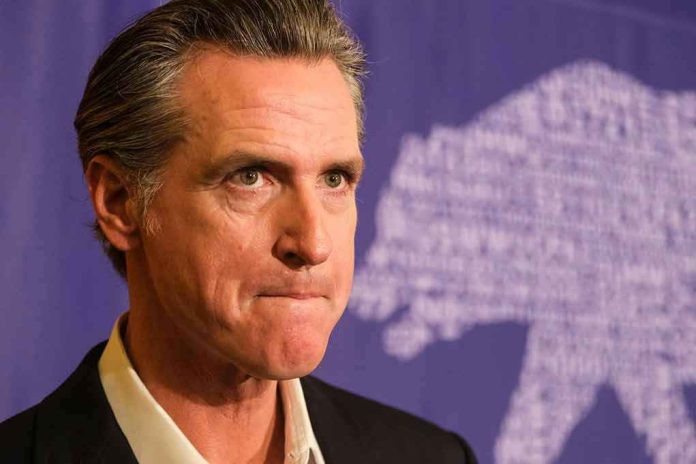
A top federal prosecutor has branded Gavin Newsom the “king of fraud,” igniting a $24 billion probe into how California burned through homelessness money while streets only got worse.
Story Snapshot
- A Trump-appointed federal prosecutor launched a $24 billion fraud investigation into California’s homelessness spending under Gov. Gavin Newsom.
- Initial federal cases already allege millions stolen through real estate schemes tied to homelessness programs.
- Newsom’s team claims he blocked over $125 billion in fraud and dismisses the probe as politically motivated.
- Massive pandemic-era fraud and weak oversight in California fuel taxpayer anger and federal scrutiny.
Federal Task Force Zeroes In On California’s Homelessness Billions
First Assistant U.S. Attorney Bill Essayli, serving in the Central District of California, has launched a federal task force to dig into an eye‑popping $24 billion California poured into homelessness over the last five years. He told a national audience that officials cannot clearly trace where that money actually went, even as tent encampments and crime have spread across major cities. Early federal indictments already target real estate operators accused of siphoning off millions from homelessness programs.
Essayli’s appearance on cable news marked a sharp escalation, because this is not a pundit talking but a sitting senior federal prosecutor openly calling Newsom the “king of fraud.” That kind of language from the Justice Department underscores how seriously investigators view California’s oversight failures. Essayli described the current set of charges as only the “tip of the iceberg,” warning more cases could land within weeks as agents comb through grants, housing contracts, and nonprofit agreements.
Pandemic-Era Fraud Exposed Deep Weaknesses In California Oversight
California’s current predicament did not appear overnight. During the pandemic, its Employment Development Department was overwhelmed by benefit claims, and a 2021 state audit documented at least $10 billion in suspicious unemployment payments. Later reporting suggested the true fraud total could be several times higher. Scammers also hit federal relief programs such as PPP and EIDL, with one California man admitting he illegally secured nearly $16 million in loans, exposing gaping vulnerabilities in state and federal vetting systems.
Those scandals reinforced a nationwide perception that California’s progressive, big‑government model cannot safeguard taxpayer dollars. Fraud rings targeted tax refunds, fire relief, and food benefits, with some schemes reaching into the hundreds of millions. Even as prosecutions mounted, state auditors continued to find problems, citing about $1.5 billion in fraudulent unemployment insurance payments in recent years and more than $500 million in 2024 alone. For many taxpayers, the pattern looked less like isolated abuse and more like a structural failure of basic accountability.
Newsom’s Defense: Anti-Fraud Claims Versus Mounting Probes
Newsom and his communications team insist the governor has been “cleaning house,” touting claims that his administration blocked over $125 billion in fraud and aggressively prosecuted “criminal parasites” who abused safety‑net programs. They highlight steps such as hiring former Trump‑appointed U.S. Attorney McGregor Scott to help chase unemployment fraud. Newsom’s camp portrays Trump and conservative outlets as peddling lies, casting the federal focus on California as a partisan attempt to damage a Democratic leader with national ambitions.
Federal investigators, however, are not campaigning; they are following money tied to specific contracts and programs. Their work builds on years of documented failures: audits flagging weak identity verification, delayed controls, and lax oversight across sprawling benefit systems. For families who watched their neighborhoods decline while hearing about billions budgeted for homelessness, the rhetoric from Sacramento rings hollow. The core question remains simple and concrete: if billions were properly spent, why are the streets worse and the fraud tallies still climbing?
High-Stakes Clash For Taxpayers, Constitutional Governance, And 2028 Politics
Essayli’s task force and Trump’s public backing of a California fraud investigation have immediate political implications. National Republicans now point to California as the potential “next Minnesota,” warning that a massive scandal could badly wound another Democratic governor. For a conservative audience, the story fits a familiar pattern: progressive leaders taxing more, spending more, expanding benefits for illegal immigrants, and then failing to guard the till, while law‑abiding citizens shoulder the burden and see few tangible results on streets and in schools.
Beyond partisan rivalry, the stakes reach core constitutional concerns about limited government and stewardship of public funds. Federal law gives Washington power to police fraud where federal dollars are involved, but state leaders control program design and enforcement culture. If California’s homelessness and welfare systems become synonymous with waste, it strengthens the case for tighter conditions on federal grants, sharper audits, and a renewed insistence that every tax dollar be traceable, measurable, and accountable to the people who earned it.
Sources:
US Department of Justice, Dr. Oz targeting California alleged medical fraud
Federal prosecutor calls Gavin Newsom ‘king of fraud’ in California
Trump says California is fraud investigation, Newsom responds
Tim Walz isn’t only governor plagued by fraud. Newsom may be targeted next