

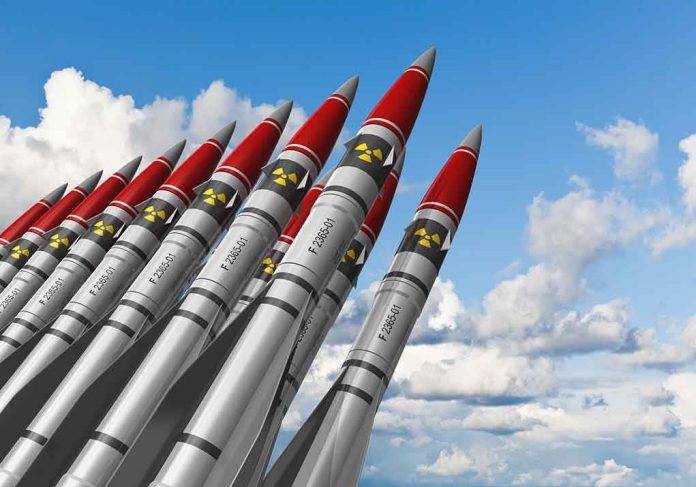
A world already rattled by wars and woke chaos is now facing a quietly building nuclear storm that career globalists spent years ignoring.
Story Highlights
- Global nuclear rules are breaking down as major powers modernize arsenals and test the limits of deterrence.
- North Korea’s hypersonic missiles, new ICBM, and nuclear‑powered submarine raise the risk for U.S. troops and allies.
- Russia–North Korea military cooperation is undermining sanctions and fueling a new arms race environment.
- Repeated failures of the Non‑Proliferation Treaty process show how international institutions have lost control.
How the Global Nuclear Order Started Coming Apart
After the Cold War, many experts claimed the nuclear nightmare had faded, but treaty after treaty has either collapsed or been abandoned. Strategic arms agreements that once restrained the United States and Russia have unraveled, while China rapidly expands and modernizes its arsenal without serious transparency or limits. At the same time, regional nuclear powers like India, Pakistan, and North Korea have moved from basic deterrence toward more flexible and potentially more usable weapons, increasing chances of miscalculation in any crisis.
The Treaty on the Non‑Proliferation of Nuclear Weapons was supposed to anchor global stability by limiting who could get the bomb and obligating nuclear states to work toward disarmament. That system is now straining badly. Recent review conferences ended without consensus, and a key 2025 preparatory meeting failed to agree on a common path forward. Non‑nuclear countries increasingly question why they should keep playing by rules that nuclear powers appear to stretch while upgrading their own arsenals and doctrines.
North Korea’s Rapid Buildup and What It Means for Americans
North Korea has turned itself into the most volatile nuclear flashpoint, building weapons that can reach U.S. allies and possibly the homeland. Kim Jong Un has enshrined nuclear arms as central to regime survival, pairing years of missile and nuclear tests with increasingly advanced systems. Recent reports describe new hypersonic weapons, long‑range strategic cruise missiles, and more capable intercontinental ballistic missiles, all designed to complicate U.S. defenses and challenge American security guarantees in the region.
Late 2025 and early 2026 marked a dangerous acceleration in North Korea’s programs. Pyongyang unveiled its Hwasong‑20, described as its most advanced ICBM to date, while commercial imagery revealed major modernization at the Yongbyon complex, including what analysts assess is a new uranium enrichment facility. Around the same time, state media displayed a largely completed hull for a nuclear‑powered “strategic nuclear attack submarine,” suggesting Kim intends to push toward survivable sea‑based nuclear forces.
Hypersonic Tests, Munitions Surge, and Russia Ties
In December 2025, Kim ordered a significant expansion of missile and munitions output for 2026, calling shell and missile production critical for strengthening deterrence. New ammunition factories and expanded plants support not just North Korea’s own forces but potentially exports to Russia, where Moscow seeks artillery and missile supplies for ongoing conflicts. A monitoring coalition of U.S., South Korean, Japanese, and other officials has already warned that this cooperation undermines United Nations sanctions and directly feeds Pyongyang’s ballistic programs.
Early 2026 brought North Korea’s first missile launch of the year, billed domestically as a test of a hypersonic weapons system. Kim oversaw the drill and emphasized continuously upgrading offensive capabilities and the nuclear deterrent in response to what he called a worsening geopolitical crisis. Hypersonic systems, which can maneuver at high speed and shorten warning times, pose special challenges for U.S. and allied missile defenses, raising pressure on commanders forced to make rapid decisions under uncertainty.
For Americans who value peace through strength, these developments underscore why a serious, constitutional foreign policy focused on deterrence, missile defense, and realistic threat assessments is essential. The same global institutions that failed to restrain North Korea also failed to stop Russian nuclear coercion during the Ukraine war or address China’s expanding arsenal. As 2026 is described by analysts as a critical moment for preserving the nuclear order, the United States faces a choice between doubling down on failed globalist frameworks or prioritizing concrete capabilities and alliances that genuinely protect American lives and interests.
Sources:
North Korea 2026: Will US and South Korea Push for Talks – and Succeed?
Kim Jong Un expected to cling to nuclear ‘security blanket’ after Venezuela ‘decapitation’
Kim Jong Un orders North Korea to boost missile production in 2026
2026 Signals Critical Moment to Preserve Nuclear Order
North Korea says latest tests involve hypersonic weapons system
North Korea’s Nuclear Weapons Program (CRS In Focus)
North Korea Conducts First Missile Launch of 2026 Into Sea of Japan
North Korea’s New Missile and Nuclear Developments – NK News