

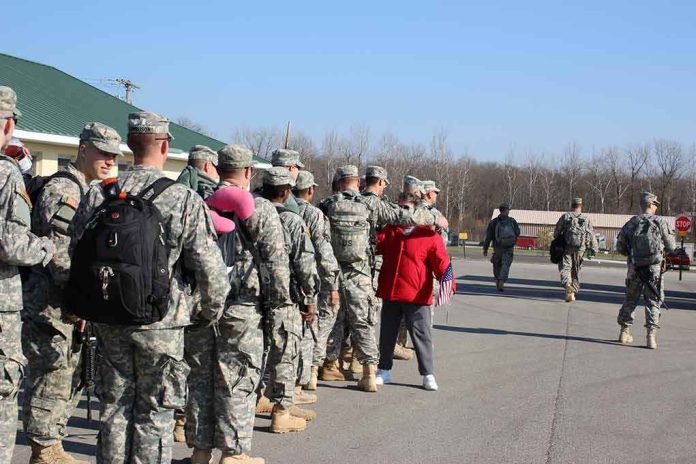
Five thousand additional American troops to Poland is either smart deterrence or whiplash diplomacy—what it means depends on which metric of strength you trust.
Story Snapshot
- President Donald Trump announced 5,000 more U.S. troops for Poland after an earlier halt to 4,000, flipping the script in a week [4][2].
- NATO partners publicly welcomed the announcement, signaling alliance reassurance despite mixed messaging [4].
- Army posture in Poland has oscillated between planned surges and abrupt cancellations tied to broader repositioning [7][8].
- The real question is capability versus signaling: steel on the ground or political theater with deterrent side effects [3].
What Happened And Why It Matters
President Donald Trump declared that the United States would send an additional 5,000 troops to Poland, a week after officials halted a previously planned rotation of roughly 4,000 personnel. The rapid reversal created a sharp contrast between the Pentagon’s pause and the White House’s push, magnifying the political stakes of a routine force posture decision [4][2]. The announcement drew quick support from transatlantic partners, who interpreted it as a renewed American commitment to frontline deterrence amid Russian pressure [4].
Poland has argued for years that forward American presence stiffens the North Atlantic Treaty Organization’s eastern flank and clarifies collective-defense resolve. U.S. Army rotations have repeatedly surged into Poland since the alliance’s Warsaw Summit commitments, moving brigades, tanks, and support units through Polish hubs as part of deterrence-by-presence [3]. The latest decision plugs directly into that pattern: boots forward, gear in motion, and a visible tripwire that Moscow must factor into any miscalculation. Allies see steel and flags; adversaries see risk.
Reassurance, Deterrence, And The Burden-Sharing Ledger
NATO reassurance works on contact—soldiers training together, logistics exercised under stress, and command relationships rehearsed until they are boring. On those metrics, more American troops in Poland strengthen deterrence while buying time for Europeans to accelerate their own capabilities. Public reaction from alliance leaders framed the move as stabilizing and welcome, an implicit admission that American presence remains the gold standard of European security insurance, even as capitals debate long-term autonomy and spending targets [4]. Common sense says deterrence favors clarity, not ambiguity.
Burden-sharing arguments cut the other way if Washington’s signals swing week to week. Conservatives typically want resolve with discipline: commitments matched by plans, not press releases. The abrupt halt of the 4,000-person rotation—followed by the 5,000 announcement—looked like policy churn, not a carefully staged surge [2][4]. That volatility confuses planners and taxpayers alike. If Europeans interpret the sequence as theater, not strategy, they may hedge on investments, undermining the very balance this deployment claims to reinforce.
Capability Versus Signaling: What Actually Changes
Force posture shifts can mean fresh combat power, or they can relabel a rotation already in the pipeline. The alliance has seen both in Poland. The United States Army Europe and Africa has repositioned people and equipment across Polish nodes as part of ongoing adjustments, reflecting a living map rather than a one-off bolt from the blue [7]. At other moments, planners canceled or paused movements, knocking personnel levels closer to pre-2022 baselines and raising questions about sustainment and predictability [8]. The operational net effect hinges on duration, enablers, and mission scope.
Trump announces deployment of 5,000 additional US troops to Polandhttps://t.co/0oIR7LXL3U
— JuliaPoems (@JJ56123) May 23, 2026
History inside the alliance shows that rotational presence—armor brigades, combat vehicles, tanks, and battalions flowing through Polish corridors—can deliver real training value and credible tripwires even without permanent bases [3]. The latest 5,000 figure matters if it arrives with logistics, air defense, and command-and-control layers that raise the cost of aggression on day one. If it amounts to a time-limited political flare, adversaries will wait it out. Voters should demand numbers and timelines, not headlines, to separate muscle from message.
How To Read The Move Through A Conservative Lens
Security first, promises kept, allies stepping up: that is the conservative test. The announcement meets the first condition if troops bring capability, not just symbolism. It satisfies the second if Washington’s word aligns with Pentagon execution without eleventh-hour rewrites. It advances the third only if Europeans continue to expand spending, infrastructure, and munitions stockpiles while hosting more training and prepositioned gear. The public welcome from partners suggests reassurance landed; the prior cancellation warns that management must tighten to keep it [4][2][8].
Bottom Line For Readers Who Prefer Results
Send the troops, lock the plan, and publish the sustainment. If this 5,000-person push to Poland endures with the right enablers, the alliance gets stronger and deterrence gets simpler. If it drifts into another announcement cycle, planners will relearn the same lesson: mixed signals cost money and invite tests. The quickest accountability check is straightforward—track arrival, mission, support, and duration against prior rotations and known Army repositioning updates, then judge whether Europe’s frontline is measurably harder to move [7][8][3].
Sources:
[2] YouTube – US scraps plans to deploy thousands of troops to Poland
[3] Web – U.S. Army moving East: Implementing Warsaw Summit Commitments
[4] Web – NATO allies welcome Trump’s Poland troop announcement, but say …
[7] Web – Press Release – USAREUR-AF repositions troops in Poland
[8] Web – US Army abruptly cancels deployment of 4,000 soldiers to Poland