

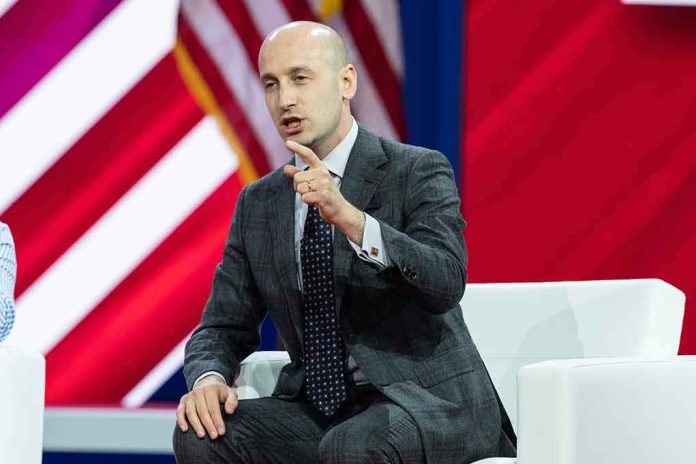
Personnel choices are policy choices; elevating Stephen Miller to White House chief of staff and the immediate resignation of Deputy Chief of Staff Richard Walters amount to a clear statement about how President Trump intends to run his West Wing and prosecute his priorities.
At a Glance
- President Trump named Stephen Miller the 33rd White House chief of staff, succeeding Susie Wiles, with the appointment set to take effect November 9, 2026.
- Trump publicly described Miller as one of his most trusted advisers and framed the move as a continuation of his core agenda.
- Deputy Chief of Staff Richard Walters resigned as Miller prepared to assume the role; public statements characterize the departure as amicable.
- The sequence fits a familiar pattern: chiefs of staff reorganize the West Wing, and senior deputies often exit during the transition.
What Happened: A Clean, Decisive Succession
The White House formally announced that Stephen Miller will serve as the 33rd White House chief of staff, replacing Susie Wiles. The announcement, issued November 6, 2026, cast Miller as a longtime aide to President Trump and credited him with shaping administration priorities on border enforcement and other marquee issues. Trump underscored that confidence in his own public remarks, calling Miller “one of my most trusted advisors” and giving a firm effective date for the handover. In the same window, Deputy Chief of Staff Richard Walters submitted his resignation, with reporting and on-record statements describing the exit as voluntary and cordial, and with Miller praising Walters’s service as “invaluable”.
Viewed strictly as an organizational event, the facts are straightforward: a president elevated an insider to the chief’s chair, the outgoing chief stepped aside, and a senior deputy chose to depart as the new boss took the helm. Those steps are common in West Wing transitions; what matters is the agenda and operating style the new chief brings—and which lieutenants stay to execute it.
How Chiefs of Staff Reshape Power in Practice
The White House chief of staff is the president’s principal gatekeeper and integrator—managing the flow of people and information to the Oval Office, arbitrating policy disputes, and aligning the Cabinet, communications, and legislative strategy. The job is structurally punishing; since 1969, the average tenure has been about two years, with rapid turnover even in otherwise stable administrations. Chiefs typically begin with a reorganization: revising reporting lines, consolidating policy councils, and installing loyalists in key staff secretary, scheduling, and communications billets. Those moves naturally prompt exits by deputies who either see a ceiling under the new structure or are allied with the prior chief.
That is the right lens for Walters’s resignation. Axios reported he offered his resignation shortly before Miller’s start date, characterizing the departure as amicable and consistent with the normal churn that follows a leadership change. Miller, for his part, publicly lauded Walters’s contributions and said he would remain supportive from outside government—standard language for a high-functioning handoff.
Stephen Miller’s Operating Model and What It Signals
Miller is not a mystery appointment; he has been central to Trump’s political and governing identity for years, from campaign speechwriting to the most contentious immigration initiatives of Trump’s first term. The White House announcement couches his promotion in continuity terms—someone “there from the beginning,” trusted to drive the president’s priorities with intensity and discipline. A chief of staff with that portfolio tends to centralize decision-making, compress the chain of command, and demand tight message control. Expect a firmer hand over interagency policy drafting, fewer freelance leaks, and faster movement from presidential impulse to executable directive.
For stakeholders outside the building, that means sharper signals and shorter reaction windows. Congressional outreach will reflect Miller’s view of negotiation—transactional when necessary, confrontational when advantageous. Communications will aim to frame conflict on terrain the White House prefers, especially on immigration and executive authority. Agencies should anticipate more tasking through the Executive Office rather than devolved process in the departments, coupled with explicit performance metrics keyed to presidential priorities.
Why Senior Turnover Spikes Around a New Chief
In every presidency, chiefs of staff inherit complex informal networks—friendships, loyalties, routines—that must be rewired to align execution with the president’s intent. Even in placid administrations, reorganization brings attrition. In modern presidencies, turnover in senior West Wing roles has routinely been high; researchers and institutional trackers have documented that chiefs create both impetus and cover for deputies to depart, whether for policy disagreements, career timing, or simply because their function is subsumed by the new structure. Trump-world, with its aggressive tempo and personalist decision style, has historically magnified that dynamic, but the mechanism is the same: new chief, new map, new team.
Against that baseline, Walters’s resignation is intelligible without resort to melodrama. A deputy aligned to the outgoing chief often faces a choice: adapt to a different center of gravity or move on. The reporting here says he chose the latter and did so on good terms, which—while it does not reveal private motivations—aligns with the institutional pattern and public statements by the principals.
Implications for Policy Execution and the Next Year
Elevating a chief of staff with Miller’s history has two immediate consequences. First, the policy docket most identified with the president—immigration enforcement, border control, and use of aggressive executive action—is likely to receive even more sustained, hands-on management from the West Wing. That typically accelerates the cycle from concept to order, increases the volume of guidance pushed across agencies, and hardens the administration’s litigation posture when challenged. Second, internal process will likely compress. Expect fewer sprawling interagency debates and more direction flowing from a smaller inner circle; that can produce clearer lines of authority but raises the premium on executional competence down the chain.
For allies, this is clarifying: the president has put a loyalist strategist in the seat designed to convert presidential will into government action. For adversaries, the signal is equally clear: anticipate fewer conciliatory gestures and more maximalist negotiating positions. Either way, the work of a chief of staff is judged not by announcements but by throughput—how reliably the building sets priorities, avoids self-inflicted errors, and lands outcomes in the courts, on the Hill, and in the departments. The coming months will show whether Miller translates trust into disciplined governance.
Sources:
themirror.com, axios.com, brookings.edu