

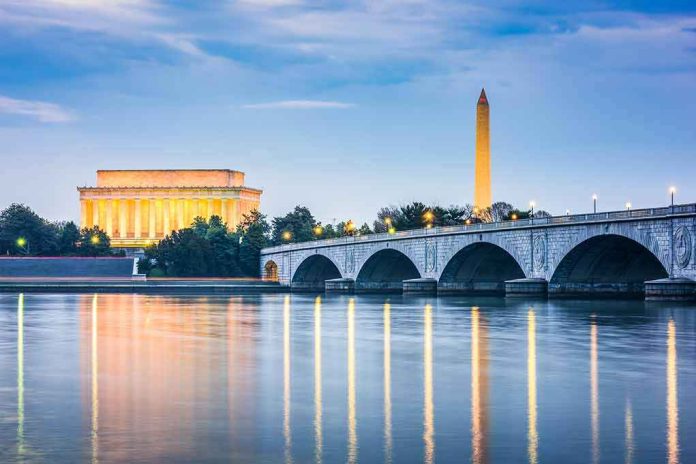
A former Olympic hero now faces a felony charge for “vandalism” at Trump’s Reflecting Pool, in a case that exposes how politics, public money, and clashing narratives can turn a loose piece of liner into a national fight.
Story Snapshot
- A Washington, D.C. grand jury indicted former Olympian David Hearn for felony destruction of property after an incident at the Lincoln Memorial Reflecting Pool.
- Prosecutors say Hearn violently ripped up about two square feet of sealant worth over $1,000, while Hearn insists he only touched a loose piece and caused no damage.
- The indictment comes amid at least five arrests, multiple citations, and growing political claims that “vandals” are to blame for problems at the pool.
- The case highlights wider frustration on right and left over how government protects symbols, spends taxpayer money, and frames citizens as threats.
What Prosecutors Say Happened at the Reflecting Pool
U.S. Attorney Jeanine Pirro announced that a grand jury in Washington, D.C., Superior Court indicted David Hearn, a 67‑year‑old three‑time Olympic canoeist, on a felony count of destruction of property tied to the Lincoln Memorial Reflecting Pool. Prosecutors say National Park Service employees saw Hearn use both hands to forcefully pull up and remove part of the pool’s bottom liner, damaging about two square feet of “American flag blue” sealant. Pirro said the government values that damaged section at more than $1,000, which is what bumps the charge from a simple misdemeanor into a felony carrying a possible multi‑year prison sentence. She also claimed witnesses heard Hearn shout that a worker “cared too much” and “it wasn’t her pool” when she confronted him. U.S. Park Police officials have framed the case as part of a broader effort to protect national monuments from what they call escalating vandalism.
Hearn was first arrested on June 19 on a misdemeanor destruction of government property charge after park officers and National Guard members confronted him at the pool. That arrest came amid a wave of similar incidents as authorities struggled with a troubled $14 million renovation that left the water bright green with algae and the new liner peeling in places. Officials say at least five people have been arrested and several more cited for vandalism at the site, with more than a dozen police reports filed. President Trump used his social media platform to claim “multiple individuals” had vandalized the pool and even alleged someone cut a 250‑foot gash in the surface, though he did not provide public evidence for that specific claim. In that charged climate, Hearn’s case moved quickly from an odd arrest of a cyclist on a long ride to a headline felony indictment.
How David Hearn Describes His Actions and the Arrest
Hearn flatly denies that he vandalized anything at the Reflecting Pool and says the government is misreading what happened. He told ABC News and other outlets that he was on a 50‑plus‑mile bike ride when he stopped at the pool as a “curious, concerned citizen” after seeing reports that the new blue coating was peeling and algae was spreading across the water. He says he saw a piece of sealant “already peeling” and partly detached from the bottom, and reached down to touch the loose end to see what the material felt like. In his words, “I did not remove, I did not damage, I did not rip, tear, break, destroy or harm any part of the Reflecting Pool.” He claims the pool looked exactly the same after he walked away as it did before he approached it.
Hearn says that as he was examining the loose fragment, a National Park Service employee told him to stop touching it, and he did. He then walked back toward his bicycle, only to be arrested by U.S. Park Police officers and held for about five hours before being released with a court date. He describes himself as fully cooperative and says he never tried to flee or resist. Hearn also insists he never grabbed a cleanup hose, despite a conservative journalist’s video claim, and suggests his bike tire might have brushed it instead. Since the arrest, he has told reporters he believes he is being made a “political example” in a high‑profile fight over the failing renovation, and he reports receiving death threats over a moment he insists caused no harm.
Politics, Public Money, and Why This Case Feels Bigger Than One Man
The Reflecting Pool controversy did not start with Hearn, and it helps explain why his case now carries such heavy political weight. The federal government spent about $14 million on the renovation, including the special blue liner that Trump personally championed as a patriotic touch. Within weeks, parts of that liner began peeling and algae turned the water a bright, almost neon green, leading to public embarrassment and questions about waste and mismanagement. Rather than first blaming contractors or design choices, top officials and Trump quickly focused on “vandals,” saying people were ripping the liner and carving deep cuts, and praising Park Police for multiple arrests. That framing makes every citizen who touches the failing surface look less like a curious taxpayer and more like an enemy of national heritage.
Olympian David Hearn has been indicted by a D.C. grand jury on a felony charge related to alleged vandalism at the Reflecting Pool, U.S. Attorney Jeanine Pirro announced on Thursday. Hearn’s attorney said, "This indictment reflects the administration’s effort to shift blame for… pic.twitter.com/o757fUMFT5
— CBS Evening News with Tony Dokoupil (@CBSEveningNews) July 2, 2026
For many Americans, the Hearn indictment hits a nerve that crosses party lines. Conservatives frustrated with wasteful spending and weak enforcement see a government that spent millions on a pool that cannot hold up, then rushes to blame individuals instead of fixing the project. Liberals angry about aggressive policing and politicized justice see a 67‑year‑old athlete facing a possible felony record based largely on the word of government employees, with no public video or independent damage report yet backing the $1,000‑plus claim. Both sides share doubts about a system where a high‑profile president’s narrative of “vandalism” can shape arrests, charges, and media coverage before all the facts are clear.
What Evidence Is Known — and What Is Still Missing
So far, the public picture of the case rests almost entirely on people’s words, not hard physical proof. Prosecutors cite eyewitness accounts from National Park Service workers who say they saw Hearn violently pull up the liner, and they quote his alleged heated remarks when he was confronted. Hearn gives a very different account, saying he gently touched an already loose piece and then stopped when told. No unedited surveillance footage from the pool has been released to show exactly what happened, and officials have not published a detailed repair bill or expert report to support their claim that two square feet of sealant cost more than $1,000 to fix. That leaves both the alleged “violence” of his actions and the key dollar figure behind the felony charge open questions for now.
In a country already divided over how police use their power and how leaders spend taxpayer money, this kind of gap in evidence feeds deeper worry. People on the right see crumbling public works and suspect the government blames “vandalism” to dodge responsibility for bad contracts and poor oversight. People on the left see citizens turned into symbols by powerful officials and fear that ordinary acts can be recast as crimes when it serves a political story. Until courts force the release of video, order independent engineering reviews, and test any physical liner pieces for real forensic links, many Americans will keep asking the same basic question: is this justice, or is the system protecting itself?
Sources:
youtube.com, cnbc.com, nbcnews.com, cbsnews.com, facebook.com, pbs.org, instagram.com