

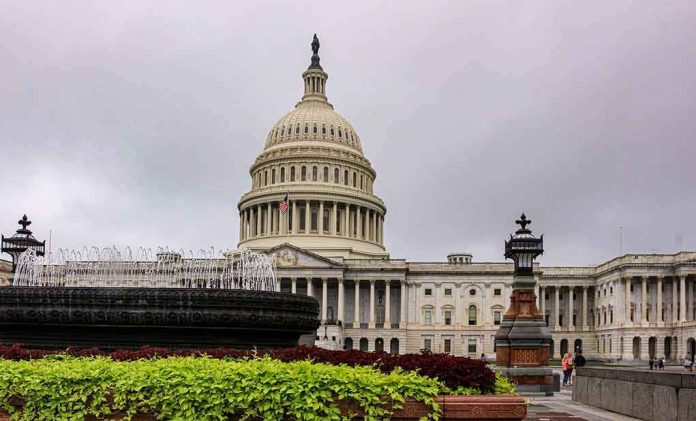
When a contractor building a president’s private ballroom simultaneously receives a secret, multi-million-dollar sole-source contract from his administration for ornamental park fountains, the issue is not just cost overruns; it is how power bends federal procurement rules toward politically connected firms and away from transparent competition.
Key Points
- The National Park Service (NPS) quietly awarded Clark Construction, builder of Trump’s White House ballroom, a sole-source Lafayette Park fountain contract that grew to $17.4 million from a prior $3.3 million estimate.
- Officials bypassed competitive bidding by invoking a rarely used “urgency” exemption, typically reserved for emergencies such as wars or natural disasters, raising questions about abuse of procurement flexibilities.
- Cost growth appears driven by double-counted inflation and a flat 50% schedule-compression surcharge that contracting experts describe as outside normal federal practice, prompting congressional demands for investigation.
- The episode sits inside a broader, well-documented pattern: politically connected firms repeatedly winning no-bid or sole-source federal work, often under weak claims of urgency or uniqueness.
How Clark’s Ballroom Work Became a Gateway to a Fountain Contract
The core facts are not contested. In 2022, under the prior administration, the National Park Service obtained an independent estimate of roughly $3.3 million to repair two aging ornamental fountains in Lafayette Park across from the White House. That estimate reflected routine deferred maintenance—pumps, plumbing, stonework—not a complex, security-sensitive project. In January 2026, however, the Trump administration agreed to pay Clark Construction $11.9 million for the same fountain project, later adding tasks that raised the total contract value to $17.4 million.
Clark was not chosen through open competition. Instead, NPS “simply offered the job” to Clark, the Maryland firm already building Trump’s expansive East Wing ballroom, and documented its decision using an internal memorandum invoking an “urgency” exemption to normal bidding procedures. According to analyses of NPS spending, less than 1 percent of the agency’s contract dollars over the past decade relied on this urgency statute; it exists primarily to address situations in which delay would cause serious harm to government operations, such as war-related damage or disaster response.
Linking the fountain work to Clark’s ballroom contract was explicit. NPS officials argued that because Clark already had people and equipment inside the tightly controlled White House security perimeter, only that firm could complete the fountains fast enough to meet an internal deadline: finishing before celebrations for the nation’s 250th birthday. In other words, the administration justified bypassing competition for a routine park project by citing a schedule pressure that arose from its own choice to undertake a massive ballroom build.
No-Bid, Sole-Source, and the “Urgency” Exception Explained
Public debate over this case has leaned heavily on labels—“no-bid,” “sole-source,” “secret”—that can obscure how federal procurement actually works. In regulatory terms, the Lafayette Park contract is a sole-source award made under an urgency exception
Such exceptions are legitimate tools when applied in the narrow circumstances Congress intended. Agencies use them when time-sensitive needs—disaster relief, critical infrastructure failures, national security threats—cannot withstand the months-long competitive process. Guidance from procurement experts underscores that no-bid or sole-source contracts are supposed to be rare, tightly justified, and subject to heightened scrutiny, precisely because they trade away price competition and openness in exchange for speed and continuity.
Nothing in federal law outright prohibits using an urgency exemption for ornamental fountains. What the evidence supports is that doing so for a non-emergency aesthetic project, timed to a ceremonial anniversary, sits far outside how NPS has historically used this authority. Contracting scholar Steven Schooner’s assessment is direct: “Self-imposed deadlines aren’t urgency. And lack of planning isn’t urgency.” That judgment captures the crux of the criticism—this looks less like a genuine emergency than a convenient legal hook to steer work to a favored contractor already on-site.
From $3.3 Million to $17.4 Million: How the Price Ballooned
The cost escalation is striking even by the sometimes generous standards of federal construction. Representative Ritchie Torres’s letter to the Interior Department’s Acting Inspector General highlights that the Clark contract ended up 427 percent above the original independent estimate. According to reporting synthesized in that letter and subsequent coverage, NPS justified the increases through two main mechanisms: applying inflation adjustments twice and layering on a flat 50 percent surcharge for “schedule compression.”
Inflation adjustments are standard in long-planned capital projects; what drew expert criticism here was the allegation that NPS effectively double-counted inflation, adding roughly $2 million on that basis alone. The flat schedule-compression surcharge is even more problematic. Compressing timelines—adding crews, working overtime, staging work differently—can legitimately raise costs. But federal practice typically demands an itemized explanation of those changes, not a blanket percentage added to the entire contract. Torres’s letter describes the 50 percent add-on as lacking basis in standard procurement practices and notes expert views that such a flat fee is “highly irregular.”
Those concerns have moved beyond the commentary class into formal oversight. Senator Richard Blumenthal has issued letters to Clark’s chief executive and NPS officials seeking full contract files and justification records, questioning why a firm already profiting from Trump’s ballroom project should receive a separate no-bid fountain contract at such a steep markup. Torres, for his part, frames the matter as a potential misuse of an emergency statute to deliver “inflated and excessive” profit margins to a politically favored vendor.
Conflict-of-Interest Concerns: What Is Proven and What Is Speculative
Critics have been quick to cast this as a pipeline from taxpayer funds to Trump’s ballroom builder, implying a quid pro quo between public contracts and private construction. The evidentiary record, however, is more nuanced. It clearly shows that Clark Construction is simultaneously building the president’s ballroom and the Lafayette Park fountains, that the fountain contract was secret in the sense of not being posted on public award databases initially, and that competitive bidding was bypassed.
What the record does not yet supply is documentation of undisclosed financial kickbacks, donor relationships, or direct personal enrichment beyond the inflated contract itself. Neither the New York Times investigation nor the congressional correspondence identifies specific campaign contribution patterns or personal payments flowing back from Clark to Trump or his political apparatus. The conflict-of-interest argument at this stage rests on optics and structural concerns: a contractor praised by the president and entrusted with a prestige project also receives a sole-source federal award with unusual cost growth.
This distinction matters. Oversight bodies and serious observers typically separate three questions: Were procurement rules followed? Were the justifications reasonable? And did the decision-makers have corrupt intent or undisclosed financial interests? The available evidence strongly challenges the reasonableness of the urgency justification and the pricing, but stops short of proving personal corruption. That is why Torres and Blumenthal have asked for Inspector General and potentially GAO audits rather than alleging criminal conduct outright.
A Pattern, Not an Isolated Anomaly
Even if this specific case eventually proves to be merely an egregious use of legal discretion rather than outright fraud, it fits into a broader pattern that should concern any taxpayer. Analyses of federal contracting show that nearly 30 percent of recent-year federal contract dollars—roughly $221 billion out of $753.8 billion—were awarded without competition. No-bid and sole-source contracts are most defensible in defense, disaster relief, and highly specialized technical fields; instead, investigative reporting has repeatedly found them in relatively ordinary services and construction jobs performed by politically connected firms.
Recent years have brought several high-profile examples. The Times has detailed profitable event-coordination contracts given by the Trump administration to an organization involved in the January 6 rally, without competing bids even though many vendors could perform the work. Kristi Noem’s political fortunes were damaged by revelations that her Homeland Security Department disbursed approximately $220 million via sole-source arrangements to companies linked to her and her associates. A broader research literature, including work summarized by the Bank for International Settlements, finds that firms with lobbying and campaign ties receive more—and larger—contracts, especially when oversight is weak.
The Clark fountain contract sits squarely within this landscape: a politically favored firm, an ostensibly mundane project, a rarely used exemption, and generous pricing justified on thin grounds. Whether or not investigators ultimately find explicit quid pro quos, the episode illustrates how easily a system designed for emergencies can be bent toward patronage when political leaders value loyalty and speed over transparent competition.
"Records also show that President Donald Trump
was directly involved in negotiating some costs
for the project.
The East Wing contract is the latest example of the administration turning to no-bid deals to hasten
a Trump-style makeover of the nation’s capital,
which has…— Marian Houk (@Marianhouk) June 30, 2026
Where Genuine Uncertainty Remains
Despite the public controversy, key documents remain out of sight. NPS and the administration have not released the full contract, the detailed cost breakdown, or the internal justification memoranda beyond selected excerpts. That secrecy is itself part of the critique—federal procurement systems depend on transparency to deter abuse—but it also means several important questions cannot yet be answered definitively.
We do not yet know, for example, whether the alleged double-counting of inflation would withstand a forensic audit, whether the 50 percent schedule-compression fee corresponds to specific overtime and staffing plans, or whether additional scope changes justified some portion of the cost growth beyond what has been publicly reported. Nor do we have official findings on whether the urgency exemption technically met the statutory threshold of “serious injury” to the government if the fountains were not ready by the 250th anniversary.
Those are precisely the issues the Interior Inspector General and potentially the Government Accountability Office are being asked to examine. A rigorous audit could either confirm that procurement officials stretched legal flexibilities far beyond their intended use or show that, while politically unwise, their decisions fell within the letter of the law. Until those findings are public, responsible analysis must acknowledge that the strongest claims—corruption, kickbacks, criminal misuse of funds—remain allegations rather than established fact.
Why This Case Matters Beyond Lafayette Park
For many observers, the symbolism of two decorative fountains and a gleaming White House ballroom is secondary. The deeper concern is how easily urgent, high-priority rhetoric can be applied to projects that are, in practical terms, neither urgent nor high-priority, thereby opening the door to sole-source awards that benefit politically aligned firms at the expense of taxpayers and genuine emergencies.
Government needs the flexibility to act quickly when lives, critical infrastructure, or national security are at stake; no serious critic argues against that. But when an urgency exemption that the Park Service uses in less than one percent of cases is invoked for aesthetic park amenities tied to a president’s celebratory timeline, the balance tilts toward political convenience rather than public necessity. In that sense, the Lafayette Park contract is less about fountains and more about the norms that restrain executive power in the everyday business of government.
For citizens who will never read the Federal Acquisition Regulation but do pay the bills, the practical test is straightforward: Are extraordinary procurement tools being reserved for extraordinary needs, or are they becoming a quiet, legal way to reward favored companies and accelerate projects that serve political image more than public interest? The evidence in this case points strongly toward the latter, and the investigations now underway will show whether the system is still capable of correcting itself.
Sources:
feedpress.me, nytimes.com, eenews.net, westernpriorities.org, ritchietorres.house.gov, facebook.com, enr.com, instagram.com, reddit.com, blumenthal.senate.gov, linkedin.com, doi.gov, inventive.ai