

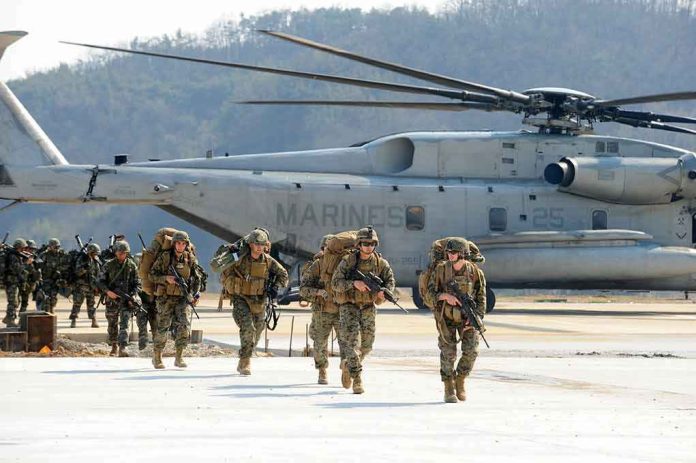
When U.S. Central Command confirmed that Iranian missiles and drones had killed two American service members and left a third missing at a base in Jordan, it crystallized a hard reality of the current U.S.–Iran war: forward-deployed forces at regional hubs like Jordan are now on the front line of a sustained, lethal contest of reach, resolve, and air defense.
Key Points
- CENTCOM has officially confirmed two U.S. service members killed in action and one missing after Iranian ballistic missile and drone strikes on a U.S. base in Jordan.
- The attack wounded four additional Americans, all medically evacuated to Jordanian hospitals and subsequently discharged; others treated for minor injuries have returned to duty.
- This incident is part of a broader pattern of Iranian or Iran-backed attacks on U.S. positions in Jordan and across the Gulf, and marks another step up the escalation ladder in an already volatile war.
- Casualty reporting, attribution, and public evidence remain tightly controlled by CENTCOM and political leaders, leaving gaps that fuel speculation but do not, so far, materially contest the core facts.
What CENTCOM Has Confirmed About the Jordan Attack
The backbone of our understanding comes from U.S. Central Command’s own statement, echoed across major news outlets and international wire services. On July 17, CENTCOM reported that two U.S. service members stationed in Jordan were killed in action while U.S. and partner forces “defended against Iranian ballistic missile and drone attacks.” One additional service member was listed as missing in action, and search and recovery efforts were initiated.
CENTCOM further detailed that four American service members were medically evacuated to Jordanian hospitals. All four were later discharged, while other personnel assessed for minor injuries were returned to duty. In keeping with longstanding casualty protocol, CENTCOM made clear it would withhold the identities of the fallen for at least 24 hours after next-of-kin notification. Independent outlets from CNN to Al Jazeera, Xinhua, Politico, and regional channels carried essentially identical casualty figures and wording, reflecting that they are all working from the same official communique.
Critically, the statement explicitly pinned attribution on Iran: the deaths occurred as CENTCOM forces “defended against Iranian ballistic missile and drone attacks” and “Iranian attacks on Friday.” That language is not hedged; the U.S. military is treating this as a direct Iranian strike, not merely an incident involving Iran-backed militias or plausibly deniable proxies.
Jordan’s Bases and Why They Matter in the U.S.–Iran War
To understand why an attack in Jordan matters so much, you have to look at how the U.S. has structured its posture against Iran. Jordan hosts key air bases used by American forces, including Muwaffaq Salti, which regional analysis identifies as a major hub for U.S. air operations. In the current war, U.S. aircraft and logistics flowing through Jordan have supported strikes on Iranian targets around the Strait of Hormuz, in Iran proper, and in neighboring states.
For Iran, those same bases are both operational threats and political targets. Tehran has repeatedly signaled that any country hosting U.S. forces—Jordan, Bahrain, Kuwait—has placed itself in the line of fire. In June 2026, Iran publicly admitted responsibility for missile and drone attacks on American positions in Bahrain, Kuwait, and Jordan in retaliation for U.S. strikes near Hormuz. Jordanian and external reporting describe repeated barrages of Iranian missiles and drones traversing Jordanian airspace, with local forces intercepting many but not all of them.
Against that backdrop, the July strike that killed two Americans is not an isolated bolt from the blue. It is part of a rhythm: U.S. strikes on Iran, followed by Iranian retaliatory barrages against the regional bases that make those strikes possible. That makes Jordan more than a quiet partner; it is now a contested battlespace.
A Pattern of Attacks and Ambiguity Around Attribution
The Jordan casualties also fit a growing pattern of Iranian or Iran-backed attacks on U.S. bases in the Middle Eastern crisis since 2023. In January 2024, a one-way attack drone hit Tower 22, a small U.S. outpost near Jordan’s border with Syria and Iraq, killing three U.S. soldiers and injuring dozens. An umbrella group, the Islamic Resistance in Iraq, claimed responsibility, while Iran denied any involvement and rejected U.S. accusations as “baseless.”
That incident highlighted a recurring dynamic: the United States traces attacks to Iran or Iranian-backed militias, Iran denies direct responsibility, and the proxy architecture creates layers of deniability. Yet, in the current phase of the war, Iran itself has increasingly stepped out from behind that veil. The Islamic Revolutionary Guard Corps (IRGC) has claimed direct missile and drone attacks on U.S. bases in Jordan, Kuwait, and Bahrain in retaliation for American strikes on Iranian territory and infrastructure.
For example, IRGC communiques and regional reports describe ballistic missile salvos against a U.S. air base at Al‑Azraq, near Al‑Azraq town east of Amman, with Jordanian forces intercepting many of the incoming weapons. Analysts at the Arab Center and other think tanks note that Iran has “attacked US forces at Jordan’s Muwaffaq Salti air base,” integrating Jordan into a triad of targets alongside Bahrain and Kuwait. Over months, that pattern has cumulatively eroded any notion that Jordan is merely a secure rear area.
Casualty Numbers and the Trajectory of the War
The deaths in Jordan carry particular weight because they add to a growing U.S. casualty count in a war that was initially framed as limited and containable. Data from the Defense Casualty Analysis System and CENTCOM statements indicate that, as of mid-July, at least 14 U.S. service members had already died and hundreds had been injured in operations against Iran. Other CENTCOM releases document six U.S. deaths in March alone, tied to Iran’s initial attacks on American positions, including a base in Kuwait struck by Iranian weapons as part of “Operation Epic Fury.”
News organizations synthesizing these releases have placed the Jordan attack within that arc. CBS News, for instance, reported that the Jordan deaths represented the 15th and 16th U.S. fatalities in the current war, and noted prior deaths from an Iranian strike on a base in Kuwait. Forbes likewise stated that “16 service members have died during the war against Iran,” counting the two killed in Jordan as the latest fatalities. In both framings, the Jordan incident is evidence not of an aberration, but of a grinding campaign in which casualty figures are slowly but steadily rising.
For an audience accustomed to thinking of U.S. wars in terms of large-scale deployments, it is important to see how this conflict differs. The U.S. footprint in Jordan and the Gulf is relatively small, but these forces sit under persistent missile and drone threat, operating in an environment where the risk of sudden, concentrated loss of life remains high even when the daily force level is modest.
Evidence Gaps, Disinformation, and Why the Core Facts Still Hold
There are real gaps in what has been made public. CENTCOM has not disclosed the specific base name in Jordan that was hit, nor released satellite imagery or air-defense sensor data showing the exact missile trajectories and impact points. Casualty figures beyond the two killed, one missing, and four evacuated have not been updated in subsequent public statements. Iran, for its part, has not yet issued a detailed statement addressing this particular July 17 strike; earlier in the conflict, it alternated between open claims of responsibility and denials.
Those absences feed speculation. YouTube channels and social accounts have floated higher casualty numbers or described dramatic failures of U.S. Patriot air defenses, often relying on unverified footage or anonymous sourcing. In previous incidents, Iranian state-linked outlets have outright fabricated claims—such as reports of U.S. deaths in Kuwait that CENTCOM later labeled “false,” forcing a public correction. In the same information space, hyperbolic casualty claims and AI-generated missile impact videos coexist with formal military statements, making it harder for lay observers to discern what is real.
Yet, in this case, the core facts are unusually uncontested. No reputable outlet has produced evidence contradicting CENTCOM’s account of two killed, one missing, four seriously wounded and discharged. Multiple independent organizations—CNN, Al Jazeera, Xinhua, Politico, CBS, and others—are all relying on the same official figures. The IRGC’s broader pattern of claiming strikes on Jordanian bases, and Jordan’s own statements about intercepting Iranian missiles, support the attribution to Iran as a matter of context. In other words, while we lack the forensic detail that intelligence agencies possess, the public record still coherently supports CENTCOM’s narrative rather than undermining it.
Jordan’s Security Calculus and Regional Implications
For Jordan itself, these strikes underscore the cost of its long-standing security partnership with the United States. Analysis from regional think tanks points out that Jordan has become more deeply embroiled in the fallout of renewed U.S.–Iran fighting, with debris from intercepted missiles injuring Jordanian civilians and Iranian forces explicitly targeting bases used by U.S. aircraft. The Jordanian Armed Forces have had to publicly reassure citizens while announcing interceptions of dozens of missiles and drones launched from Iran toward Jordanian territory.
Strategically, Jordan sits at a nexus between the Levant and the Gulf. U.S. basing there allows American aircraft and drones to range across Iraq, Syria, the northern Arabian Peninsula, and into Iran. That gives Washington flexibility but also makes Jordan a logical focus of Iranian retaliation when U.S. strikes reach deep into Iranian territory or hit infrastructure near chokepoints like the Strait of Hormuz. Iran’s explicit messaging to Jordanians—warning them to “dismantle American bases”—is designed to create domestic pressure on Amman to reconsider how far it is willing to go in supporting U.S. operations.
The deaths of American personnel on Jordanian soil raise the stakes of that debate. They make tangible, for both Jordanians and Americans, that the war’s front line is no longer confined to the Gulf or to discrete maritime incidents. It now encompasses the deserts and towns of a country that for decades prided itself on being a relatively insulated partner rather than a battlefield.
What Comes Next: Military Posture and Political Choices
Looking ahead, two trajectories bear watching. The first is operational: how the U.S. adjusts its air and missile defenses at exposed bases like those in Jordan. After the 2024 Tower 22 attack, CENTCOM quietly reassessed air-defense needs across the theater, considering changes to sensors, interceptors, and command-and-control structures. The July strike and the deaths it caused will likely prompt another round of hard questions about how well U.S. systems can handle coordinated missile and drone salvos, especially when adversaries learn and adapt from each exchange.
The second trajectory is political. Casualties—especially in small numbers, dispersed over months—do not automatically drive strategy shifts. But they do shape domestic conversations about risk tolerance, war aims, and the balance between deterrence and escalation. Sixteen American service members killed in a conflict framed as limited is not a mass casualty event; it is, however, enough to force policymakers to explain what those lives are being risked and spent for, and whether the current posture in places like Jordan is achieving those goals at an acceptable cost.
For now, the July 17 attack in Jordan stands as a clear datum: Iran is willing and able to strike U.S. troops on the soil of regional partners, and U.S. forces, though defended, are not invulnerable. It is an episode in a longer war, but for the families of the dead and missing—and for the commanders now revisiting their defense plans—it is also a pivot point, where abstract strategy has once again met the concrete human price of implementation.
Two U.S. Service Members Killed, One Missing in Iranian Attack on the Muwaffaq Salti Jordanian Air Base
Two U.S. service members were killed, four were hospitalized, and one remains missing in action following an overnight Iranian ballistic missile and drone attack on the… https://t.co/7iCPNLf1dG pic.twitter.com/GM2Ypb21hH
— SubX.News® (@SubxNews) July 18, 2026
Sources:
redstate.com, centcom.mil, cnn.com, aljazeera.com, war.gov, defenseone.com, iranpress.com, thehill.com, presstv.ir, middleeastmonitor.com, bbc.com, abcnews.go.com, kwsn.com, en.wikipedia.org, reuters.com, arabcenterdc.org, wsj.com, wsls.com, jpost.com, cfr.org, fdd.org, youtube.com