

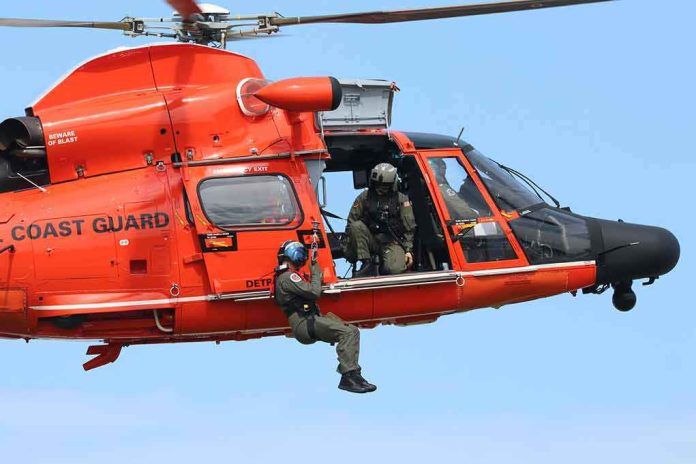
In aviation disasters at sea, the first hard fact is often wreckage: once searchers confirm a debris field, the investigation moves from uncertainty about “if” to disciplined work on “how” and “why.” That is where this case now sits.
At a Glance
- The U.S. Coast Guard located a debris field off Nantucket confirmed to be from a missing Gulfstream G100 medical flight.
- The air ambulance departed Bermuda for Boston with six aboard; contact was lost in the early morning hours.
- Search assets covered well over a thousand square miles; operations continued through the night after debris was found.
- Debris confirmation marks the investigation’s start, not its conclusion on survivorship or cause.
What is established: the aircraft, the route, and the debris field
Search crews with the U.S. Coast Guard reported locating a debris field off the coast of Nantucket and confirmed it was from the missing aircraft, a Gulfstream G100 configured as a medical transport. The flight originated at Bermuda’s L.F. Wade International Airport and was bound for Boston when it disappeared over the Atlantic. Authorities consistently described six people aboard the jet, reflecting its role as an air ambulance transporting a patient with accompanying medical crew and support personnel. These are the central facts; they are uncontested in contemporaneous reporting and Coast Guard statements that anchored the search and rescue effort.
Timing details from aviation authorities align with an overnight loss of contact. The aircraft departed Bermuda late at night and, roughly one to two hours into the flight, controllers reported losing communications and radar tracking in the vicinity of Nantucket Island. The Coast Guard received notice and issued search-and-rescue alerts during the 1:00–2:00 a.m. window, then surged aircraft and vessels to the presumptive last-known position and projected drift area. That operational picture—debris confirmation and sustained night operations—fits the pattern of a major offshore response.
How the search works at sea: sensors, grids, and drift
Maritime aviation searches start with geometry and probability. When a jet vanishes from radar and radio, rescuers define a datum—last known position, altitude, track, and speed—then model how wind and currents could advect floating debris and life rafts. Aircraft and cutters fly and steam methodical search patterns, expanding or shifting grids as evidence emerges. In this case, officials described a search area on the order of 1,600 square miles, swept by helicopters, fixed-wing aircraft, and fast-response vessels. Such scale is typical when the last credible latitude-longitude places a casualty near offshore winds and complex currents; wide-area coverage is the only way to quickly convert uncertainty into finds.
Once debris is sighted, crews document, mark, and when feasible recover representative items—insulation, interior panels, seat cushions, lightweight composite fragments—since buoyant materials tend to surface quickly while heavier components sink or drift differently. Confirmation that debris belongs to the missing airframe can be established visually and by part numbers, livery, or unique interior fitments. With that confirmation in hand, the mission bifurcates: continue survivor search while initiating preservation of evidence for the accident investigation.
The aircraft and its mission: what a Gulfstream G100 air ambulance implies
The Gulfstream G100 is a mid-size business jet often tasked for medical transport because of its speed, range, and cabin configuration flexibility. Air ambulance operations introduce additional layers of coordination: medical teams and equipment onboard, time-sensitive patient considerations, and dispatch procedures that must mesh with weather, alternates, and crew duty limits. A six-person manifest for such a mission—four crew plus two passengers (often a patient and a family member)—is common, and it matches public descriptions of this flight. The route from Bermuda to Boston is well within the G100’s performance envelope; the operative risks on a night oceanic leg are meteorology, systems reliability, and the unforgiving nature of darkness over water where visual cues are minimal.
Several outlets relayed that controllers received an emergency declaration before contact ceased. In modern cockpits, an electrical problem can range from a single-bus fault to cascading failures that affect avionics, radios, and flight instruments; the pilot’s actions then revolve around conserving remaining systems, stabilizing the aircraft by reference to reliable instruments, and diverting to the nearest suitable runway. If weather in the terminal area is marginal and multiple instruments are suspect, the workload increases sharply. Those are generalized dynamics, not conclusions about this accident—but they explain why an emergency call, night IMC, and a rapid loss of contact are taken so seriously by rescuers and investigators.
From debris to cause: the investigative sequence ahead
Confirming wreckage at sea is the investigative opening move. The National Transportation Safety Board assumes control of the safety investigation for U.S.-jurisdiction accidents, coordinating with the FAA and, where appropriate, with foreign authorities tied to the operator, registry, or equipment manufacturers. The NTSB’s process is deliberately staged: early factual updates, then a preliminary report summarizing verified sequence data, then thorough wreckage documentation and systems analysis leading to a final report with probable cause and contributing factors. The Board also controls wreckage access to protect evidentiary integrity.
In prior cases—air ambulances and business jets alike—the distribution of debris, deformation signatures on recovered parts, and flight-path reconstruction from radar and ADS-B form the spine of the causal analysis. Investigators map debris fields to infer impact angle or in-flight breakup, correlate instrument readouts and maintenance records with pilot reports, and overlay weather data to test hypotheses about icing, turbulence, or convective activity. Sometimes the path is straightforward; more often, it is cumulative and methodical, with each recovered component narrowing the plausible set of failure modes.
Why debris confirmation matters—and what it does not say
The Coast Guard’s confirmation that the debris belongs to the missing Gulfstream does two vital things. First, it localizes the event: investigators can now anchor their search grids, plan subsea survey work if warranted, and brief families with specificity about where the aircraft came to grief. Second, it separates speculation from the physical record: part numbers, structural fractures, and instrument states are the raw materials of truth in aviation accidents. What debris confirmation does not do is answer questions about survivorship or cause. Those answers require time and disciplined evidence work; treating the first wreckage report as final explanation is a public habit investigators routinely have to correct.
Meanwhile, search operations continue because time matters for rescue, and currents rapidly disperse light debris. Night operations after a debris find are common and, when feasible, prudent; they expand the window in which life-saving is still plausible. That is why the Coast Guard maintained aircraft and cutters on scene after confirming the field—an operational decision aligned with established search-and-rescue doctrine.
Debris found near Nantucket is believed to be from a missing emergency medical plane that lost contact over the Atlantic according to the US Coast Guard.
The flight from Bermuda to Boston carried four Canadians and two Bermudians. — via Al Jazeera, PBS NewsHour pic.twitter.com/Lp0Rgozo9D— United Humans (@unitedhumans) October 4, 2026
The human and institutional stakes
Aeromedical flights operate at the intersection of clinical urgency and aeronautical safety. Crews are trained to resist the pressure to “launch at any cost,” yet the very mission selects for flying in the margins: off-hours departures, dynamic weather, and unfamiliar alternates. When an accident interrupts that chain of care, the toll extends beyond the six souls on board to families, care teams, and communities on both ends of the route. That broader canvas explains the swift, resource-intensive search—the imperative is moral as well as procedural.
Sources:
abcnews.com, bbc.com, nytimes.com, cnn.com, apnews.com, cbsnews.com, boston.com, abc17news.com