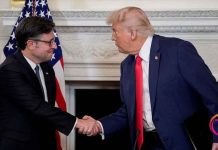

Adam Kinzinger is still warning America about “tyranny” under President Trump—while positioning himself as a made-for-media ex-Republican voice for the left.
Story Snapshot
- Kinzinger, a former GOP congressman and Jan. 6 select committee member, remains a high-profile Trump critic in 2026.
- He testified around the Jan. 6 anniversary and argued Trump allies are “rewriting” what happened, while criticizing GOP leaders over accountability disputes.
- He continues a post-Congress media push that includes promoting a documentary and doing long-form interviews about the GOP’s direction.
- Available reporting does not document personal financial “cashing in,” but it does confirm ongoing media activity built around his anti-Trump message.
Kinzinger’s 2026 message: Trump still equals “threat”
Adam Kinzinger’s central claim entering 2026 is that the political danger he warned about did not end with the 2024 election outcome. Reporting on his Jan. 6 anniversary appearance describes Kinzinger emphasizing that narratives about the Capitol riot are being reshaped and that accountability is being avoided. He also criticized Republican leadership in Congress in that context, framing the dispute as a test of whether institutions will treat Jan. 6 as a defining event.
Kinzinger’s testimony appeared alongside legal-constitutional framing from Illinois Attorney General Kwame Raoul, who underscored limits on executive power and referenced founding-era arguments. That pairing matters because it places Kinzinger’s warnings inside a broader “democracy protection” storyline favored by many progressive outlets and activists. For conservative readers, the key is separating what is documented—his repeated public warnings—from what is not yet established in the public record about specific unlawful actions.
From Republican congressman to DNC stage and beyond
Kinzinger’s break with the party is not new. He served in Congress from 2011 to 2023 and became one of the most visible Republican critics of Trump after the 2020 election period. After Jan. 6, he voted to impeach Trump and joined the House select committee investigating the attack, a move that intensified backlash among GOP voters and helped drive his exit from Congress amid hostile primary terrain.
By 2024, Kinzinger’s posture had moved from internal critic to open ally of Democrats on the biggest question—stopping Trump. ABC News reported he endorsed the Democratic ticket and appeared at the Democratic National Convention, telling viewers the GOP had departed from what he considered “conservative.” That moment cemented his role as a familiar bipartisan validator for Democrats: a former Republican willing to publicly argue that the party’s Trump era is an emergency rather than a political realignment.
Media projects feed the same narrative—facts versus inference
In early 2026 coverage, Kinzinger used long-form interviews to argue the GOP has changed fundamentally and to predict “Trumpism” will burn out after Trump’s term. A widely circulated interview described him positioning himself as closer to Democrats on certain priorities, including foreign policy toward Ukraine, and recounting personal security concerns around Jan. 6, including that he carried a gun that day. Those details reinforce his chosen identity: a warning voice from inside the old GOP.
The research provided also references a documentary, “The Last Republican,” and a podcast appearance in which Kinzinger discussed politics and the 2026 midterms. That footprint is real and verifiable as activity, but the sharper accusation—“cashing in” financially—doesn’t appear to be proven by the cited reporting alone. Conservatives can reasonably critique the incentive structure of modern politics and media, but the available sources mainly establish visibility and messaging, not income or improper profiteering.
Why conservatives should focus on constitutional specifics, not slogans
Kinzinger’s public case leans heavily on broad warnings—authoritarianism, threats to democracy, fears of military misuse—rather than a narrow list of adjudicated constitutional violations. That difference is important for Americans who care about due process and limited government. When political figures warn of “tyranny,” the most responsible standard is demanding specific actions, clear legal theories, and verifiable evidence—not simply dramatic rhetoric that can be repackaged into endless news cycles.
No Kings? More Like No Dignity – Kinzinger Cashes In on Imaginary Tyranny While Real Conservatives Laugh https://t.co/ZzvwOba4pL
— Fearless45 (@Fearless45Trump) February 17, 2026
At the same time, Kinzinger’s claims highlight a live political fight: which institutions set the narrative about Jan. 6, and how that narrative is used to justify future policy and power. With Trump back in the White House and voters having made their choice in 2024, the unresolved tension is obvious: Kinzinger’s warnings persist even after electoral validation for Trump. That makes his campaign less about new facts and more about persuading Americans to reinterpret the last decade through a single lens.
Sources:
Former Republican Rep. Adam Kinzinger set to speak at DNC, endorse Harris
Kinzinger and Raoul emphasize importance of the Jan. 6 insurrection anniversary
Kinzinger: ‘Changed’ GOP? I’m probably to the left of Republicans now