

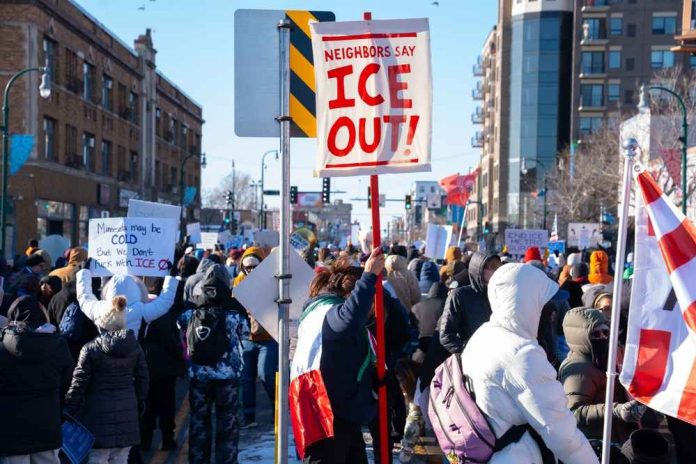
Federal prosecutors say Antifa-linked organizers plotted forceful attacks on immigration agents in Minneapolis—raising hard questions about union-space involvement and the rule of law.
Story Snapshot
- Fifteen defendants face federal conspiracy and violence-related charges tied to anti-immigration enforcement actions in Minneapolis [2].
- Prosecutors say two Antifa-linked groups coordinated to obstruct lawful operations and target officers, not just protest [2].
- The case cites specific January 23 and March 1 actions and a mix of alleged “hard” and “soft” tactics [2].
- Reports mention gatherings in labor-linked spaces, but the record here does not name a union that directed violence [1].
Federal Charges Tie Activists to Coordinated Anti-Enforcement Plot
Federal prosecutors in Minnesota unsealed an indictment charging fifteen people with conspiracy to impede or injure federal officers, plus counts for solicitation of violence, interstate threats, interstate stalking, assault on a federal officer, and destruction of government property [2]. Officials said the defendants joined an agreement to interfere with immigration enforcement by force. Prosecutors identified members and associates of Direct Action Minnesota and described links to two Antifa-aligned groups that “violently oppose immigration law enforcement” [2]. They stressed charges target conduct, not speech, during the press briefing [2].
Press coverage says the indictment focuses on actions on January 23 and March 1, and describes activists using “hard” and “soft” tactics against officers and facilities [2]. Prosecutors also said the case followed a months-long investigation by federal agents into efforts to block operations and attack personnel [2]. Independent outlets reported the same basic charges and timeline, confirming this was not a single-source claim. Newsrooms including public media and national wires repeated the core allegations tied to anti-enforcement organizing in Minneapolis [7].
What We Know—and What We Do Not About Any Union Role
Several reports say the government referenced labor-linked spaces and worker assemblies as touchpoints in the network. However, the record provided here does not show the actual indictment text or exhibits. The sources do not identify a specific labor union that planned, ordered, or coordinated violent acts, leaving that part unconfirmed in the public materials at hand [1]. This gap matters. If prosecutors have messages, minutes, or sign-in records tying union officials to illegal planning, that proof is not visible in the supplied reporting [1].
Some coverage pushes back on the Antifa framing. One outlet says prosecutors accused the named organizations of Antifa links “without evidence” in the materials it reviewed, highlighting a key dispute over labels versus proof [4]. That claim underscores why the full indictment and supporting exhibits need daylight. The government says the groups coordinated to obstruct and injure officers; skeptics say the case blurs political identity with criminal conduct. Until the filings are public, that argument will continue [4].
Law, Order, and the Line Between Protest and Violence
The law draws a bright line. Peaceful protest is protected speech. Conspiracy, stalking, threats, assault, and property destruction are crimes, no matter the cause. Prosecutors state the defendants crossed that line by agreeing to use force to block immigration enforcement [2]. Reports say agents tied planning to encrypted chats and organized blockades. Those specific digital and timeline claims, if supported by evidence, will weigh heavily in court. The defense will likely argue observers and protesters are being overcharged for dissent [2].
Conservatives see a bigger pattern. Political networks try to nullify federal law on the street, then claim immunity under the First Amendment when tactics turn violent. That approach puts officers, bystanders, and property at risk. It also erodes equal justice for legal immigrants who followed the rules. The Trump administration’s Justice Department is right to bring conspiracy and assault cases when the facts support them. That protects lawful authority, community safety, and the Constitution’s order [2][7].
Accountability Next Steps and Questions for Transparency
Congress and the public should press for the complete indictment, exhibits, and any unsealed communications that show who planned what, when, and how. Clear evidence can confirm whether labor spaces were simply venues, hubs for mutual aid, or places where unlawful plans were made. Specifics also matter for the Antifa label: was it ideological overlap or operational membership? A clean record helps jurors judge facts, not spin. Precision will protect protest rights while punishing violence [1][2].
Bottom Line for Readers
Prosecutors allege a coordinated conspiracy to attack immigration enforcement in Minneapolis. The charges are serious, detailed, and supported by a stated investigative record. The Antifa and union-space angles drive strong reactions, but the available public materials do not yet show a named union directing violence. Both defenders of the accused and defenders of law and order should want the same thing now: full, public evidence and a swift, fair trial that makes the facts clear [1][2][7].
Sources:
[1] Web – Feds Reveal Violent Antifa Conspirators Coordinated With a Major Labor …
[2] Web – Minnesota Unionists Among Those Targeted in Federal Indictments …
[4] YouTube – Feds Charge 15 Tied to Antifa With Interfering With ICE
[7] Web – Feds charge 15 Minnesotans with conspiracy to impede federal …