

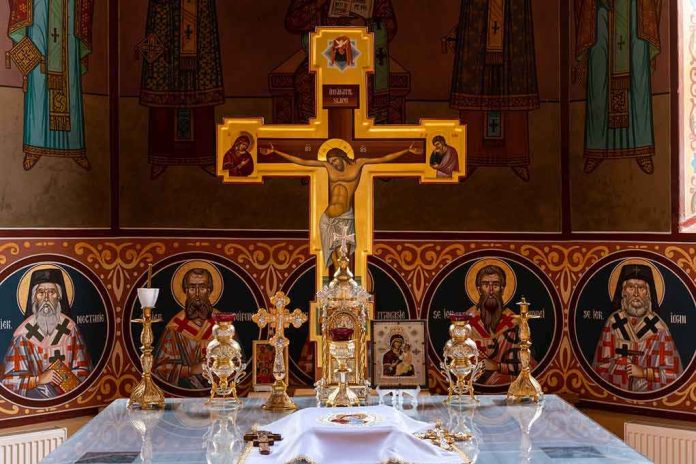
When gunmen turned a funeral into a killing ground at a Greek Orthodox church in southern Jordan, the shock was not only the bloodshed but the setting: a country where attacks on religious sites are rare, and where communities in places like Karak have long lived side by side without such scenes of mass violence.
At a Glance
- Gunmen opened fire during a funeral at a Greek Orthodox church in Jordan’s Karak governorate, killing seven people, according to authorities.
- Dozens were wounded; contemporaneous reporting varied on the injury count as hospitals triaged victims across the region.
- Officials described the attackers as unknown assailants and launched a nationwide investigation.
- The site and method fit a pattern: rare but consequential assaults on religious venues in otherwise stable states.
What Happened: A Funeral, Then Gunfire
Authorities in Jordan reported that gunmen opened fire during a funeral at a Greek Orthodox church in Karak, roughly 180 kilometers south of Amman, killing seven people. Visual material aired on state television showed multiple armed individuals approaching and firing at the church compound before fleeing, consistent with an attack planned to exploit the vulnerability of a large, stationary crowd gathered in mourning. The core facts—an assault on a church funeral and seven deaths—were carried across major outlets the same day, underscoring the gravity of the event in a country unaccustomed to such scenes.
Initial casualty counts for the injured varied as ambulances cycled victims to different facilities and officials consolidated reports. One official tally cited about 40 wounded, while others reported figures in the 20s or 30s as hospital admissions were updated over the course of the day. Discrepancies of this sort are common in the early hours of mass-casualty incidents; the fatality count of seven held steady across reporting streams, even as the number of injured moved with the flow of clinical data.
Where It Fits: A Rare Strike at a Religious Site in a Stable State
Jordan’s security architecture—professional intelligence services, tight coordination between police and gendarmerie, and a social compact that frowns on sectarian incitement—has historically insulated the kingdom from the frequency of attacks seen elsewhere in the region. That is why the Karak shooting stands out. Attacks on churches or Christian gatherings in Jordan are highly uncommon, though not without precedent: authorities have previously disrupted plots against Christian venues, and Karak itself was the scene of a deadly 2016 militant attack that targeted security forces and civilians before being suppressed. The contrast is clear: the norm is coexistence and quiet; the outlier is targeted violence.
The venue matters. Religious compounds are soft targets by design—intended for openness, not fortification. A funeral amplifies that vulnerability: predictable time and place, concentrated attendance, and divided attention. In security planning, such gatherings are classic “pattern-of-life” opportunities for adversaries who want maximum casualties with minimal planning. The apparent use of multiple shooters, including at least one carrying a semiautomatic rifle as seen on broadcast footage, is consistent with that calculus—simple weapons, short engagement, rapid egress.
Mechanics of the Attack: How Such Operations Are Mounted
Church compounds in Jordan typically rely on community vigilance and, on higher-risk dates, a visible police presence or discrete plainclothes coverage. An adversary seeking to penetrate that daily routine looks for liminal moments—when mourners arrive, process, or disperse. The reported sequence in Karak resembles a “walk-up” assault: attackers arrive on foot or exit a nearby vehicle, initiate fire from close range to generate panic, and withdraw before responding units converge. The goal is speed over complexity; firearms, not explosives; surprise, not siege. The state-television images described in coverage—multiple assailants, mixed weapon types—fit that short-duration profile.
Why not more sophisticated means? Because firearms attacks minimize pre-incident signatures. Procuring rifles and pistols through criminal channels draws less attention than constructing explosives or coordinating a large cell. In a state like Jordan, where intelligence services are practiced at tracking extremist networks, the lower the planning footprint, the higher the chance of reaching the target window. That is also why early investigations focus on weapon provenance, travel routes, and communications dumps—where the operational security is likeliest to have frayed.
Names, Numbers, and the Early-Report Problem
Readers will have noticed conflicting injury totals across the first wave of coverage. That variance reflects two dynamics. First, triage and transfer: victims split across multiple hospitals, with initial counts based on admissions rather than consolidated registries. Second, definitional drift: some outlets count only hospitalized patients; others include those treated and discharged. In Karak, the seven-dead figure stabilized quickly across outlets, while injuries ranged from the high 20s to around 40 as numbers settled. In mass-casualty reporting, fatalities harden fastest; nonfatal injuries lag until hospitals and ministries reconcile lists.
Location labels also traveled under different transliterations—Karak governorate; Hamoud/Hmoud village; St. George’s Greek Orthodox Church—describing the same geography at different levels of specificity. Such variation, common in Arabic-to-English place names, can make parallel reports look conflicting when they are not. The more precise anchor—the Karak governorate and the Greek Orthodox church context—linked the strands back together in authoritative accounts.
What We Know—and What It Means for Jordanian Security
Officials said the perpetrators were unknown assailants and announced a full investigation. That phrasing is procedural rather than evasive: in the first days after a fast-moving assault, the intelligence priority is to identify the cell, secure the weapons supply line, and determine whether the attack was a one-off criminal strike, a sectarian crime, or militant violence with ideological aims. Regardless of motive, the operational lesson for Jordan is the same: sporadic, small-footprint attacks on soft targets are the hardest to prevent, even in a capable security state.
For Christian communities in Jordan—about two to three percent of the population, with a historic presence in Karak—the incident will prompt a reexamination of routine security at high-attendance rites: funerals, feast days, holiday vigils. Expect adjustments that balance access with deterrence: controlled-entry courtyards during large services, closer coordination with local police, and community patrols trained to spot pre-incident surveillance. For authorities, the near-term playbook is familiar: surge visible policing around churches, run down weapons traces, and communicate clearly to prevent rumor from filling the gap between an attack and arrests.
7 killed, 34 injured in funeral shooting inside church in S. Jordan https://t.co/FBo2NVIgSA
— Daily Finland (@DailyFinland) October 23, 2026
The Larger Frame: Rare Events, Outsized Consequences
In relatively stable states, a single attack on a religious site can do disproportionate social and political damage—less because it signals systemic collapse than because it strikes symbols of common life. The Karak shooting belongs in that category. It will not redefine Jordan’s security posture overnight, but it will harden thinking about soft-target protection and emergency response at communal gatherings. The right lesson is the disciplined one: protect what is vulnerable without treating neighbors as suspects. The country’s history of interfaith coexistence, particularly in the south, is an asset; after an attack like this, it is also a shield.
Sources:
youtube.com, apnews.com, bbc.com, cp24.com, twincities.com, edition.cnn.com