

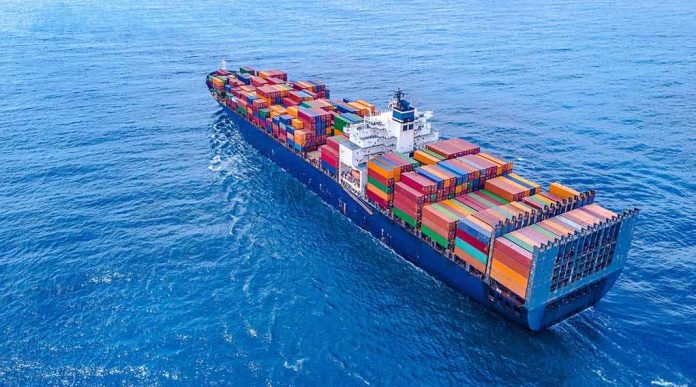
Blockades live or die on clarity: defined rules, credible force to enforce them, and legal footing sturdy enough to withstand scrutiny from neutrals whose ships, insurance markets, and diplomacy ultimately determine whether “effective control” exists at sea.
The Short Version
- U.S. Central Command extended enforcement to ships that receive cargo by ship-to-ship transfer from vessels loaded at Iranian ports, treating those transfers as blockade evasion.
- Washington frames the expansion as targeting identifiable sanctions evasion, not ordinary neutral traffic through the Gulf and Strait of Hormuz.
- The policy cites the law-of-naval-warfare model of blockade; its legality turns on classic requirements such as declaration, notification, effectiveness, impartiality, and civilian protection.
- U.S. force posture—carriers and destroyers—indicates an operational, not merely declaratory, blockade, but effectiveness and legal predicates remain only partially documented publicly.
What changed: from port entries to ship-to-ship transfers
CENTCOM’s November advisory widened the aperture of enforcement: any ship that receives cargo via a ship-to-ship (STS) transfer from a vessel subject to the blockade and carrying cargo loaded at an Iranian port “may be considered to be evading the blockade.” In practical terms, that moves the locus of interdiction from harbor chokepoints to the dispersed gray zones where the shadow fleet masks origin with mid-sea handoffs. The advisory states such vessels may be stopped, boarded, diverted, captured, or ordered back to an Iranian port of origin—classic blockade verbs that matter because they signal a willingness to use force to disrupt transshipment chains rather than simply naming bad actors on paper.
That focus is not theoretical. Shadow-fleet tactics—AIS dark activity, falsified paperwork, layered STS chains—have become the modus operandi for Iranian petroleum. U.S. sanctions guidance and enforcement actions have repeatedly highlighted STS clusters (for example, Singapore’s eastern outside port limits) as hubs for laundering origin and hull identity. The expanded rule aligns enforcement with that operational reality.
Target and scope: sanctions evasion, not all neutral shipping
The enforcement guidance frames its target narrowly: vessels tied to Iranian loading points via STS transfers. It does not purport to halt all Gulf or Strait of Hormuz transits, and reporting describes the formal blockade line as focused on vessels attempting to enter or leave Iranian ports. That distinction—between neutral commerce and evasion-linked shipping—matters for legal and diplomatic reasons. Blockade law tolerates interference with neutral vessels only to the extent necessary to maintain the blockade’s effectiveness and prevent carriage of contraband; indiscriminate disruption risks rendering a blockade unlawful and alienating the very flag states whose acquiescence sustains maritime order.
Still, even a tailored rule invites friction. By allowing STS lineage alone to support a presumption of evasion, the advisory creates an evidentiary shortcut. It is operationally sensible—STS chains are how sanctioned cargo moves—but it raises predictable questions from neutrals about proof standards, inspection protocols, and remedies when innocent cargo is swept up. The public record to date does not detail boarding thresholds, chain-of-custody rules, or expedited review for wrongly diverted shipments.
The legal frame: classic blockade law, modern questions
The United States appears to be situating the policy in the classical law-of-naval-warfare template, reflected in the San Remo Manual’s conditions: declare and notify the blockade, make it effective, apply it impartially, and safeguard essential civilian supplies. That framework has governed great-power practice since the age of sail, adapted through two world wars and post–U.N. Charter practice. It draws a bright line: a blockade is a belligerent measure in armed conflict, not simply a peacetime adjunct to sanctions. If those predicates are met, belligerents may stop, search, and capture blockade runners on the high seas; if not, peacetime law reasserts the flag state’s exclusive jurisdiction over its vessels.
Here, the public record is mixed. The advisory signals an attempt to comply with form—notification and a carve-out for neutral ports—but it does not, in its public-facing descriptions, lay out the full legal predicate: the specific armed-conflict classification, the self-defense theory, or any Security Council authority that would move the operation squarely under the law of armed conflict rather than ordinary peacetime navigation rules. Legal analysts have therefore flagged the gap as a vulnerability in the policy’s external legitimacy, even if more detailed memoranda exist but remain classified.
Force and feasibility: making “effective” real
Effectiveness is not rhetorical; it is the legal and practical hinge. A blockade must be maintained by a force sufficient to prevent ingress and egress to the enemy coast. On this score, U.S. deployments are not symbolic. Reporting describes a third carrier strike group joining the theater and a flotilla of destroyers assigned to enforcement tasks—numbers consistent with sustained maritime interdiction, air coverage, and the logistics tail a blockade requires. Against a coastal state with limited blue-water escort capability, that is a credible force posture.
Effectiveness, however, is measured by outcome, not order of battle. The public evidence trail has yet to produce interdiction statistics, diversion rates, or verified reductions in illicit flows that would demonstrate operational success over time. Without that data, observers must infer from posture and anecdote rather than a ledger of captured or turned-back cargoes. In the blockade business, absence of proof is not proof of absence—but it is a communications handicap in the court of neutral opinion.
Competing claims: sovereignty, humanitarian risk, and the Caspian escape valve
Tehran’s response is categorical: it characterizes the blockade and associated attacks on Iranian vessels as violations of Article 2(4) of the U.N. Charter—aggression and collective punishment that threaten international peace and maritime security. Iranian statements warn that depriving civilians of food, medicine, or other essentials through interference would constitute war crimes. These are legally weighty accusations; they land with more force if evidence emerges of delays or diversions of protected cargo, because blockade law carves out humanitarian exemptions by design.
A second line of dispute concerns geography and reach. Commentators have emphasized that while U.S. naval power can police the Gulf, it cannot sail into the Caspian Sea; the 2018 Aktau Convention bars non-littoral militaries, and the sea is landlocked. That makes the Caspian an evasion corridor for small, often military-relevant cargo moving between Russia and Iran, even as southern oil flows face greater pressure. The U.S. has stood up Task Force Iron Gate to address that network, but a desk-driven sanctions task force is not a hull in the water; its success will depend on diplomacy with littoral states and financial interdiction rather than boarding parties.
I don't believe they're seriously considering such a move.
The Iranians are looking to permanently end the war, lift some of the sanctions, end the blockade, and release some of their funds the U. S. has.
Harming our President would bring exactly the opposite of that.
— Paul Holmes (@PaulHol4635828) November 14, 2026
Where the real tests lie: documentation, discipline, and neutrality
The architecture of a lawful and sustainable blockade is procedural as much as kinetic. Four disciplines will decide whether this expansion proves durable. First, legal transparency: publishing the formal U.S. theory of authority—armed conflict classification, self-defense analysis, and how San Remo conditions are met—would undercut claims of illegality and reassure partners wary of precedents on the high seas. Second, targeting rigor: documenting how STS-based inferences are operationalized—boarding thresholds, evidence standards, and quick-release mechanisms for neutral cargo—would reduce friction with insurers and flag states.
Third, metrics: credible interdiction data—names, IMOs, manifests, AIS histories, and outcomes—is the currency that proves effectiveness to skeptical audiences without disclosing sensitive intelligence. Fourth, humanitarian safeguards: transparent carve-outs and audited inspection timelines for food and medicine are both a legal requirement and the surest way to blunt the narrative of collective punishment, which gains traction with a single well-documented mistake.
Why this matters beyond Iran
The United States is not just enforcing a sanctions regime; it is shaping state practice about how economic warfare migrates onto the world’s sea lanes. If a major power can characterize sanctions evasion as blockade running and back that claim with carriers and rules, other powers will study the model—in the Black Sea, the South China Sea, and chokepoints from Bab el-Mandeb to the Danish Straits. That is why formality, restraint, and proof of adherence to the law of blockade are not niceties. They are the price of preserving a maritime order that neutrals still recognize as legitimate, even when great powers flex.
Sources:
news.usni.org, opiniojuris.org, english.aawsat.com, news-gazette.com, en.hathalyoum.net, abcnews.com, lawfaremedia.org, en.mfa.ir, globalsecurity.org, gcaptain.com, cbsnews.com, ofac.treasury.gov, state.gov, academic.oup.com