

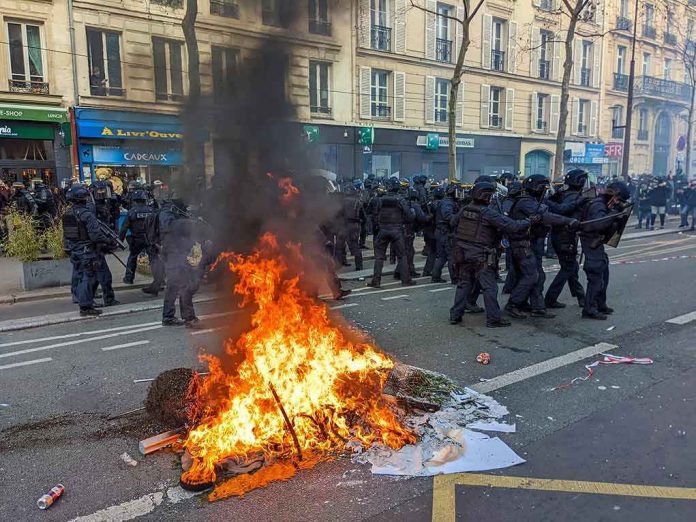
When mass protest collides with opportunistic violence, the public conversation fixates on flames and shattered glass; in France, recent nationwide demonstrations produced both a large, overwhelmingly peaceful turnout and a concurrent wave of looting, arson, and assaults on public buildings that authorities and reporters documented across multiple cities.
At a Glance
- Demonstrations over living costs and public services coincided with widespread incidents of looting, arson, and vandalism across French cities, not just Paris.
- Authorities made over a thousand arrests in a single day of marches counted in the hundreds of thousands, and nearly 2,400 across the broader unrest period, underscoring the scale of disorder within the larger movement.
- Limoges’ 143-year-old town hall was devastated by fire; local officials described a premeditated attack while evacuations were underway.
- France’s protest tradition routinely mixes large peaceful crowds with a smaller violent contingent; the current episode follows that historical pattern.
What happened: large protests accompanied by organized and opportunistic violence
France’s latest wave of demonstrations featured two realities at once. On the one hand, hundreds of thousands of people marched over the cost of living and strains in public services. On the other, police and municipal officials across the country reported fires set in streets and buildings, smashed storefronts, and waves of looting and attempted looting. Coverage from national and international outlets described clashes with law enforcement, vandalism directed at city halls and schools, and coordinated break-ins by masked groups using the demonstration footprint as cover. The Interior Ministry’s own characterization—confrontations, shop attacks, and damage to public buildings—matches the on-the-ground reporting rather than contradicting it.
Arrests scale this picture. On a day when authorities estimated roughly 550,000 participants nationally, police made at least 1,200 arrests linked to the unrest. When the broader period is tallied, nearly 2,400 people were arrested in connection with riots, looting, and arson, according to figures cited by Deutsche Welle from French authorities. Arrest is not conviction; it does, however, quantify the extent of criminal disorder that accompanied the marches and helps anchor the assessment beyond imagery and anecdotes.
Beyond Paris: a nationwide pattern of damage
This was not a capital-only phenomenon. Reports of vandalized public buildings, looted businesses, and street fires came from multiple prefectures. Limoges, a city of roughly 130,000 people in west-central France, became the most emblematic case when its town hall—a 19th-century landmark—was set ablaze. The mayor, Guillaume Guérin, said there was a clear, premeditated intent to burn down the building while people were still inside; evacuations proceeded under the threat of the fire spreading, and the regional prefect later said the structure was largely lost, with its roof collapsed and two-thirds of its exterior destroyed. In a country accustomed to forceful protest, incinerating a city hall during civic unrest is a high-water mark in symbolic and material terms.
Officials and reporters also documented assaults on other municipal sites and attempts to force entry into shops in provincial cities. The geographic spread matters: it tells us this was not a localized riot but a traveling repertoire of tactics—street fires, volleys of projectiles at police lines, smash-and-grab retail attacks—surfacing wherever demonstrations created anonymity and distraction. The same cycle has played out before in France: a legitimate mass grievance draws out large crowds; a smaller subset uses the moment to attack property and, at times, public institutions.
How France got here: a protest tradition that contains multitudes
To understand the coexistence of large peaceful marches with conspicuous violence, place this episode within France’s contemporary protest lineage. The Yellow Vest crisis of 2018–2019 combined sprawling, decentralized mobilization with some of the most intense protest violence the country had seen since 1968. Scholars and policing researchers note that at the peaks of those demonstrations, damage ran high while leadership remained diffuse and claims heterogeneous—fuel taxes, wages, services, and representation all in the mix. What matters for present purposes is the base-rate lesson: large French protest movements often include a minority willing to deploy arson, property destruction, and physical confrontation without that minority defining the entire movement.
This analytical frame helps reconcile the arrest numbers with the crowd counts. It also clarifies why authorities can report dozens or hundreds of serious incidents on a day when most participants marched peacefully. That duality is not contradiction; it is the historically normal structure of contentious politics in France. It also helps explain why organizers frequently denounce violence even as it occurs on the margins of the events they called, and why police and prefects talk bluntly about “violence and looting” while simultaneously acknowledging the size of the broader protests.
What the numbers do and do not tell us
Arrest totals are strong signals of disorder but imperfect indicators of culpability distribution. The core facts are not in doubt: law enforcement detained more than a thousand people in a single day of mass marches and almost 2,400 across the period of heightened unrest; reporters documented numerous incidents of arson, looting, and vandalism; and major public property, including Limoges’ town hall, suffered catastrophic damage. Those figures and events establish that violent and destructive activity was a material feature of the protests. What they cannot do on their own is assign a percentage of the whole crowd to those acts or adjudicate motives across all incidents. French judicial processes will sort individual responsibility; the public-policy analysis rests on the pattern: a minority leveraged the demonstrations to commit crimes on a national scale.
Attribution claims about who orchestrated violence—immigrant groups, foreign actors, or specific parties—are common in polarized debate, but the reporting at hand offers no evidentiary foundation for such broad conclusions. Officials have blamed “ultra-left” elements for instigating vandalism at points, while others pointed to masked groups mingling with students; in the absence of prosecutorial records and completed investigations, the prudent reading remains confined to what the arrests and incident reports substantiate: opportunistic looting, coordinated attacks on certain public buildings, and sustained clashes with police alongside mass demonstrations.
The current damage from the French protests is 1.2 billion Euros.
Massive protests against the rising cost of living across France have now escalated into a series of violent riots. As historical buildings, which even survived two World Wars, fall victim to flames, the…
— Gossip Lanka News (@gossiplanka) October 21, 2026
The Limoges inflection point: symbolism and consequence
Burning a town hall during civic unrest crosses a threshold from random property damage to an attack on a civic symbol. Town halls in France are literal and figurative centers of public life: they house records, public meeting spaces, civil services, and a visible emblem of the Republic in every commune. The Mayor of Limoges’ account—emphasizing premeditation while evacuations were underway—captures why this incident galvanized national attention: it suggested intent not just to pilfer or to damage but to demolish a seat of local democracy at a moment of maximal visibility. Such acts intensify political and policing responses, harden public opinion against violent tactics, and risk overshadowing the grievances that brought the larger crowds into the streets in the first place.
What it means going forward
The immediate policy implications are predictable: more robust policing of protest perimeters, targeted surveillance of known violent networks, and pressure on organizers to improve stewarding and route management. Expect, too, parliamentary and ministerial reviews that seek to separate constitutionally protected assembly from criminal opportunism—especially where attacks on civic buildings are concerned. Historically, French authorities alternate between accommodation of protest claims and muscular order maintenance; episodes like Limoges nudge that dial toward the latter.
The political implication is subtler. When peaceful majorities and violent minorities share the same streets, narrative control becomes a second front. Citizens can handle complexity: they can register both that most demonstrators marched peacefully and that looting and arson were serious and widespread. Policy that reflects that complexity—protecting assembly while preventing and punishing violence—will be more durable than rhetoric that collapses one reality into the other. In this episode, the record supports both halves of the truth: a vast protest movement, and within it, a notable pattern of looting, arson, and attacks on public property documented by authorities and the press.
Sources:
reason.com, dw.com, bbc.co.uk, cnbc.com, france24.com