

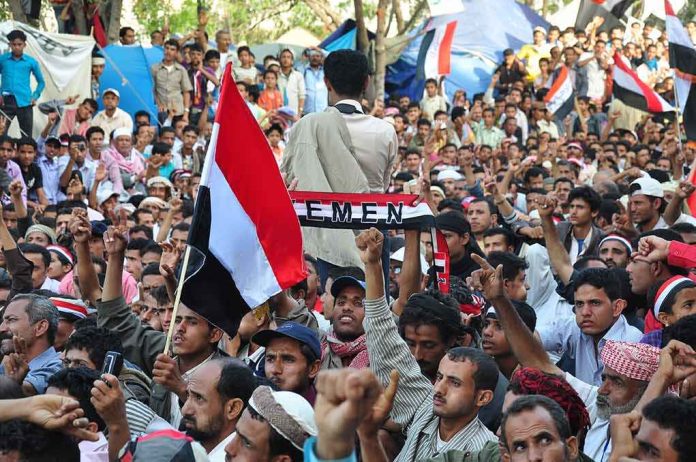
When a wartime leader moves from the language of preparation to the language of action, he is not just resetting tempo; he is redefining the state’s theory of control. That is what Rashad al-Alimi did in a televised address announcing Yemeni government military operations to retake Houthi-held territory and “extend the authority of the state and its institutions across the entire national territory.”
The Short Version
- Yemen’s internationally recognized leadership launched a campaign to reclaim areas held by the Iran-aligned Houthi movement, shifting from mobilization to execution.
- Al-Alimi framed the operation as a whole-of-state effort by the armed forces, security services, and allied formations under an approved plan.
- Government spokesmen described extensive precision strikes accompanying the announcement; outside reporting treats the launch as a consequential new phase of the war.
- The campaign sits inside a familiar Yemen pattern: strategic announcements, contested ground, and limited independent access for verification, with regional stakes radiating into the Red Sea and Gulf.
What the Yemeni Government Announced, and Why It Matters
In a nationally broadcast statement, Yemen’s Presidential Leadership Council chairman, Rashad al-Alimi, declared that government forces have moved “from the preparation phase to the action phase” and begun operations to retake remaining Houthi-held territory. He set an unambiguous objective: restore state authority nationwide and reassert the reach of government institutions. The address, delivered in his capacity as head of state and commander-in-chief, called on the armed forces, security bodies, and all military formations to execute assigned missions under an approved plan; it also explicitly identified the military target as the Houthi movement, which the government describes as an Iran-backed militia.
Officials tied the authorized campaign to a period of mobilization and decision-making by the National Defense Council, signaling that procedural thresholds—intelligence preparation, logistics, and operational authority—had been met. In the immediate narrative window around the launch, a government spokesman said Yemeni forces conducted hundreds of precision targeting actions against Houthi positions, consistent with an opening phase designed to degrade command nodes, artillery, and air-defense assets that could blunt maneuver on the ground.
How This Fits Yemen’s War Logic: Mechanism and Aims
The mechanism implied by Al-Alimi’s framing is a combined campaign: initial shaping strikes to reduce Houthi operational depth, followed by synchronized action by regular army units, security forces, and allied formations to press along contested axes. In Yemeni practice, “all military formations” spans formal brigades under the Ministry of Defense, Interior Ministry security units, and regionally rooted auxiliaries integrated at varying levels of command. The strategic aim—restore the writ of the state—carries two layers: reestablish administrative presence (governorates, courts, revenue collection) and secure key corridors, particularly those tied to Taiz, Marib, and approaches to the Red Sea lanes that bound Yemen’s geopolitical relevance.
This is also a signaling operation to audiences beyond the front: to domestic constituencies who expect the state to contest encroachment, to regional backers who calibrate support against momentum, and to the Houthis themselves, whose calculus of risk and resource allocation shifts when the government presents not episodic counterattacks but a campaign plan. In modern Yemeni campaigns, shaping fires and limited probes precede any attempt to fracture Houthi defensives—networks that, over years, have adapted to absorb attrition and reposition quickly along high-ground sanctuaries.
Where the Conflict Stands: The Pattern and the Terrain
Yemen’s post-2014 war has repeatedly cycled through escalations framed as decisive turns, interrupted by pauses, local deals, and re-accumulation of force. The Houthis hold the capital Sana’a and much of the northwest; the internationally recognized government holds swathes of the east and south with Saudi backing; and the Red Sea coastline and highland passes convert tactical wins into strategic leverage with outsized speed. Independent trackers and scholars have long documented why observers struggle to validate the scope and novelty of such offensives in real time: access is restricted, front lines are fluid, and both principal actors shape information flows to their advantage.
That informational environment matters because it influences war finance, recruitment, and diplomacy. Analyses by the Congressional Research Service and others have noted that prolonged conflict has generated profiteering, institutional capture, and external patronage networks that reduce incentives to compromise; Iranian material support—smuggling channels, knowledge transfer—has enabled Houthi range and persistence even under coalition pressure, while Saudi and Emirati backing has kept government-aligned structures viable despite factionalism.
Strategic Stakes: Red Sea Security and Regional Signaling
The government’s stated objective—to push back a movement tied to Iran and reassert control—interlocks with maritime and energy-security concerns. Control over corridors near the Bab al-Mandab strait, through which a significant share of global trade transits, gives outsized political leverage; over recent years, Houthi attacks on cross-border and maritime targets have forced regional and extra-regional actors to commit air and naval assets, and to consider how Red Sea friction can ripple into insurance rates, shipping routes, and oil price dynamics.
For Riyadh and allied capitals, a disciplined Yemeni campaign that degrades Houthi strike capacity and recovers key nodes could reduce cross-border risk and strengthen bargaining positions. For Tehran, a resilient Houthi posture that resists or stalls government advances sustains a low-cost pressure tool against rivals. That is why announcements like Al-Alimi’s echo beyond Yemen’s borders; they are immediate military commitments and also opening arguments in a regional conversation about deterrence, endurance, and the price of stability.
How to Read Government Claims in a Low-Access War
Serious observers of the Yemen file adopt two habits. First, take state commitments seriously when they are issued by accountable principals—here, the head of the Presidential Leadership Council on national television—because such statements realign bureaucracies, supply lines, and external support. Second, analyze by function: watch for evidence of sustained, multi-axis operations—logistical throughput, tempo of fires, and synchronized ground movement—rather than single-day strike tallies. In Yemen, the presence of a plan and the mobilization it triggers often matter more than early, sometimes inflated numbers.
Two contextual facts bear remembering as this campaign unfolds. One, the country’s conflict ecology rewards holders of urban centers, passes, and nodes along trade routes; quick gains in open ground mean less than slow, cumulative control of chokepoints. Two, media coverage remains structurally constrained. Reporting and humanitarian access have been curtailed by all sides for years, leaving many reputable outlets reliant on official statements and a narrow band of local correspondents—useful, but insufficient for granular battle damage assessment.
YEMEN: Tens of thousands of Saudi-backed government troops are now taking part in a counteroffensive against the Houthis — with the ultimate objective reportedly extending all the way to Sanaa.
The U.S. is helping, but Washington says it is not joining the fighting directly for…
— World Context News (@WorldContextN) October 4, 2026
What to Watch Next: Indicators of a True Campaign
Several indicators will reveal whether the government’s move is a broad offensive or a transient surge. Look for coherent axes of advance linked to strategic objectives (easing the Taiz siege, securing Marib’s approaches, pressuring Sana’a’s periphery); consistent reporting of the same unit designations across weeks, which signals sustained tasking; and evidence of administrative re-entry where ground is retaken—governor appointments, police deployment, and revenue collection resumption. Parallel diplomatic activity—either to consolidate gains or to trade them for concessions—often follows within weeks of meaningful battlefield momentum.
Sources:
ynetnews.com, al-monitor.com, france24.com, aljazeera.com, english.aawsat.com, english.news.cn, tass.com, bbc.com, cnn.com, reuters.com, rand.org, acleddata.com, congress.gov, cjr.org, cfr.org, hrw.org