

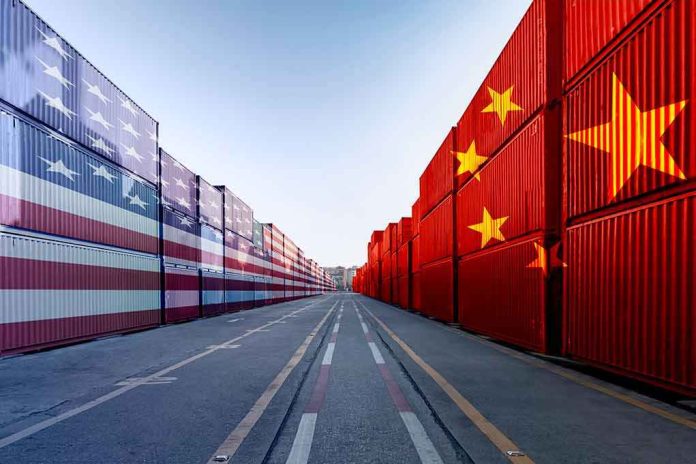
Selective tariff relief — targeted, reciprocal, and explicitly limited to “non‑sensitive” goods — is the point, not the exception: Washington and Beijing just used a narrow $30 billion each-way package to ease pressure where it’s commercially painless while preserving leverage where strategy still rules.
The Short Version
- The U.S. and China announced reciprocal tariff reductions covering roughly $30 billion of goods in each direction, tied to a Trump–Xi summit in Washington.
- The relief is confined to non‑sensitive product lists: U.S. exports include agricultural goods, wood/logs, cosmetics, and medical devices; U.S. imports include small appliances, toys, and holiday decorations.
- This package sits inside a broader framework that also creates an AI dialogue and committee mechanisms for follow‑through.
- Coverage alternates between $30 billion per side and $60 billion combined; both describe the same scope of reciprocal lists.
What changed: a narrow truce by product list, not a broad peace by principle
After President Xi Jinping’s Washington visit and meetings with President Trump, both governments announced a reciprocal tariff package covering about $30 billion of goods each way, with relief explicitly limited to “non‑sensitive” categories. That framing matters because it delineates where both sides can concede without touching the scaffolding of strategic tariffs — sectors tied to technology, security, or industrial policy stay protected. The reported U.S. export list runs through agricultural shipments, logs and other wood products, cosmetics, and select medical devices; the U.S. import list features consumer‑facing, low‑complexity categories such as small appliances, toys, holiday decorations, and children’s car seats. The common thread is low strategic salience and relatively high political visibility — products households and farm states notice, without loosening controls in chips, advanced manufacturing, or critical minerals.
Some outlets describe the package as $60 billion; others say $30 billion. The difference is arithmetic framing, not substance — the lists are reciprocal and of similar scale. When paired, they sum to roughly $60 billion in two‑way trade coverage; when stated one‑way, they’re $30 billion. Either way, what’s on offer is targeted relief, not a general rollback.
How selective tariff relief works in practice
Modern tariff architecture is built on tariff lines — granular product classifications under the Harmonized System. A political deal becomes economic reality only when customs authorities publish the affected lines, effective dates, and rates. In reciprocal packages like this, trade ministries translate a negotiated “topline” — $30 billion of non‑sensitive goods each way — into annexed lists of HS codes matched to tariff treatments. For importers and exporters, the commercial question is simple: does my product’s HS line appear on the list, and what is the new rate? The reported categories here are consistent across major outlets, suggesting a coherent list on both sides, but the policy design purpose is just as clear: create visible consumer and farm‑sector relief while fencing off export controls, security‑screened technologies, and other pressure points that each side wants to preserve.
Because the package is narrowly defined, its price signals concentrate in seasonal and discretionary items (toys and holiday goods) and in commodities and inputs (logs, select agricultural lines, and some medical devices). This pattern pulls on two levers at once: it eases headline inflation in modest, consumer‑noticeable ways and it clears political space for farm exporters and mid‑market manufacturers that can ship quickly once duties fall.
How we arrived here: escalation, carve‑outs, and periodic resets
Since 2018, the U.S.–China tariff relationship has moved in cycles: rounds of escalation that ratchet up average rates, punctuated by truces that pair selective relief with commitments on other fronts (from purchase targets to fentanyl‑precursor enforcement). Even when tariff rates are temporarily reduced, the average duty burden remains well above pre‑2018 norms, and sensitive sectors stay insulated from cuts. The new package follows that script: it is a truce instrument nested inside a durable rivalry, not a structural peace agreement. Reuters contextualized this tranche of relief as part of a broader diplomatic thaw that also creates a channel for AI dialogue — an institutional bridge that acknowledges technology policy is now intertwined with trade, even when the tariff lists avoid tech‑sensitive lines.
Historical analogues abound. The Phase One agreement cut some tariffs while memorializing Chinese buying commitments; later resets adjusted specific rates or suspended tranches temporarily. Each iteration refined the same logic: use tariffs as leverage, then trade them for selective relief and complementary pledges — never fully unspooling the strategic scaffold. The present package, bounded to “non‑sensitive” goods, is essentially a cleaner, more explicit version of that playbook.
What’s actually on the lists — and why those choices
The reported composition is not accidental. On the U.S. import side, toys, small appliances, and holiday decorations are dominated by Chinese supply chains and face limited reshoring prospects in the near term; lowering duties here delivers immediate relief to retailers and consumers without conceding technology or defense adjacencies. Children’s car seats sit at the intersection of safety‑regulated goods and family budgets — a high‑salience category with low strategic sensitivity. On the U.S. export side, agricultural products and wood are politically potent and logistically ready; cosmetics and certain medical devices offer value‑added margins without crossing red lines tied to advanced semiconductors or dual‑use equipment. The result is a package that maximizes near‑term commercial impact relative to geopolitical cost.
For businesses, the operative implications are straightforward. Importers of covered seasonal goods should expect cleaner pricing for the coming retail cycle. Agricultural shippers, especially in categories identified by the lists, gain a window to reclaim shelf space in Chinese distribution. Medical device makers covered by the relief will still navigate product registration and procurement hurdles, but a lower duty rate lifts their price‑performance against domestic and third‑country competitors. The losers, if the category is excluded, are precisely those in “sensitive” sectors — by design.
The companion architecture: AI dialogue and committee follow‑through
A narrow tariff package can dissipate quickly without mechanisms to manage disputes and update lists. That is why the summit also produced an agreement to launch an AI dialogue and to stand up trade and investment committee structures to handle follow‑on work. The two elements are linked: as AI increasingly threads through industrial policy, export controls, and standards, an institutional channel reduces the odds that technology frictions immediately metastasize into tariff escalation. Committees, for their part, are the plumbing that turns a headline into operating reality — venues to validate HS lines, time tables, and carve‑outs as commercial conditions change.
None of this signals an end to rivalry. It acknowledges that even rivals need predictability in non‑sensitive lanes of commerce and a place to talk when technology policy bleeds into trade.
US and China each list $30B for tariff cuts after Trump-Xi.
– US: 77 items – toys, sports gear, Christmas decorations.
– China: 1,619 items, mostly US farm goods.
– Timing and cut size still unclear.Holiday import cost stays open until duties fall.
Source: CNBC / Writer: BF— Brandon Friez (@bfriez) September 29, 2026
How to read the numbers — and what to watch next
When you see $30 billion, ask “per side or combined?” Here, $30 billion describes one‑way coverage; $60 billion describes the sum of reciprocal lists. Either formulation captures the same practical scope. For households, the immediate effect concentrates in holiday‑adjacent and children’s products. For producers, the signal is clearest in listed agricultural and input categories. For macroeconomists, the package is too small to reset bilateral balances; it is large enough to soften edges where politics and prices meet.
The forward markers are concrete. First, publication and implementation of the tariff lines and effective dates — the bridge from communiqué to customs. Second, the tenor of the new AI dialogue and whether it quarantines sensitive tech disputes from spilling into broader tariff policy. Third, whether committee work expands the non‑sensitive lists over time, creating a wider free‑commerce corridor inside a still‑competitive relationship. If the past eight years taught anything, it is that selective relief is sustainable only when it is maintained institutionally, not just announced at summits.
Sources:
nypost.com, cnbc.com, thenationalnews.com, cambridge.org