

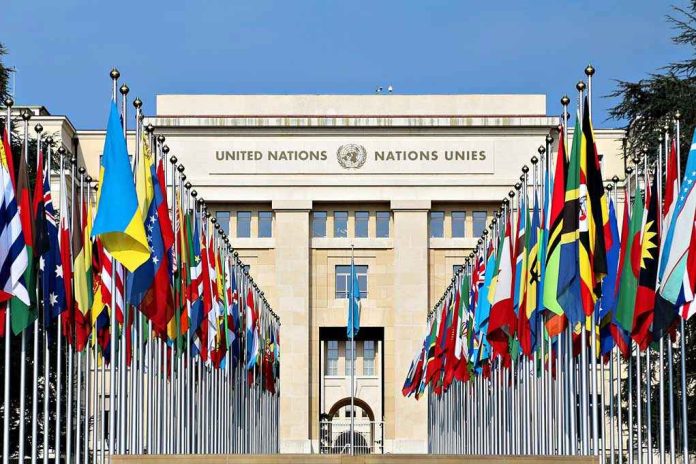
At the United Nations, a walkout is not a mystery; it is a message. When Cuba’s delegation stood and left the General Assembly chamber during President Trump’s speech as he labeled their government “an absolutely failed state” that “will fall,” the moment carried a plain diplomatic meaning: Havana refused to sit and absorb a frontal attack before a global audience. The incident was real, visible, and on record—an emblem of hard-edged messaging colliding with equally public rejection.
At a Glance
- Cuban delegates walked out of the UN General Assembly during President Trump’s address after he called Cuba a failed state and predicted its fall.
- Trump’s language was explicit and confrontational, positioning U.S. pressure as regime-threatening and imminent.
- Multiple outlets independently documented the walkout and tied it to the Cuba section of the speech.
- As diplomatic theater, a UN walkout is symbolic signaling—high in visibility, rarely determinative of policy outcomes.
What happened in the room
During a set of remarks aimed squarely at adversarial governments, President Trump described Cuba as “an absolutely failed state,” asserted it was “failing like never before,” and declared that it “will fall.” Cameras in the chamber captured members of Cuba’s delegation rising and moving toward the exits as he spoke; multiple reporters in the press pool and wire services noted the walkout in real time and linked it to the Cuba passage of the speech. In diplomatic terms, the act is uncomplicated: when a head of state uses the UN rostrum to delegitimize a government, that government’s diplomats sometimes respond by withholding their presence rather than granting tacit legitimacy through attentive silence.
Because the United Nations General Assembly is a stage as much as a legislature, the optics matter. A delegation’s empty seats are not an accident; they are the counter-message. On this day, the counter-message was delivered plainly by Havana’s envoys. Major outlets carried the images and the language that provoked them, fixing both the assertion—Cuba is failing and will fall—and the immediate, visible response in the public record.
How UN walkouts work: symbolism, not settlement
Walkouts at the UN are an established instrument of diplomatic signaling. They do not negotiate terms, amend resolutions, or alter sanctions; they communicate censure in a language the institution understands—presence or absence. The General Assembly’s rituals heighten this dynamic: the camera lingers on the speaker, then scans the hall, and every delegation knows that staying, leaving, applauding, or withholding response is legible far beyond Turtle Bay. As a result, walkouts tend to generate intense media coverage and domestic political utility for both sides—the speaker points to visible discomfort as proof of pressure, and the target highlights departure as refusal to dignify what it deems a hostile or illegitimate narrative.
The record from this session fits that pattern. The Cuban exit was immediate and pointed, and it traveled widely in coverage. That is what walkouts do best: they create a picture that stands for a policy disagreement. What they do not do—on their own—is settle the disagreement or measure strategic effect. A government can lose a room and keep its grip at home; it can also weather rhetorical blows while pursuing its own diplomatic aims elsewhere.
The substance of Trump’s Cuba line—and why it triggered an exit
Presidents have used the UN rostrum to advance coercive diplomacy before, but Trump’s formulation about Cuba left little room for hedging. He cast U.S. pressure as existential for Havana and forecast regime failure as an outcome, while asserting that Washington would not permit “a haven for foreign adversaries” in its neighborhood. Those are maximalist claims in the performative heart of multilateralism; they challenge legitimacy, not policy detail. In such cases, a targeted delegation’s choice set is familiar: respond from the floor and dignify the premise, or walk out and deny the premise an audience. Cuba chose the latter, and the tie between the trigger language and the exit was documented contemporaneously by on-scene reporting.
The administration’s intention was equally legible. Declaring a neighbor a failing regime that “will fall” seeks to project resolve to domestic and foreign audiences simultaneously. In the UN’s grammar of power, that is a bid to define the narrative arc before others can soften it. The walkout did not contest what was said; it refused to sit for it. Both actions are part of the same conversation, conducted nonverbally and on camera.
Parallel reactions in the hall
The same address drew other visible signs of disapproval in the chamber from adversarial delegations, reinforcing the sense that the speech’s most confrontational passages were received as intended—provocatively. Reporting in several outlets described a second delegation staging a walkout during the address, a common clustering pattern at UNGA when a speech is structured around naming and shaming multiple targets in sequence. The point is not coordination so much as predictability: when a leader trains the institution’s spotlight on specific governments, those governments often choose the most legible form of rebuttal available to them.
What a walkout proves—and what it doesn’t
The evidence here is strongest on two counts: the words used and the bodies exiting. Trump’s phrasing about Cuba is on record; the Cuban delegation’s departure is on video and in multiple independent write-ups. Those are facts, not interpretations. What neither fact can carry, on its own, is a claim about durable political damage inside Cuba, or measurable shifts in the regime’s stability, or subsequent policy concessions—a leap that would require a different evidentiary base. In UN politics, symbolism and consequence are related but distinct. The former often precedes the latter; just as often, it does not.
Trump told world leaders at the UN that Cuba’s communist regime “will fall.”
The Cuban delegation’s response? They stood up and walked out.
One speech. One walkout. A striking moment of rising tensions between Washington and Havana. 🇺🇸🇨🇺 https://t.co/fBcvjSkDrq
— Shahbaz (@Shahbazdreamz) September 22, 2026
How to read incidents like this going forward
Three filters help. First, separate the chamber from the chessboard: a walkout is a signal broadcast from one venue, not a proxy for outcomes across the system. Second, track linkages—if an exit is followed by statements, demarches, or tangible changes in bilateral conduct, the symbolism is maturing into statecraft. If not, it remains theater with communicative value but limited strategic content. Third, judge speeches by their intended audiences. Leaders often craft UN passages to resonate at home as much as abroad; when a target delegation walks out, both sides get usable footage for their respective narratives.
Sources:
pjmedia.com, nypost.com, thehill.com, timesnownews.com, kentucky.com, reuters.com