

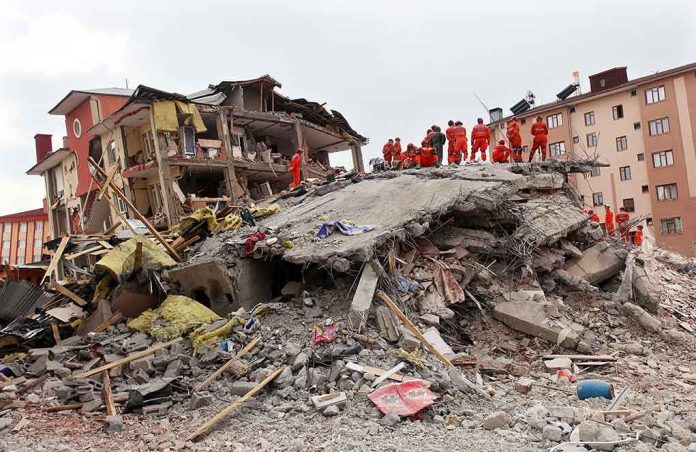
When a 7.4 magnitude earthquake tears through a mountainous, road-poor stretch of western Colombia, the first casualty is often not a life but a number — and the gap between “confirmed dead” and “feared missing” tells you less about the disaster’s true scale than about how quickly a country can count its own wounds.
Key Points
- A magnitude 7.4 earthquake struck near San José del Palmar in Chocó department, triggering landslides, building collapses, and a multi-day search-and-rescue operation across dozens of cities and towns in western Colombia.
- Government agencies, the military, and the Colombian Red Cross mobilized specialized urban search-and-rescue teams, canine units, and army rescue platoons within hours, an operational response corroborated across UN, humanitarian, and independent news sources.
- Casualty and missing-person tallies varied enormously in the first 72 hours — from roughly 111 to more than 250 dead, and from hundreds to over 2,700 missing — a spread typical of early disaster reporting rather than evidence of a botched response.
- Damaged roads, bridges, and airport closures slowed access to the hardest-hit interior towns, a logistical reality that shaped both the pace of rescues and the reliability of early figures.
- The quake arrived as a newly inaugurated Colombian government took office, adding political scrutiny to an already difficult humanitarian test.
What the Ground Truth Actually Shows
Strip away the discrepancies in the death toll and one operational fact holds firm across every credible account: search-and-rescue crews were on the ground within hours and stayed there for days. UN News reported that Colombian authorities were “continuing search and rescue operations” with people “still trapped beneath the debris” near the epicenter in Chocó department. The International Federation of Red Cross and Red Crescent Societies confirmed the same picture independently, stating that Colombian Red Cross teams had deployed thirty search-and-rescue responders to Chocó even as damaged roads, downed bridges, and a closed airport complicated access. Two organizations with no reason to coordinate their messaging arrived at the same conclusion through separate channels — that is the kind of corroboration that matters in a fast-moving disaster.
The mobilization went well beyond humanitarian volunteers. Colombia’s national disaster agency, UNGRD, activated four specialized Urban Search and Rescue teams drawn from Bogotá, Envigado, Yopal, and Medellín, while the National Army placed five rescue platoons on alert with extraction tools, generators, and search dogs. That is a textbook national-level response architecture — the kind built after decades of Colombian experience with landslides, volcanic activity, and prior seismic events in a country that sits astride the Pacific Ring of Fire. President Abelardo de la Espriella, only recently inaugurated, framed the priority in blunt terms: “The first priority is rescuing the people trapped under the rubble”, a statement rescue crews on the ground in Cali and elsewhere appeared to be executing literally, sifting debris by hand and with buckets when heavy equipment couldn’t reach collapsed structures.
Why the Casualty Numbers Kept Moving
Anyone following the coverage in real time would have noticed the death toll seemingly changing by the hour — from just over 100 to nearly 200 to, in some accounts, north of 250. Missing-person estimates were even less stable, swinging from the low hundreds to figures exceeding 2,700 depending on the outlet and the moment a given report was filed. This is not evidence of confusion inside the rescue operation itself; it is the predictable signature of disaster arithmetic in its earliest phase. Municipal registries, hospital intake logs, and family-reported missing lists all update on different clocks, and in the immediate aftermath they rarely reconcile with one another. Al Jazeera’s figure of 132 confirmed dead with “hundreds” missing, drawn from the Colombian Geological Service, sat alongside other outlets citing figures nearly double that within the same news cycle.
Two structural forces widen that gap further. First, missing-person counts are inherently provisional — they capture anyone unaccounted for at a moment in time, including people who later turn up alive, displaced, or simply out of cell-phone range because towers went down. Second, physical access to the disaster zone was itself compromised. The IFRC noted damaged roads, collapsed bridges, and a closed airport in the affected departments, conditions that slow not just rescue logistics but the flow of verified information out of remote towns like San José del Palmar. A rescue team working sixteen-hour shifts in a collapsed neighborhood in Cali has little bandwidth to also update a national casualty spreadsheet in real time. The lag between action and accounting is where headline numbers diverge — not in the sincerity or scale of the response.
What a Skeptical Reader Should and Shouldn’t Doubt
It is fair, and useful, to be skeptical of any single casualty figure quoted in the first days after a major earthquake; history — from Haiti in 2010 to Turkey and Syria in 2023 — shows these numbers get revised, sometimes sharply, as registries stabilize and remote areas become reachable. It is a different matter, however, to treat that volatility as grounds for doubting that a serious, well-resourced rescue effort was underway. On that point, the evidentiary record is unusually consistent: UN reporting, humanitarian-agency statements, and independent outlets covering Cali, Pereira, Quibdó, and Manizales all describe the same picture of soldiers, police, firefighters, and volunteers working through debris with excavators and, where machinery couldn’t reach, their bare hands. No credible source in the record disputes that the operation happened or that it was substantial; the disagreement is confined entirely to magnitude of loss, not existence of response.
What would sharpen the historical record further — and this is where independent verification genuinely lags the news cycle — is public release of the underlying documents: UNGRD’s incident action plans, army deployment orders, and the Colombian Geological Service’s revision notes on the quake’s magnitude and epicenter. Those records would let researchers reconcile the wildly divergent missing-person estimates with an actual registry rather than a running tally of press citations. Until then, the responsible reading of this event is the one the primary humanitarian sources support: a large, competent, multi-agency rescue operation responding to a genuinely catastrophic earthquake, with the human toll still being tabulated rather than in dispute.
As Search for Thousands of Missing Pushes on, Colombia Earthquake Tests New President https://t.co/PKSuWl1n0g pic.twitter.com/4ITjb5yfDR
— The Japan News (@The_Japan_News) August 12, 2026
The Broader Pattern This Fits
Colombia’s experience here is not an outlier; it is the norm for how the world learns about major earthquakes. The first 72 hours produce a flood of partial, sometimes contradictory data because the incentive structures of emergency response and of news reporting point in different directions — rescue teams are optimizing for saving lives, not for producing clean statistics, while newsrooms are optimizing for the fastest verified number they can attribute to a source. Readers who understand that tension are better equipped to judge future disasters, in Colombia or anywhere else, without either dismissing early rescue reporting as unreliable or treating a single headline figure as gospel. The rescue was real. The final count, as always, will take longer than the story does.
Sources:
youtube.com, abc7news.com, news.un.org, x.com, cnbc.com, apnews.com, scmp.com