

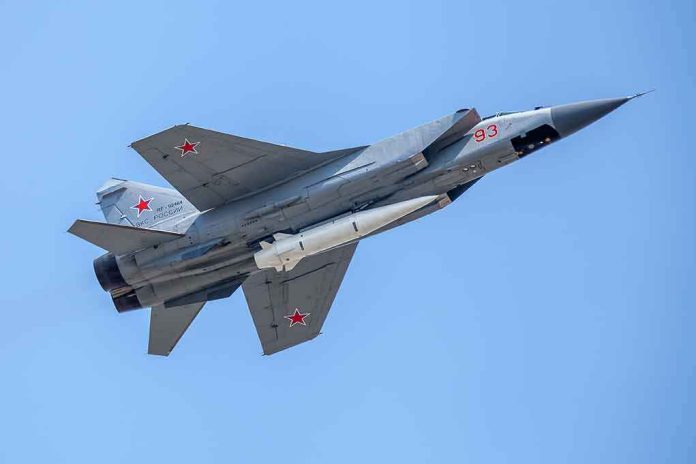
Air policing over NATO’s eastern flank has entered a new phase: allied jets are no longer just shadowing intruders, they are shooting them down—because low, slow, weaponizable drones turn a border probe into a sovereignty breach in minutes.
At a Glance
- Romania’s defense authorities tracked a drone from the Black Sea well into national airspace and ordered a Romanian F‑16 to destroy it over unpopulated terrain, treating the event as an active air defense operation rather than a near-border anomaly.
- The President publicly confirmed the engagement and emphasized risk-managed execution—uninhabited area, single missile shot, debris secured—underscoring rules-of-engagement discipline.
- Attribution to Russia has solidified over repeated incidents, though initial statements on the first shootdown preserved investigative caution; the broader pattern aligns with Moscow’s Shahed/Geran‑2 campaign against Ukrainian Danube targets.
- Russia rejects blame and calls the cases staged; those claims are assertions without produced counter-evidence, in tension with Romania’s radar tracks, debris recoveries, and repeated allied scrambles.
What changed: from monitor-and-warn to engage-and-neutralize
The operational facts are straightforward and consequential. Romanian air-defense radar detected a drone over the Black Sea, east of Sulina, tracked it along a westbound route across Romanian territory—Sulina to Brăila to Fetești to Buzău—and committed fighters to intercept. Multiple aircraft launched: Italian Eurofighter Typhoons from Mihail Kogălniceanu and Romanian F‑16s from Fetești. A Romanian pilot fired an air-to-air missile and destroyed the target over an unpopulated area near Padina, Buzău County. That sequence, released by Romania’s Ministry of National Defence and echoed in contemporaneous reporting, reflects a deliberate engagement inside sovereign airspace, not a fleeting skirmish on a frontier line.
President Nicușor Dan confirmed the shootdown within minutes—time-stamping the event around 11:00—and explicitly framed the safety calculus: the area was uninhabited, so the pilot could fire “without any risk involved.” That on-the-record confirmation matters because it ties the tactical decision to political accountability: clear rules of engagement, geographically bounded risk, and a single-shot solution to neutralize the threat.
Mechanics of the intercept: why drones force quick decisions
Air forces classify drones by speed, altitude, radar cross-section, and potential payload. Shahed/Geran‑2 types—propeller-driven, with composite airframes and small signatures—live in the seam between air defense and law enforcement; they are slow enough to appear benign to a layperson and cheap enough to be expended in swarms, yet they can carry explosives or serve as decoys, and they often fly at altitudes that spoof civilian clutter. Against that profile, the Romanian decision tree is narrow: once a radar track crosses deep into national airspace and continues inland, the defender cannot assume benign intent or wait for forensic certainty. The correct sequence is detection, classification, correlation with the regional strike picture, scramble, visual identification if feasible, weapons clearance, and kinetic defeat over the safest available footprint.
That is precisely what occurred. The announced track—Black Sea to Buzău—was not a border skim; it was a meaningful penetration that, if left unaddressed, risked a crash into populated areas or critical infrastructure. The presence of allied Typhoons alongside Romanian F‑16s signals that the incident ran through NATO’s integrated air and missile defense workflows, not a unilateral snap judgment.
Attribution, evidence, and the gap between operational and forensic certainty
Two realities can be true at once. First, Romanian officials were right to act with operational certainty: a drone inside national airspace on a traversing track is a legitimate target. Second, initial public statements did not assert full forensic certainty about origin; early language ranged from “drone” to “most likely a Russian drone” while debris analysis proceeded. In the days around this first intercept, prosecutors and subsequent briefings in related incidents described recovered drones as Russian-made Shahed models used by Moscow in its Ukraine campaign, with the President later denouncing repeated violations as “inadmissible and intolerable”.
That evidentiary arc matches the coalition’s experience since 2022: first, act to eliminate hazard; then, attribute with increasing confidence as fragments, guidance units, and airframe components are cataloged. Reporting across incidents documents dozens of incursions or fragment falls linked to Russian operations against Ukrainian Danube ports—events that generate spillover hazard corridors into Romania. The cumulative pattern, not a single fragmentary press line, is what anchors attribution in practice.
Russia’s denials and what they do—and do not—contest
Moscow’s public stance has been consistent: reject Romanian accusations, suggest staging, and insist that origin cannot be known absent forensic proof. Those are talking points, not counter-evidence. In this case, Romania has released the operational narrative—radar detection, track across specific waypoints, multi-jet scramble, missile shot, debris recovery—while Russia has not provided telemetry, launch records, or any technical data to support an alternative account. Reuters and other outlets captured the Russian line, but the burden here lies with the party contesting a documented air-defense engagement over another state’s territory; mere denial does not outweigh radar plots, recovered debris across cases, and repeated allied intercepts.
It is also telling that as similar events accumulated, investigators publicly identified at least one recovered drone as a Shahed model used by Russia, and allied officials hardened their language regarding recurrent Russian airspace violations. That trajectory—caution at the moment of kinetic action, firmer attribution as evidence accrues—is the opposite of a narrative rush; it is how responsible militaries avoid over-claiming while still defending their skies.
Why this matters beyond a single missile shot
Strategically, these engagements mark a shift in deterrence signaling on the eastern flank. For two years, NATO air policing largely meant escort and observation; drones changed the calculus. They are cheap, plentiful, and often routed along the littorals and river corridors where Ukraine’s ports sit close to NATO borders. Romania’s ministry has tallied rises in incursions, fragment recoveries, and scrambles this year alone, mirroring the intensification of Russia’s long-range strike campaign. Once a member state demonstrates it will fire—in controlled conditions, with allied integration—the cost to the aggressor rises and the margin for “accidental” overflow narrows.
Domestically, these decisions shore up public confidence. Romanians have seen the consequences of inaction: a Geran‑2 crash into an apartment building in Galați injured civilians earlier in the campaign, and sea drones have detonated in port approaches. Air-defense commanders cannot risk another politically and morally indefensible urban impact when a track is already well inland. Kinetic defeat, when feasible over uninhabited ground, is the responsible choice.
The unresolved questions that still deserve daylight
Three lines of transparency would strengthen the public record without compromising sources and methods. First, sanitized radar plots and engagement logs—timestamps, altitudes, headings—could substantiate the announced Sulina–Brăila–Fetești–Buzău trajectory. Second, a photographic inventory of recovered debris from across incidents, with manufacturer-identifiable components and guidance units, would advance the forensic case in the public domain. Third, Parliament-level review of rules of engagement could clarify when non-kinetic options—jamming, spoofing, directed energy—are viable versus when a missile shot is the only safe recourse. None of these asks second-guess the shootdown; they codify best practice for the many incidents to come.
Even with fuller transparency, intent will sometimes remain inferential. A drone can drift, be misrouted, or be deliberately sent to test response. In a war zone’s periphery, that ambiguity is the point of the tactic: impose cost, harvest intelligence on NATO readiness, and exploit legal and political hesitancy. The only practical counter is a standard of action that treats deep incursions as actionable hazards regardless of claimed intent, balanced by post-action forensic rigor.
NATO fighter jet shoots down drone over Romania – https://t.co/JBNOCmCcOR https://t.co/yKqoLVYgxS
Follow @NewsHubGlobe for 24/7 breaking news from around the world. pic.twitter.com/YglDHSxu3A
— News Hub (@NewsHubGlobe) August 17, 2026
What to watch next: doctrine, cost, and alliance coherence
Doctrine is catching up. Expect more explicit “engage over empty ground” corridors, faster joint authorization across allied air-policing detachments, and investment in cheaper interceptors to avoid spending front-line missiles on $20,000 drones. Cost curves matter: a day of swarming drones can drain a magazine faster than a fighter wing can reload. Mixing sensors, electronic attack, guns, and point-defense missiles—layered and locally commanded—will stretch magazines without accepting risk to cities or bases.
Bottom line
Romania’s F‑16 shootdown was not a one-off flourish; it was the logical culmination of two years of lessons about drones, borders, and deterrence. The operational case was clear—a tracked penetration well inside national airspace, intercepted under allied procedures, neutralized over empty land, then publicly owned by the head of state. Attribution has moved from cautious to confident across repeated incidents; Russia’s denials have not been accompanied by countervailing data. In this environment, the alliance’s credibility rests on two paired commitments: act decisively to keep hazards out of populated skies, and keep building a forensic record sturdy enough to withstand adversarial spin. That is how deterrence and legitimacy reinforce each other, one intercept at a time.
Sources:
reuters.com, euronews.com, pravda.com.ua, agerpres.ro, politico.eu, english.news.cn, cnn.com, foxnews.com, bbc.com