

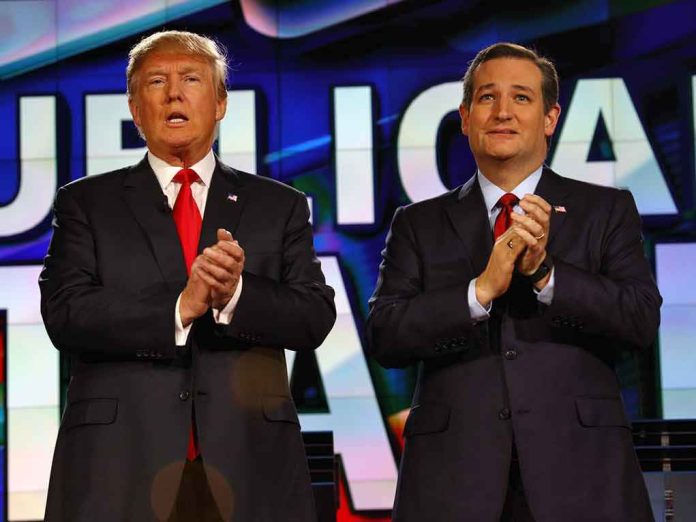
Moments of televised fury at party conventions are not glitches in American politics; they are features of a high-stakes ritual that rewards maximalist signaling, and in 2016 one such moment turned explicitly violent when a crowd member repeatedly shouted “He should be shot!” during Senator Ted Cruz’s prime-time Republican National Convention speech in Cleveland.
At a Glance
- During Ted Cruz’s July 20, 2016 RNC address, a person in the arena repeatedly yelled “He should be shot!” as Cruz referenced Democrats, amid a larger wave of boos and heckling.
- The incident unfolded on national television during a marquee convention night and became part of a volatile scene that included security escorting Heidi Cruz from the floor.
- Coverage and the published text of Cruz’s remarks allow time-matching of crowd reactions to specific passages of his speech.
- The episode illustrates how conventions concentrate intra-party conflict and can escalate from performative hostility into explicit threats under the glare of live broadcast.
What happened in the arena: a violent shout inside a larger eruption
Cruz’s appearance on the third night of the 2016 Republican National Convention was already combustible. He declined to endorse the nominee from the podium, and the room turned on him—boos, chants, and jeers converged as he pressed through prepared remarks. Amid that din, multiple reports captured a clearer, more alarming note: a man in the crowd repeatedly yelled “He should be shot!” timed to a portion of Cruz’s address when he referenced Democrats by name. The moment did not occur in a quiet corner; it unfolded in front of cameras and a national audience on a night the party had scripted for unity and spectacle.
The disruption’s intensity had immediate, practical consequences on the floor. Cruz’s wife, Heidi, was escorted out by security as tensions spiked, and a would-be physical confrontation with Cruz elsewhere in the venue was restrained—details that underscore the atmosphere in which a shouted death threat landed and carried. While the noisy crescendo was remembered for the boos greeting Cruz’s non-endorsement, contemporaneous coverage and later accounts record the explicit threat as part of the same rolling outburst, a darker chord within the larger chorus.
How we know: contemporaneous text, timing, and broadcast observation
Two forms of documentation anchor this episode. First, we have the verbatim text of Cruz’s 2016 convention speech published the same day, which fixes the progression of his remarks to which the arena reacted. Second, broadcast and post-event reporting synthesized what viewers and correspondents witnessed in real time—a “wild night” that saw Cruz heckled and the room surge into hostility as he pressed toward his “vote your conscience” line. That scaffolding matters because it allows a reader to reconstruct when the threat surfaced relative to identifiable passages in the speech, and why it was audible enough to be remarked upon amid the broader uproar.
Accounts describing the precise language—“He should be shot!”—are consistent in characterizing it as repeated and as occurring when Cruz invoked Democrats. Although the individual who shouted has not been publicly identified in the available reporting, the narrative through-line across sources is clear: the threat emerged from within the convention audience while Cruz was on stage, not from protesters outside or from a post-production overlay.
Mechanism of escalation: why conventions can cross from theater to threat
National conventions compress three accelerants into one room: polarized delegates with factional grievances, a live broadcast incentive to “make a moment,” and a candidate-centered narrative that personalizes political conflict. When a speaker cuts against the crowd’s expectation—as Cruz did by withholding an endorsement—micro-signals of disapproval can snap into synchronized behavior. The psychology is simple and powerful: boos normalize; heckles invite one-upmanship; and in a permissive soundscape, the line between performative aggression and explicit incitement can be crossed by an individual seeking to be heard above the din. Social identity theory helps explain the pile-on, but the broadcast environment amplifies it—what would be an ugly aside at a county convention becomes a national artifact when microphones and cameras are trained on the stage.
Historically, conventions have incubated moments of unruliness both inside and outside the hall, from bruising floor fights to street clashes. The 1968 Democratic Convention in Chicago is the benchmark for protest violence outside the venue; inside the hall, modern conventions typically control the choreography tightly, but factional splits and grievance politics periodically surface through chants and threats when unity fails to hold. The Cruz episode fits that lineage on the in-hall side of the ledger: an intra-party fracture expressing itself as live, audible menace directed at political opponents while the cameras rolled.
What the incident does—and does not—tell us about the party and the period
It would be a category error to read a single shout as a plebiscite of a party’s conscience; it is not. But dismissing it as mere noise misses the structural cue it provides: by 2016, the Republican coalition was negotiating power and identity in real time, and a portion of that negotiation took the form of transgressive speech that targeted out-groups and dissenters. In this case, as Cruz named Democrats in a hall primed for combat, a member of the audience moved from derision to an explicit call to lethal violence. The through-line is not that “everyone” believed it, but that the environment was permissive enough for someone to voice it audibly and repeatedly during prime-time proceedings.
Conventions, because they are television first and deliberative politics second, can normalize the language they platform. The fact that networks, transcripts, and next-day write-ups all memorialized this night means the words—and the escalation—entered the political bloodstream. Subsequent coverage aggregated the moment alongside other chants and heckles, but the specific threat stands out because it collapses the distance between rhetorical combat and the literal call for harm—an ethical and legal threshold that democratic politics should not casually cross.
GOP CONVENTION CROWD SHOUTS "HE SHOULD BE SHOT" AS TED CRUZ NAMECHECKS DEMOCRATS
A chilling moment unfolded Thursday night at the Republican midterm convention in Dallas when a crowd member repeatedly shouted "He should be shot!" as Senator Ted Cruz rattled off the names of… https://t.co/3y7XNau5WD
— THE WORLD CORRESPONDENT (@TheWorldCorresp) September 11, 2026
Implications: guardrails for live political rituals
Two practical lessons follow. First, floor management and security protocols must treat explicit threats as qualitatively different from standard rowdiness—quick identification and removal are not simply order-keeping; they are deterrents that prevent copycat escalation. Second, broadcast partners can reinforce normative boundaries by refusing to romanticize or replay violent exhortations as colorful texture; editorial choices shape whether a moment is immortalized as spectacle or bracketed as unacceptable. None of this implies sanitizing politics. It does insist that a live civic ritual watched by millions demand a higher floor than “whatever the crowd will bear.”
The 2016 Cruz incident endures because it revealed how thin that floor can become when factional stress, performative incentives, and the roar of a national audience converge. We remember the boos. We should also remember the line that was crossed—and how easily it can be crossed again if institutions mistake noise for democratic vitality.
Sources:
cnn.com, en.wikipedia.org, rawstory.com, npr.org, pbs.org, abcnews.com