

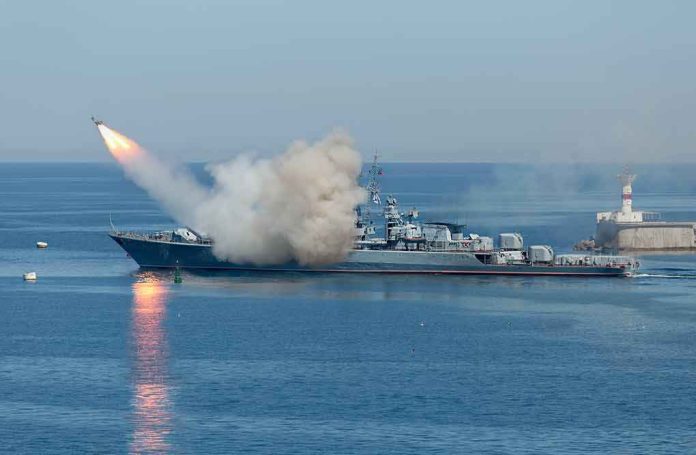
The sinking of the Moskva mattered because it was not just a ship loss; it was the first unmistakable proof that Ukraine could cripple a prestige Russian surface combatant with a cheap, domestically built anti-ship missile and alter the balance of power in the Black Sea.
Intro Header
- The cruiser Moskva, flagship of Russia’s Black Sea Fleet, was hit and later sank in April 2022.
- Ukraine said Neptune missiles struck the ship first; a senior U.S. defense official later confirmed two Neptune hits.
- Russia said a fire and ammunition explosion caused the sinking, but the public record settled on missile damage as the trigger.
- The episode became a textbook case of asymmetric warfare: a far smaller force using precision missiles to impose strategic cost far above the price of the weapon fired.
What Happened to Moskva
The Moskva was the largest Russian warship lost in combat since World War II, and its disappearance from the Black Sea was a severe operational and symbolic blow to Moscow. Ukrainian officials said on 13 April 2022 that their forces had struck the cruiser with two R-360 Neptune anti-ship missiles, setting off a fire; Russia responded that an onboard blaze had triggered munitions explosions, and that the vessel later sank while under tow in rough seas. A senior U.S. defense official then confirmed that the ship had been hit by two Neptune missiles, giving the Ukrainian account the strongest public corroboration it received in the early phase of the war.
That sequence matters because the Moskva was not a generic patrol craft. It was the Black Sea Fleet’s flagship, a major air-defense and command platform whose loss forced Russia to push other ships farther from the Ukrainian coast. In practical terms, the sinking reduced Moscow’s ability to project naval power near Odesa and made Russian maritime operations more cautious, more distant, and less effective. In symbolic terms, it punctured the aura of Russian naval invulnerability that the Kremlin had cultivated for years.
Why a Cheap Missile Could Kill an Expensive Warship
The enduring fascination with Moskva is the arithmetic, but the deeper lesson is tactical. A modern warship is not a floating fortress; it is a system whose sensors, defenses, damage-control procedures, and command functions must all work under pressure, and a single successful hit can unravel the whole stack. Neptune is a coastal anti-ship cruise missile designed to fly low and exploit radar horizons, which makes it especially dangerous against ships operating close to shore. Once a missile breaks through, the issue is no longer the sticker price of the weapon that hit it, but whether the target can absorb the blast, contain fire, and keep fighting.
That is why the common cost comparison, while striking, is only half the story. Yes, Neptune missiles were far cheaper than the cruiser they disabled, and the resulting loss was economically lopsided in Ukraine’s favor. But the real value lay in what the strike did to Russian doctrine and deployment. After Moskva, Russian ships in the Black Sea had to behave as though Ukraine could reach them, and that forced a wider stand-off posture that ceded freedom of movement to the defender. In war, the most expensive consequence is often not the destroyed hardware; it is the change in behavior that follows its destruction.
How the Narrative Was Built in Real Time
Moskva also became an object lesson in how wartime attribution works. In the first hours, the public record was fragmented: Ukraine claimed a missile strike, Russia blamed an onboard fire, and U.S. officials initially withheld a firm judgment while saying the Ukrainian version was plausible. That is normal in modern conflict reporting, where governments have strong incentives to shape the first account and outside observers rarely have immediate forensic access. Over time, though, the evidence hardened around the missile-strike explanation, and the U.S. confirmation made it difficult to sustain the notion that the ship simply burned and slipped beneath the waves by accident.
The later Russian acknowledgement that the ship had been sunk by a missile strike further narrowed the dispute, even if Moscow continued to control the details it was willing to release. That kind of delayed admission is typical when a military loss is both real and embarrassing: the event itself cannot be denied forever, but the state tries to manage the chronology, the casualty figures, and the cause. On Moskva, the key fact was always the same. The warship was hit, damaged, and lost. The argument was over who could say so first, and under what wording.
What the Moskva Loss Changed in the Black Sea
The broader significance of the sinking goes beyond a single hull on the seabed. The Moskva had functioned as a visible anchor of Russian naval authority in the Black Sea, and its loss exposed the vulnerability of large surface combatants in a missile-saturated littoral environment. In the months that followed, the Black Sea became a more contested and more dangerous theater for Russia, because the cruiser’s absence meant fewer layers of air defense, less command redundancy, and less confidence in operating close to Ukraine’s coastline.
For Ukraine, the strike became a proof of concept. A country without a conventional blue-water navy showed that it could impose serious naval costs with land-based missiles, intelligence support, and disciplined targeting. That mattered strategically because it changed the definition of power at sea: not who owns the largest fleet, but who can deny the other side access to the waters that matter most. Moskva did not end the naval war in the Black Sea. It did, however, mark the moment when Russia’s fleet stopped looking like an unquestioned master of that space and started looking exposed.
Why Moskva Still Matters
Years later, the sinking remains a durable case study in asymmetric warfare because it combines three rare things: a prestigious target, a comparatively cheap weapon, and a consequence that was both material and psychological. The cruiser’s loss embarrassed Russia, emboldened Ukraine, and signaled to every navy watching that mass and pedigree are no defense against good intelligence, low-flying missiles, and a defender willing to take the shot. If one event captured the modern logic of maritime denial in the Black Sea, this was it.
Sources:
19fortyfive.com, en.wikipedia.org, bbc.com, nbcnews.com, nytimes.com, cbsnews.com, pravda.com.ua, facebook.com, journals.ametsoc.org, reuters.com, themoscowtimes.com