

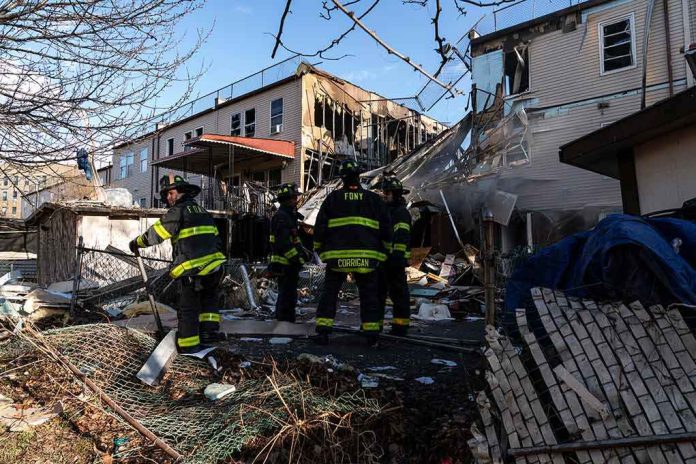
Urban search-and-rescue is a race against physics: when a masonry building lets go, seconds matter, and the only credible measure of a city’s readiness is what happens in that first hour—who arrives, how they stabilize a crumbling scene, and whether people come out alive.
At a Glance
- FDNY, NYPD ESU, and specialized rescue teams mounted a major technical rescue after a partial collapse at Bedford and Flatbush in Flatbush, Brooklyn.
- At least two people were removed from the rubble during the initial operation, as searches continued for others.
- Officials locked down the corridor, warned the public to avoid the area, and maintained a methodical, hand-by-hand search in unstable debris.
- The cause of the collapse remained under investigation; early reporting focused on adjacent excavation while authorities emphasized ongoing rescue and safety.
What happened and why the response mattered
The collapse struck a three-story mixed-use structure in Flatbush, shearing open apartments and folding debris toward an adjacent construction pit shortly after 4 p.m. The call sequence is precise enough to anchor the operational timeline: the alarm was received at roughly 4:01 p.m., drawing a surge of FDNY and NYPD Emergency Service personnel that converted a chaotic street corner into a technical rescue site within minutes. Firefighters and ESU officers executed a grid search—brick by brick, void by void—while command isolated utilities, secured a widening perimeter, and pushed back onlookers as road closures rippled across Bedford and Flatbush. Among the most consequential facts: at least two victims were extricated from the rubble during the initial operational period, proof that a genuine rescue, not merely a recovery, was underway.
Rescuers kept the heavy equipment idle at the curb, a deliberate choice when pancaked floors and fractured walls hang in residual tension; one wrong pull can turn survivable voids into lethal compressions. The FDNY labeled the effort a “major technical rescue,” a designation that signals the deployment of specialized companies, collapse caches, shoring systems, canine teams, and medical assets staged for immediate on-scene stabilization. Aerial footage and street-level video corroborated what that label implies: multiple companies working the pile, ladders posted to compromised interiors, and stretcher removals threading through cordons as the search continued.
Mechanics of an urban collapse rescue
Collapse rescue in New York follows a tested choreography. Command first secures the scene—gas, electric, and traffic—then builds a search plan around likely survivable voids: stairwells, doorways, bathtub pockets, and where floor joists might bridge without total crushing. The work is slow by design; firefighters tunnel and crib to support every inch advanced, cross-checking with canines and listening devices before committing personnel deeper. The Flatbush operation matched that doctrine: reporting described hand-by-hand debris removal, K-9 support, and careful avoidance of heavy machinery while stability was uncertain. In parallel, medics prepare to deliver care inside the collapse footprint, where a victim may need hemorrhage control, airway management, or hypothermia mitigation before extraction is safe enough to move.
Urban rescues also hinge on information discipline. Command seeks apartment rosters, witness accounts, and construction site logs to reconcile who might be inside. That count frequently shifts in the first hours—the point at which the public most craves certainty is the very moment the facts are still forming. Flatbush followed that pattern: initial mentions of people possibly trapped gave way to confirmed removals and, later, to evolving casualty tallies as searches progressed. That flux is not evidence of confusion; it is the nature of dynamic incident data in an unfolding technical rescue.
Location, timing, and scene control
The collapse footprint sits at a nexus of neighborhood arteries—Bedford Avenue near Newkirk and Flatbush—where a single structural failure can snarl bus lines, emergency access, and utility protection plans. The precision of the dispatch address and the reported 4:01 p.m. alarm time offered logistical clarity for incoming units and later for investigators assembling a minute-by-minute record. City emergency managers and police pushed alerts directing the public to avoid the corridor, anticipating prolonged traffic disruption; those measures do more than clear space for trucks and stretchers, they reduce secondary injuries from crowd pressure and keep the soundscape quiet enough for listening operations at the pile.
On the ground, visual reporting showed firefighters operating on both the debris surface and within the exposed interior rooms of the standing portion—an indicator that structural specialists had judged at least parts of the shell temporarily supportable under controlled access. That kind of dual-domain search—simultaneously interior and pile—is resource-intensive and typically reserved for incidents where survivable spaces plausibly remain.
What we know about casualties—and what that means
Two people were definitively removed from the rubble during the rescue phase, with FDNY describing active searches for others potentially trapped—an operational reality that shaped everything from shoring choices to medical staging. Later reporting from reputable local outlets referenced at least one fatality and a broader injury count as hospital notifications were reconciled and next-of-kin processes advanced. In collapses, those numbers often solidify only after the scene transitions from rescue to recovery; Flatbush tracked that sequence. The substantive takeaway is not the variability of early tallies but the demonstrated capability to find, reach, and remove living patients in unstable conditions.
It is appropriate—once lives are no longer in immediate jeopardy—to press for full reconciliation of patient dispositions across EMS, hospitals, and the medical examiner. That reconciled ledger yields lessons about entrapment patterns, time-to-extrication benchmarks, and which tactics saved minutes that, in this domain, equate to survival odds.
Cause and accountability live on a separate track from rescue
The question of why the structure failed is legitimately distinct from how well the city executed the rescue. Early visual evidence and on-scene accounts highlighted an adjacent excavation, and subsequent coverage examined permits, stop-work orders, and enforcement records; investigators from the Department of Buildings typically reconstruct such failures by tracing load paths, shoring design, and foundation interaction with excavation geometry. That inquiry proceeds in parallel with, not in place of, life safety operations. Treating these as separate lanes preserves both priorities: save who can be saved now; determine causation with rigor later. Collapsing those lanes into a single narrative—assigning blame while victims remain under debris—tends to erode clarity and risks contaminating technical conclusions with speculation.
New York’s broader experience underlines the need for that bifurcation. The city has documented significant swings in construction incident and injury counts across recent years and has responded with targeted sweeps and regulatory tightening after major structural events; the investigative arc typically culminates in detailed findings that pinpoint precise procedural or engineering failures and drive code or enforcement changes.
Kno dem streets very well, Flatbush, Bedford, Rogers & Newkirk. My ❤️ goes out to my fellow Brooklyn Peeps in the wake of the tragic building collapse. Almost without saying we r strong & will come back from this…my sympathy & condolences 2 the families of the ones we loss 🙏🏽
— UncleMike (@billskid) November 12, 2026
What this incident teaches about readiness
The Flatbush collapse demonstrates the characteristics of a competent urban rescue: fast convergence of qualified units, disciplined scene control, deliberate hand search in unstable conditions, and confirmed live removals. Those are the outcomes that matter in the golden hour of structural failure. A single caveat is warranted and common to this class of event: casualty numbers evolve during the rescue phase as responders reconcile missing-person reports with actual extrications and hospital intake; that dynamism reflects due diligence, not disarray. The subsequent causation investigation—likely to scrutinize excavation design, shoring execution, and compliance history—will have its own evidentiary clock and consequences.
For residents and property stakeholders citywide, the practical guidance is simple. If you live or work beside a deep excavation, pay attention to posted permits, stop-work notices, and site-safety plans; report anomalies promptly. For policymakers, the lesson is to keep the two systems healthy in tandem: prevention through rigorous permitting, inspection, and enforcement; and response through sustained investment in technical rescue capability. Flatbush shows why both matter—and how, when the second must perform, it can still pull people from a pile that looked, at first glance, unsurvivable.
Sources:
foxnews.com, fox2now.com, whmi.com, cbsnews.com, fox56news.com, diyatvusa.com, pix11.com