

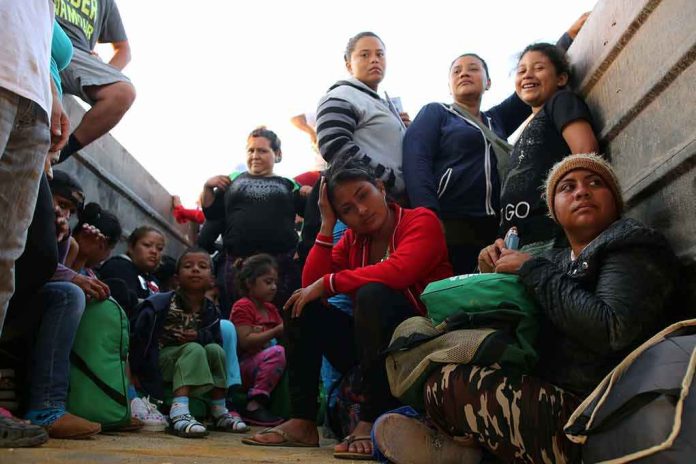
When a large migrant caravan sets out from southern Mexico, the decisive question is not how many people march, but how the United States and Mexico choose to manage the event long before anyone reaches a port of entry; policy signals, cross-border coordination, and distance all shape outcomes more than spectacle at the fence.
At a Glance
- The Trump administration signaled a no-release posture: turnarounds, arrests, prosecution, and deportation for illegal entry attempts, including potential transfers to third countries.
- DHS said it was tracking the caravan and communicating with Mexico, which reportedly worked to disperse or redirect the group in southern states.
- The caravan’s starting point in Chiapas put it over a thousand miles from the U.S. border, giving weeks for deterrence, processing offers in Mexico, or attrition to shrink its size.
- Some participants sought legal status and work in Mexico rather than continuing north, complicating assumptions that every marcher will head for the United States.
What policy signals actually meet a caravan on the road
Caravans rarely collide with a blank slate at the U.S. line; they encounter a layered policy environment that begins well to the south. In public remarks carried by multiple outlets, White House Border Czar Tom Homan said that migrants attempting to cross illegally “will be immediately turned around, or they’ll be arrested and prosecuted and deported,” adding that if a home country delayed acceptance, transfers to third countries were on the table. He coupled that with a categorical pledge: “Zero releases from the border under the Trump administration.” These statements, whatever one thinks of their tone, are operational signals designed to reach migrants, smugglers, and foreign governments as much as domestic audiences. They set an expectation: no entry via illegal crossing, no broad release into the interior, and removal pathways that do not depend solely on a single destination government.
Signals alone do not move people or buses; coordination does. DHS officials and allied commentary described U.S. engagement with Mexico and suggested Mexican authorities would help disperse or redirect the group before it approached the northern frontier. That comports with post‑2018 practice in which Mexico deploys immigration and security forces in Chiapas, Oaxaca, and Veracruz to slow caravans, offer documentation, or channel people into asylum processing—an approach repeatedly catalyzed by U.S. diplomatic pressure. While the detailed cables and taskings are not public in the record here, the through-line is familiar: Washington broadcasts a hard line; Mexico absorbs the operational burden hundreds of miles south.
Distance, time, and attrition: why “1,500 miles to go” matters
Geography imposes its own enforcement. A caravan setting out from Tapachula faces two to four weeks of walking and waiting before it could even stage near a U.S. port of entry. That timeline gives governments room to act: Mexico can extend humanitarian visitor cards, work authorizations, or transfers to shelters; NGOs triage injuries and dehydration; and the United States can reinforce its messaging and coordinate removals logistics. In practice, attrition is the rule—families accept documentation in Mexico, individuals peel off to work in southern states, and the headline number dwindles as the group advances. Reporting on the Fe y Esperanza caravan placed it in Chiapas with more than 1,500 kilometers remaining; in that window, the enforcement policy is felt indirectly—through options and obstacles—long before a U.S. agent makes first contact.
This is why categorical assurances about outcomes at the line often function as upstream deterrents rather than promises of a dramatic confrontation. If third‑country removal is credibly available, if illegal crossers are prosecuted, and if no one is released on recognizance, the rational calculus for continuing north changes. Even when the hard data on releases and prosecutions are not published alongside the statements, the policy articulation itself influences decisions on the road.
What Mexico does—and why that frequently decides the ending
The center of gravity in caravan management sits in Mexico’s south, not at San Ysidro or Eagle Pass. After 2018, Mexican authorities—under persistent U.S. pressure—built a pattern of containment: intercept large groups, disaggregate them, transport subsets to administrative hubs, and offer short‑term documentation or relocation. Contemporary accounts around this caravan describe precisely that playbook, including transport offers in Chiapas linked to regularization documents. When accepted, those offers bleed momentum from the march and reduce the number who press onward to Mexico’s northern border.
This division of labor is not accidental. It aligns with academic and policy literature showing that caravans spur earlier-stage controls by transit states and that U.S.–Mexico cooperation repeatedly converts a media event into a series of administrative actions far from the cameras. The practical consequence for a caravan is simple: the likeliest “reception” is screening and paperwork in southern Mexico, not a mass stand-off at the Rio Grande.
What entrants would face at the U.S. line under a “no release” posture
Assume a subset reaches the border and attempts entry between ports. Under the policy articulated by Homan, Border Patrol would arrest adults for illegal entry, refer repeat crossers for prosecution, and move quickly to removal—expedited where applicable. Those ineligible for return to their home countries could be transferred to third countries pursuant to diplomatic arrangements, a contingency Homan highlighted precisely because source-country acceptance has historically been a bottleneck. That suite of outcomes—arrest, prosecution, deportation, or third‑country transfer—adds up to a border that is procedurally “closed” to illegal entry and unreceptive to immediate release claims.
What about those who present themselves at ports seeking protection? The public remarks in the record do not spell out the asylum screening cadence, but a no‑release framework typically pairs with detention during credible‑fear processing or rapid removal if claims do not pass threshold screening. The promise at issue is not leniency; it is throughput—moving cases toward removal without parole, absent a statutory exception.
Not every marcher is headed for the United States
Caravans are heterogeneous by design. Spanish-language coverage and on-the-ground video indicated that many Fe y Esperanza participants voiced a preference to remain in Mexico if they could regularize their status and find work. That is consistent with what seasoned observers see repeatedly: the caravan operates partly as a mobile information market, where Mexican permits, local job leads, and shelter capacity pull significant numbers off the road. It is also a reminder to treat simplistic claims about a monolithic intent to storm the U.S. border with skepticism—groups fracture, and destinations diverge.
The humanitarian layer travels with the group: NGOs and local authorities provide food, water, and first aid for exhaustion and injuries, which both stabilizes vulnerable migrants and offers touchpoints where Mexican officials can route people into formal processes. That blend of care and administration is not incidental; it is how caravans are domesticated into casework rather than confrontation.
The pattern endures even when the headlines change
Across the past decade, the most durable truths about caravans concern response, not rhetoric. U.S. officials project consequences; Mexico executes early containment; distance imposes attrition; and only a fraction present at the U.S. line. Research on the post‑2018 era documents that caravans routinely trigger pre‑border controls and policy performances in both countries, with outcomes shaped more by intergovernmental choreography than by the raw size of the march. For a reader trying to forecast “what happens when they arrive,” the better question is: what has already happened to them in Chiapas, Oaxaca, and Mexico City, and what signals—credible or otherwise—did they receive from Washington along the way?
Put concretely, a caravan today is likely to encounter three things before any U.S. agent: a Mexican transport offer tied to temporary documents, a thinning column as families opt to stay and work in Mexico, and a drumbeat of U.S. statements promising no release and rapid removal for illegal entry. If a contingent nevertheless reaches the border, expect processing that prioritizes detention and removal rather than release. The drama at the fence is the exception. The system upstream is the rule.
Bottom line
If you are handicapping the outcome of a south‑to‑north caravan under the current posture, the smart money is on dispersion in Mexico, not mass admission into the United States—and on a hard enforcement response for those who still attempt illegal entry after weeks of signals to turn back.
Sources:
bigleaguepolitics.substack.com, wltreport.com, ground.news, rvmnews.com, womensystems.com