

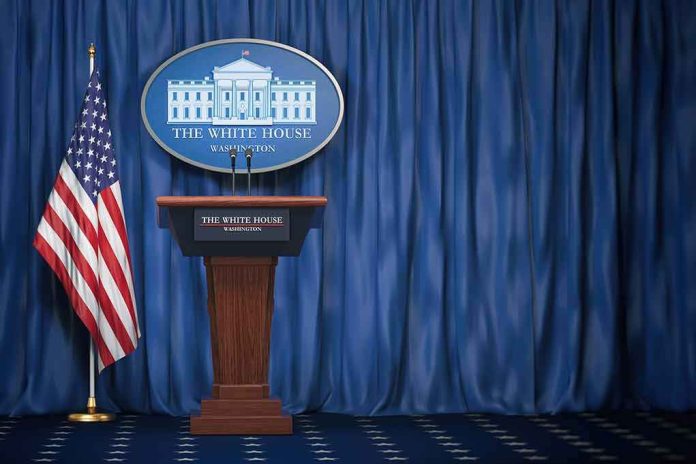
The first briefing a press secretary delivers is less a press event than a constitutional handshake: it signals how an administration intends to inform, argue, and be held to account—day in, day out—before a national press that will test every premise and every statistic.
At a Glance
- President Trump appointed Katie Zacharia to succeed Karoline Leavitt as White House press secretary, announcing an introductory briefing in the James S. Brady Briefing Room.
- Zacharia framed the job as an official appointment and pledged to engage the press corps on the administration’s record and priorities.
- Her pathway to the lectern ran through pro-Trump media and a stint in government communications, a profile that aligns with Trump’s personnel preferences.
- The press secretary’s role is institutional and archival by design: briefings leave transcripts, video, and advisories that form a durable public record.
What happened and why it matters
President Trump named Katie Zacharia as White House press secretary, publicly setting her start and an introductory briefing in the West Wing’s Brady Room. Multiple outlets reported the appointment and succession, quoting Trump’s praise for her loyalty and effectiveness and specifying the plan for a Tuesday morning debut at the podium. Zacharia accepted the mantle in on-record statements, thanking the president and signaling readiness to work with the White House press corps to communicate the administration’s agenda. The choreography here is straightforward and familiar: the president announces, the appointee affirms, and the press office sets a formal first outing to establish working norms.
Why that routine matters is not ceremonial. A press secretary is the executive branch’s daily interpreter—translating policy, absorbing scrutiny, and, when necessary, absorbing fire. An orderly handoff and a clear first engagement provide the scaffolding for everything that follows: on-background guidance, rapid-response notes, the cadence of briefings, and the settlement of access rules. Administrations that get this right build credibility and velocity; those that don’t spend months reacquiring basic traction.
The job: spokesperson, traffic controller, and archivist-in-chief
The modern press secretary stands at the confluence of policy, politics, and process. Mechanically, the office runs on three rails. First, message integration: aligning Cabinet, agencies, and the West Wing around language and facts that will withstand questions from beat reporters who live inside the details. Second, access management: who gets called, how often briefings run, whether specialists are brought to the podium to defend technical moves on security, trade, or health. Third, documentation: advisories, pool notes, video, and transcripts that become the official memory of the administration’s public stance, often used in litigation, oversight, and history.
That third rail is underappreciated. White House briefings leave an institutional footprint—posted transcripts, timestamped video, and archival indexing—that stretches back decades. The Obama, Clinton, and Reagan-era records illustrate the norm: near-daily briefings with full-text and video preserved for public retrieval; the Nixon materials even catalogue the series as part of the permanent record. This is not ephemera; it is the ledger by which administrations are held to their word.
How this appointment fits Trump’s communications pattern
Zacharia’s selection tracks with President Trump’s long-standing preference for communicators steeped in his media ecosystem and fluent in combative television formats. Reports describe her as a senior communications adviser affiliated with Trump’s media orbit and a brief DHS spokesperson—credentials that foreground loyalty and on-air dexterity more than long tenure in bureaucratic press shops. Trump’s own announcement language highlighted her steadfast support for his agenda and confidence in her ability to “deliver strong results,” which mirrors his prior emphasis on surrogates who can prosecute an argument as much as explain a policy.
That choice has practical implications. A press secretary fashioned in the mold of a television advocate can energize the president’s base and compress complex messages into crisp, repeatable lines. The tradeoff is the learning curve of governing specificity: budget baselines, statutory hooks, and interagency processes that reporters will probe, often with primary-source texts in hand. The test is whether an advocate can also be the system’s fact discipline.
The stakes of a first briefing
First outings establish rules of engagement. Will the press office hold stand-ups most weekdays, as has been customary across parties? Will it rotate questions equitably among the wires, networks, and specialty beats? Will subject-matter principals—NSC staff, NEC economists, HHS scientists—join to brief when policy turns technical? History suggests that administrations that institutionalize these practices early buy themselves policy running room later.
Substance also matters out of the gate. Reporters will test commitments on immigration enforcement, economic indicators, and foreign policy flashpoints; they will expect specific figures, legal authorities, and implementation timelines. The press secretary’s credibility is a compound of three things: precision under questioning, willingness to revisit and correct the record, and consistency between podium statements and what agencies actually publish. Those metrics are set early and are hard to reset once the press corps calibrates its trust.
Continuity and change in the Brady Room
Despite differing political styles, the office itself is conservative in the small-c sense: its work product looks similar across eras because the downstream users—Congress, courts, historians—require standardization. The archived record of routine, often dry, exchanges under Democratic and Republican administrations alike underscores the point: briefings are institutional assets, not just communications moments. Where administrations do diverge is in frequency, the length of Q&A, and the elasticity of claims tolerated before corrections are issued. Those levers shape the daily temperature of the briefing room and the tenor of coverage.
Zacharia inherits that infrastructure. Her success will hinge on how quickly she marries message discipline to the mechanics of government disclosure: timely guidance to beat reporters, coordinated data drops with agencies, and clear rules for when subject experts take point. Done well, the office reduces ambient noise and raises the signal-to-noise ratio of public debate. Done poorly, it invites process stories that crowd out policy.
What to watch next
Three markers will reveal how this press operation intends to run. First, cadence: a predictable schedule of briefings and gaggle opportunities signals openness and reduces speculative reporting. Second, documentation hygiene: same-day transcripts and video, paired with corrections when warranted, restore shared factual baselines even amid sharp disagreement. Third, integration: how often agency principals and policy staff appear alongside the press secretary when the questions demand technical precision. Institutions reward those habits; history memorializes them.
Sources:
abcnews.com, cnbc.com, nytimes.com, dw.com, nbcnews.com, obamawhitehouse.archives.gov, nixonlibrary.gov, reaganlibrary.gov
When Fake News is panicking over President Trump's new press secretary choice, we know we're on the right track.
"The newly appointed White House press secretary Katie Zacharia previously promoted the debunked Pizzagate conspiracy theory and shared posts accusing Democrats and… pic.twitter.com/rdacRhhJXO
— Bridgett Fertig (@LightOnLiberty) October 12, 2026
This is a header
This is a paragraph.