

Campaign sound bites about war fall apart the moment you ask the two questions that actually govern outcomes: what, precisely, is the objective, and what theory of success links military force to that objective at an acceptable cost. The Booker–Murphy clash over the Iran war distilled this into stark relief, offering voters not just different temperaments but rival theories of how wars are won—or avoided.
The Short Version
- Murphy endorsed “finishing” the war with Iran: decisive force, a defined end state, no open-ended quagmire.
- His rationales—block an Iranian nuclear weapon and punish the IRGC’s repression/terrorism—were clear but thin on public, verifiable specifics.
- Booker argued the war lacked an endgame, inflated costs at home, and reflected a recurring U.S. error: force first, strategy later.
- History suggests preventive strikes can delay nuclear programs but rarely erase capability; durable outcomes hinge on politics, not just bombs.
What Murphy Actually Said—and Why It Landed
In a nationally broadcast New Jersey Senate debate at Rider University, Republican Justin Murphy, a Navy veteran, told voters exactly how he’d advise President Trump on Iran: “finish it”—press superior force to a “positive” conclusion, avoid a drawn-out deployment, and abandon any pretense of stalemate management. He anchored the case to two security claims: deny Tehran a nuclear weapon and impose consequences on the Islamic Revolutionary Guard Corps (IRGC) for repression and support to terrorism. Seen through a military professional’s lens, the appeal is intuitive. Define an end state, mass force to reach it, and exit cleanly. Voters can understand that. It is operational clarity in a sentence.
That clarity, however, is rhetorical, not yet operational. Neither the debate exchange nor subsequent coverage surfaced public detail on target sets, force levels, escalation thresholds, civilian protection, or the war-termination criteria that would convert “finish it” from applause line to executable plan. The same gap applies to the factual foundation of the nuclear risk: no declassified intelligence, enrichment timelines, or inspection findings appeared alongside Murphy’s claim in the public record cited here.
Booker’s Counter-Case: Ends Without Means Are Fantasy—and Means Without Ends Are Worse
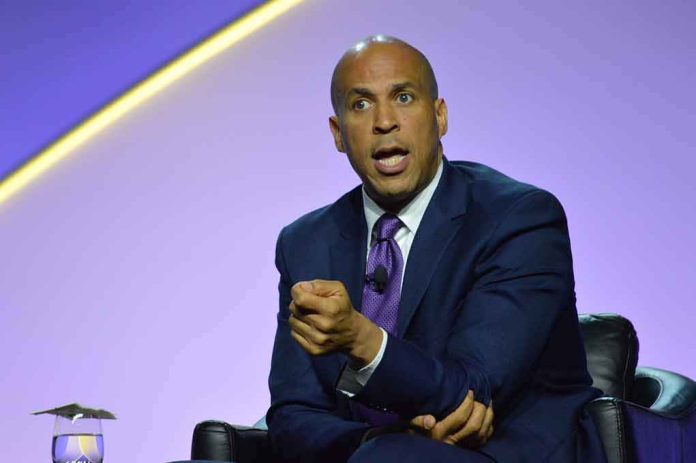
Democratic Senator Cory Booker pressed the opposite thesis: military power belongs at the end of a process, after diplomacy and alliance work, and only in service of a realistic endgame. He called the decision to go to war with Iran “colossally stupid,” tying it to American casualties, tens of billions in spending, higher gasoline prices, and disruption at the Strait of Hormuz—costs he argued were borne by families back home while delivering none of the administration’s stated objectives. The critique was not merely tonal; it was structural. A war lacking an end state becomes its own purpose, he argued, a pattern the United States has paid for repeatedly in the Middle East.
On the evidentiary ledger, Booker’s argument has the advantage of internal coherence: if you cannot specify the political result you seek—regime behavior change, verified nuclear rollback, deterrence of proxies—and the mechanisms by which force delivers it, you have not designed a strategy; you have designed an operation. Strategy adjudicates what “finish” means and when more bombs produce fewer gains. Absent that, insistence on escalation reads less like resolve and more like drift.
The Mechanism Question: How Force Supposedly Delivers the Ends
Murphy’s theory of success implies two mechanisms. First, that military destruction or coercion can durably prevent Iran’s nuclear acquisition. Second, that punishing the IRGC reduces repression and regional terrorism. The historical literature on preventive strikes is sobering here. Attacks can impose delay—sometimes significant—but they rarely erase capability because knowledge, dispersed infrastructure, and political will endure; absent a broader political settlement, programs reconstitute or adapt. As for counterterrorism by interstate coercion, kinetic punishment may suppress tempo or shift proxy calculus for a time, but without a credible path to behavior change—sanctions, diplomacy, inducements, and enforcement integrated—the effect can be transient or counterproductive.
Booker’s mechanism critique runs in parallel: wars that lack a defined political theory of victory default to tactical activity—strikes, raids, attrition—that neither settles the nuclear file nor stabilizes the region, while exacting economic and human costs at home. He connects those costs explicitly to household budgets (energy prices, inflationary pressure) and to the opportunity cost of federal spending redirected from domestic priorities. The proximate statistics are inherently fluid in war, but the burden-of-proof standard he asserts is consistent: leaders must demonstrate how force, not simply more of it, closes with the desired end state.
Where the Evidence Is Strong—and Where It Is Thin
Three claims are well supported. One, Murphy did publicly and unambiguously endorse “finishing” the war, on a national stage; this was not a stray line in a donor email but a televised position. Two, he tied that to Iran’s nuclear ambitions and the IRGC’s malign activity, providing at least a high-level rationale. Three, Booker’s rebuttal—force last, diplomacy first, no endgame—was equally explicit and consistent across venues, including a long-form interview.
By contrast, two foundations are weak in the public record available here. Murphy’s nuclear and terrorism rationales lack the declassified specificity—inspection data, enrichment metrics, intelligence assessments—on which a reader could independently judge imminence, magnitude, or the expected effect of force. And neither side supplied a granular war-termination framework: what counts as “finish,” how compliance would be verified, and what triggers de-escalation or re-escalation. In the absence of those details, the comparative weight tilts toward the cautionary case—because strategy is a discipline of constraints, not only of will.
U.S. Sen. candidate Justin Murphy (@JerseyJustinUSA) (R-NJ) calls on President Trump to "finish" the Iran war and tells him to "put your cowboy hat on and get out there and kick some ass and get this done." https://t.co/9t2CbQOidK
— آدر ليسنر (@OTHER1LISTENER) October 11, 2026
The Historical Lens: Preventive War’s Track Record
Preventive military actions aimed at nuclear programs are uncommon but not exceptional; more than a dozen have been contemplated or executed over recent decades. Scholarly assessments, including work comparing Iran with earlier cases such as China, reach a consistent conclusion: airstrikes and sabotage can delay, sometimes for years, but they seldom eliminate the underlying scientific and industrial base; durable outcomes require political arrangements that change incentives and oversight, not just damage equipment. This does not foreclose the use of force; it clarifies what force can and cannot purchase on its own. In plain terms, bombs buy time. Strategy decides how to spend it.
Implications for Voters and Policymakers
If you find Murphy’s instinct appealing—finish decisively, no quagmire—the unavoidable follow-on is to demand his finish line. What specific nuclear rollback would satisfy the objective? What constraints on IRGC behavior would constitute success? What instruments, beyond strikes, make those conditions stick? Without those answers, “finish it” is not a plan; it is a mood. If you prefer Booker’s caution—force last, diplomacy first—the reciprocal obligation is to define the red lines at which force becomes necessary and the coalition, enforcement, and verification architecture that makes diplomacy something more than aspiration.
Wars are ultimately contests for political outcomes. The path to those outcomes may include force, but the roadmap cannot end there. The Murphy–Booker exchange usefully sharpened the choice. It also reminded us why, in matters of war, the most decisive words are not the loudest ones but the most specific.
Sources:
redstate.com, dailywire.com, nj1015.com, wn.com, inquirer.com, newjerseyglobe.com, yahoo.com