

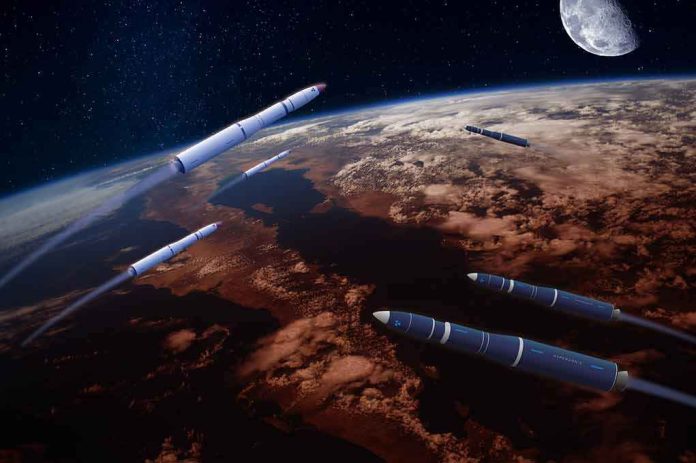
With Flight 14, SpaceX is attempting the decisive pivot from experimental hops to an orbital transportation system—an integrated mission that inserts Starship into orbit, deploys payload, and flies long enough to collect the data that turns a prototype into a product.
At a Glance
- SpaceX states Flight 14 begins Starship’s orbital missions, targeting payload delivery of Starlink V3 and new in-space tests.
- The profile calls for insertion to a roughly 275-kilometer orbit, about six laps over nearly 10 hours, then a controlled deorbit and splashdown.
- First operational deployment from Starship: 26 Starlink V3 satellites, a step toward bulk broadband launches.
- Booster 21 performs ascent and a controlled splashdown; the focus is orbital performance and data return over hardware recovery.
What Flight 14 is designed to prove
SpaceX has framed Flight 14 as the start of Starship’s orbital service: placing payload into orbit while gathering system data over a long-duration flight, and demonstrating critical end-to-end functions like an orbital insertion burn, payload deployment, thermal protection performance, and a late mission engine relight for deorbit. This is not a single stunt but a progression of interlocking objectives that together mark the transition from suborbital experimentation to a basic, repeatable orbital transport profile. The target orbit sits around 275 kilometers—low enough to manage debris and reentry risk, high enough to validate guidance, thermal, power, and communications systems across multiple day-night cycles.
On this flight, Ship 41 carries a Starlink V3 batch—the first time Starship is planned to place operational satellites into a stable orbit from its own upper stage dispenser. The company’s flight timeline has the vehicle perform a brief orbital insertion burn roughly 25 minutes after liftoff, enabling about six orbits across nearly ten hours before a single-engine relight to begin controlled reentry and a splashdown west of Chile. SpaceX’s own update also points to first-time demonstrations relevant to future architectures: orbital payload delivery today; on later flights, orbital propellant transfer and other in-space tests as the system matures.
Mechanics of the mission: from pad to orbit to splashdown
Starship is a two-stage, methane-oxygen, fully reusable architecture designed to unify heavy-lift, high-volume payload delivery and rapid reflight. Flight 14’s ascent, powered by a 33-engine Super Heavy booster, aims to place Ship 41 on a suborbital trajectory before a short orbital insertion burn imparts the horizontal velocity that closes the loop into orbit. That small burn—seconds long—carries disproportionate importance: it validates upper-stage engine relight timing, propellant settling, and guidance handoffs at orbital velocities. Once on orbit, the spacecraft’s primary job is not speed; it is stability. A near ten-hour coast checks power margins, thermal gradients, propellant boil-off behavior, avionics robustness, and the communications plan needed to operate a very large stainless-steel vehicle across multiple ground passes.
Payload deployment—26 Starlink V3 satellites—tests an equally consequential system: bulk on-orbit release from a high-capacity dispenser. The ability to seed a full shell rapidly is central to Starship’s business logic, which hinges on lowering the per-kilogram cost of orbit for SpaceX’s own constellation and, eventually, for external payloads. After deployments are complete, the vehicle must nurse its resources for hours before the most unforgiving test of all: a single Raptor relight for deorbit, followed by controlled atmospheric entry, thermal protection assessment, and a water landing in a remote corridor in the Pacific. The booster, meanwhile, performs its own controlled splashdown in the Gulf of Mexico—an incremental step on the road to full rapid reuse.
How we got here: test cadence, regulatory gates, and information flows
No heavy-lift program is linear. Starship’s early flights prioritized surviving max dynamic pressure, hot staging, and stage separation; subsequent sorties stretched duration and tested reentry handling. Along the way, SpaceX iterated on engines and thermal protection, adjusted flight software, and modified ground systems. Parallel to the engineering loop runs the regulatory loop. Under U.S. law, the FAA licenses commercial space launch and reentry, while other agencies handle spectrum and environmental reviews; a mission’s ambition only becomes a mission’s plan when those approvals align with vehicle readiness. That sequencing explains why public timelines often begin with a company’s target date and mature as FAA actions post and rehearsals complete; specialized trackers and mainstream outlets then translate those moving parts into a coherent schedule.
For Flight 14, the public record reflects that evolution: a SpaceX program update defining the step-change—“starting with Flight 14, Starship will begin flying orbital missions” and deliver Starlink V3—paired with mission pages and coverage that outline the orbit, the multi-orbit duration, and the deployment plan. The core through-line is consistent: Flight 14 is built to reach real orbit and work there long enough to qualify the systems Starship needs for operational payload delivery.
What truly matters technically: three make-or-break demonstrations
First, orbital insertion and attitude control. The upper stage must prove it can execute a tightly timed, brief burn with settled propellants, acquire the right attitude and momentum trim for payload operations, and maintain thermal balance and power across hours. Second, the dispenser. High-volume deployment imposes structural, thermal, and contamination considerations inside the payload bay; a clean, timed release of 26 vehicles without interference builds credibility for Starship as a high-throughput launcher. Third, the deorbit relight after nearly nine hours. Long coasts invite propellant stratification and thermal shifts; a reliable relight in that regime is a prerequisite to any mission that brings Starship home deliberately rather than as an uncontrolled decayer.
There are ancillary but nontrivial goals. SpaceX has signaled a long-term path toward in-orbit propellant transfer—vital for lunar lander and deep-space profiles—beginning with the data Flight 14 can gather on boil-off and tank conditioning over many hours. Thermal protection refinements, including tile retention strategies, face their audit in the plasma regime on descent; even a water landing yields actionable evidence about heating patterns and structural response for future recoveries.
Where the program goes if Flight 14 delivers
If Starship executes the full profile—orbital insertion, payload deployment, and controlled deorbit—the milestone is larger than one mission patch. It would validate Starship as a functional orbital upper stage with real payload throughput, enabling a ramp in Starlink deployment that reduces constellation logistics and, over time, operating cost per bit delivered. It would also unlock the next rung of flight tests SpaceX has queued: progressively more ambitious reentry and recovery attempts, and, when licensed, on-orbit cryogenic transfer. The commercial implications are straightforward: higher cadence and larger fairing volume expand the menu for satellite buses and constellations that have been space- and mass-limited on traditional rideshare stacks.
Equally important is the industrial tempo behind the scenes. The Raptor test cadence at McGregor, pad system upgrades, and parallel pad development are the plumbing that converts a one-off success into repeatable operations. A reusable, heavy-lift system only changes economics if it turns missions into sorties and sorties into flights on a schedule; Flight 14 is the first full demonstration aimed squarely at that conversion.
SpaceX received FAA approval for Starship Flight 14, on track for Monday as the first revenue flight carrying 26 V3 Starlink satellites, per tracker with FAA source.https://t.co/qFaZKI7g8i
— shipfrontier (@shipfrontierai) September 27, 2026
A note on dates, windows, and the license-to-fly
Launch schedules are dynamic by design; public target dates often shift as vehicles, weather, and regulatory processes align. The FAA is the licensing authority for commercial launch and reentry in the United States; spectrum coordination and environmental assessments are necessary but not sufficient by themselves. In that context, SpaceX’s program declaration about Flight 14’s orbital role provides the “what,” while the evolving launch window and license issuance provide the “when”—a choreography familiar to anyone who has watched complex flight test campaigns mature from ambition into capability.
Sources:
en.wikipedia.org, techtimes.com, spacex.com, spacelaunchschedule.com, space.com