

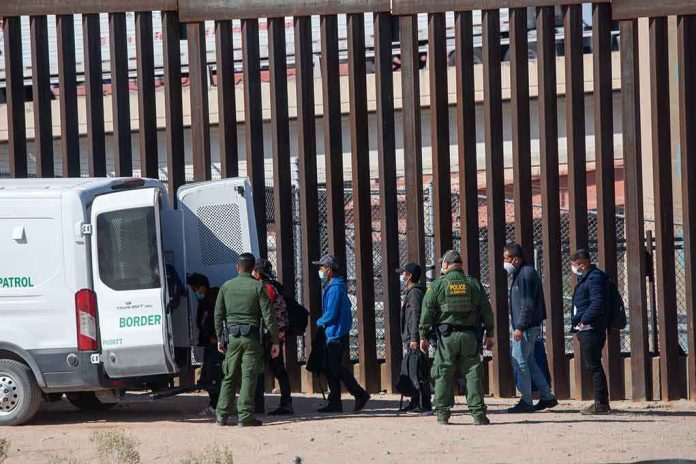
“Zero releases” is not a slogan; it is an operational setting that reshapes the entire border pipeline. Pair it with a federal push on noncitizen voting cases, and you have a government staking its credibility on throughput discipline — moving people and cases into detention, transfer, or removal rather than release, and referring suspect voter files to prosecutors rather than letting mismatches linger.
The Short Version
- DHS and CBP say the southern border has logged 16 consecutive months of zero releases — a policy outcome about post-apprehension custody, not a claim of zero crossings.
- The policy contrasts sharply with prior parole releases; DHS materials cite “zero parole releases in August” versus “over 10,000” two years earlier.
- Separately, DHS leadership touts an illegal-voting crackdown: 1,620 cases under investigation, 151 arrests, and a large universe of records flagged for review.
- Critics counter that “zero releases” may mask later ICE releases and that noncitizen-voting prosecutions and convictions remain scarce relative to allegations.
What “zero releases” actually measures — and why it matters
When DHS and CBP say “zero releases,” they are describing a custody outcome after Border Patrol apprehends someone who crossed illegally: instead of being released into the interior pending proceedings — the long-criticized “catch and release” — individuals are held, transferred to ICE, removed, or otherwise processed without a Border Patrol street-side release. That is an administrative throughput metric; it does not mean entries have stopped or that encounters dropped to zero. DHS’s own public framing makes this distinction explicit, and outside summaries have been careful to note it. The point is that custody is retained at the first federal touchpoint rather than ceded to the community before adjudication.
Metrics like this shape behavior on both sides of the border. For migrants and smugglers, release policies function as a de facto signal about expected outcomes; for the government, eliminating Border Patrol releases forces downstream capacity planning — detention beds, transportation, expedited removal flights, asylum-screening cadence — to meet the intake reality. In practice, sustaining “zero releases” across months requires synchronized case routing and surge resources. DHS public statements claim the government has done exactly that for over a year.
How the 16-month streak compares to prior practice
Comparative baselines matter. DHS-linked materials contrasted “zero parole releases in August” with “over 10,000” parole releases under the prior administration in the analogous month two years earlier, underscoring the shift’s magnitude and its political message: the Border Patrol is no longer the pressure valve. While the precise mix of expedited removals, Title 8 outcomes, and ICE transfers is not provided in these summaries, the headline is about custody control, not encounter volume. That framing is consistent across both DHS’s own release and independent explainers that translated the term for lay readers.
Skeptics raise a fair caveat: “zero releases” by Border Patrol does not necessarily capture what happens later in ICE custody — bond decisions, parole for medical or humanitarian reasons, or release after favorable case outcomes. That is a narrower critique than it may sound; it challenges whether a Border Patrol metric should be read as a systemwide release ban. It does not refute the stated Border Patrol policy record, which is the core claim on offer here.
The parallel track: a federal crackdown on alleged illegal voting
Running alongside border enforcement, DHS leadership has amplified a voter-integrity initiative focused on noncitizens who allegedly registered or voted. Public remarks described a program using database comparisons — state voter rolls against federal immigration-status data — to surface suspect records for investigation. According to those on-record statements, investigators are working 1,620 cases, have made 151 arrests, and are examining a much larger pool of potentially problematic records. DHS also spotlighted several arrests involving noncitizens in Texas with alleged voting activity stretching back years, illustrating the program’s retrospective scope. These are stated case counts and arrest tallies, not adjudications.
The mechanism here, too, is throughput: identify candidates via cross-dataset matching, triage for probable cause, and move viable matters to prosecutors. Properly built, that pipeline can deter small-scale but real violations; built sloppily, it overwhelms agents with false positives. Independent reporting outside the administration’s announcements has long found that noncitizen voting exists but at extremely low incidence — orders of magnitude below political rhetoric — which means any wide-net screen must contend with base-rate math. In such domains, precision beats volume.
Where the evidence is strong — and where it needs corroboration
On border custody, the strongest evidence is DHS’s own publication claiming 14 consecutive months of zero releases as of mid-July, later extended in subsequent coverage to a 16-month streak. That is a specific, falsifiable administrative metric asserted by the responsible agencies and echoed across explainers that clarify its meaning. Absent a contradictory dataset, the most reasonable reading is that Border Patrol has in fact operated without releasing apprehended migrants during that period — with the important caveat that this describes a single handoff stage, not full lifecycle outcomes.
On the voting crackdown, the factual backbone is thinner: we have agency leaders’ counts of active investigations and arrests, plus a handful of named examples. Those are consequential but preliminary signals. Case counts tell us workload; they do not tell us conviction rates, dismissal reasons, or error rates in the underlying matches. This is exactly where neutral research suggests caution: comprehensive reviews by journalists and election-law scholars have repeatedly found noncitizen voting to be rare, and some investigations of past sensational claims collapsed under methodological scrutiny. Any large “suspect universe” therefore demands transparent methods and careful prosecution screening to avoid mistaking data noise for systemic fraud.
Policy consequences and the questions that still matter
Zero releases, sustained over many months, reduces one politically fraught outcome — rapid release after apprehension — and signals a clear deterrent posture. The policy’s operational price tag sits elsewhere: detention capacity, transportation logistics, asylum-screening throughput, immigration court calendars, and removal operations must all absorb what the front end no longer offloads. Without public, systemwide data — custody durations, removals executed, transfers to ICE, ultimate case dispositions — we cannot assess whether the burden was shifted cleanly or whether bottlenecks simply migrated downstream. That accounting would turn a headline metric into a full-system performance readout.
The voter-enforcement track requires a different kind of transparency. To evaluate claims of hundreds or thousands of suspect records responsibly, the public needs the matching criteria, validation protocols, and the final ledger of outcomes: charges filed, pleas, dismissals, acquittals, administrative removals, and confirmed ineligibility corrections. In a domain where documented incidence is low and public skepticism is high, precision and postmortem disclosure are not luxuries — they are the backbone of public trust.
Bottom line
Take the claims at their most defensible meaning. On the border, DHS and CBP assert a 16‑month run in which Border Patrol did not release apprehended illegal crossers; available evidence supports that specific operational fact, properly bounded. On elections, DHS has opened a large number of inquiries and made arrests using cross-database screens; that demonstrates investigative effort, not yet scale of proven illegal voting. Both programs are about tightening the government’s grip on throughput. The next layer of credibility — and the one that will determine whether these initiatives endure — is rigorous, systemwide transparency on outcomes.
Sources:
townhall.com, hindustantimes.com, dhs.gov, theguardian.com