

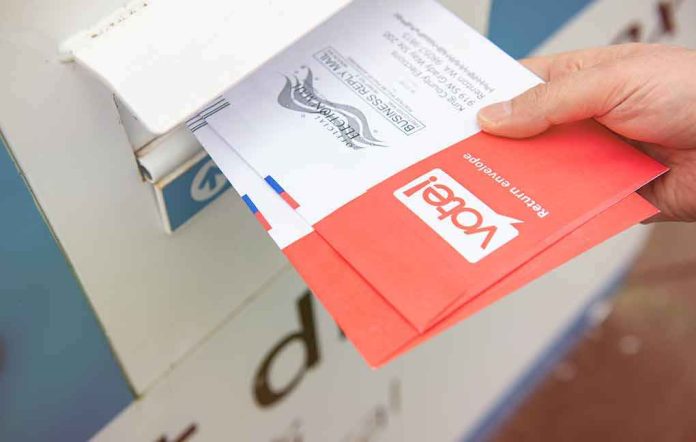
When federal agencies step into the machinery of elections, the most important question isn’t technological—it’s constitutional: who gets to set the rules. The recent fight over the Postal Service’s ballot-mail rule turned on that core allocation of power, and the challengers’ case persuaded multiple courts that USPS crossed from mail operations into election regulation.
The Short Version
- USPS issued a final rule tying acceptance of ballot mail to states uploading voter name/address data and envelope barcodes into a new federal portal.
- District and appellate courts concluded the rule likely regulates elections—a power the Constitution assigns to states and Congress—so enforcement was blocked.
- USPS defended the rule as operational housekeeping, not election regulation, and told the Supreme Court it only relied on data election officials already hold.
- Operational readiness was doubtful: USPS acknowledged the portal wasn’t launch-ready and states hadn’t been trained, undercutting feasibility before an election.
What the USPS rule tried to do—and why it mattered
USPS finalized a rule to condition acceptance of ballot mail on two pre-mailing steps by state election officials: upload recipient name and address data, paired with envelope barcodes, to a new Federal Ballot Mail Portal; and submit ballot-envelope designs for agency review. In litigation, the Postal Service characterized this as pre-acceptance verification to improve handling accuracy using information election offices already possess, not a scheme to adjudicate voter eligibility. The agency’s filings described an architecture of portal registration, barcode matching, and design standards embedded in the Domestic Mail Manual—concrete mechanisms rather than abstract policy rhetoric.
That framing matters because the legal boundary here is bright: USPS plainly has authority to set mail-handling standards; it does not have independent authority to regulate the “manner” of holding elections. The closer a postal rule looks to a prerequisite for whether and to whom ballots may be mailed, the more it drifts into a domain the Constitution reserves to states and to Congress.
The constitutional line the courts saw crossed
Challengers argued the rule went beyond mail logistics by effectively interposing a federal clearance step before states could send ballots, and by countenancing refusal to process ballot mail not aligned with the federal portal. A federal district judge agreed the plaintiffs were likely to prevail on the claim that USPS lacked statutory authority to promulgate the rule, and an appellate panel quoted the Elections Clause frame: regulating the manner of elections is for states and Congress, not an executive agency acting without a clear congressional grant.
On a narrower statutory plane, opponents pointed to Congress’s exhaustive list of mail matter USPS may lawfully refuse. Ballots aren’t on it. If the rule functionally empowered USPS to reject otherwise mailable ballots based on portal noncompliance, courts were primed to view that as ultra vires—beyond the authority Congress conferred. These holdings didn’t resolve the ultimate merits, but they were decisive enough at the preliminary stage to halt enforcement for the election cycle.
USPS’s defense: this is operations, not election law
USPS told the Supreme Court that the rule merely standardizes ballot-mail processing to improve speed and accuracy: require barcodes that already exist in postal workflows, harmonize envelope designs for sortation, and pre-match recipient data to reduce misdelivery or delay. Crucially, the agency stressed it sought only information election officials already keep; it wasn’t building a federal voter-roll or dictating who may receive a ballot. The stay application framed the portal as a verification tool at acceptance, not a gatekeeper of eligibility.
Even so, two weaknesses blunted that defense. First, the rule’s enforcement lever rested on USPS’s acceptance of ballot mail—an operational decision that, to challengers and judges, slid toward regulating access when refusal to process was on the table. Second, the infrastructure was not ready. In sworn declarations, USPS acknowledged the portal wasn’t launch-ready; it might be available for voluntary use “sometime next week,” which is not a confidence-inspiring posture on the eve of election mailings. Those admissions fed the classic election-law pitfall: late-breaking structural changes with uncertain implementation trigger injunctions on timing grounds alone.
Feasibility and the risk of disenfranchisement
Litigation documents from state and local officials underscored practical concerns: no operational portal to train on, no time for nationwide barcode and envelope-design compliance, and no clear remediation path if the system mismatched names or codes. Election administrators argued that layering a new, untested federal step between printing and mailing could slow outbound ballots and bottleneck returns—an unacceptable risk when statutory receipt deadlines loom. Postal labor weighed in similarly, warning that assigning USPS workers to verify ballot mail against a federal list is alien to their mission and capacity.
USPS countered that the requirements were modest extensions of existing mail-standards practice, not new determinations of voter eligibility. But courts do not grant agencies the benefit of the doubt when the practical effect during an active election window is a novel acceptance filter administered through unfinished technology.
How we got here: the recurring tug-of-war in election administration
This episode tracks a familiar pattern in election disputes. Executive-branch actors, citing integrity or efficiency, use administrative levers to standardize processes. Opponents respond that absent clear congressional authorization, agencies cannot alter how states run elections—especially close to voting. The courts, asked to referee on an emergency basis, default to two stabilizing principles: states run elections unless Congress plainly says otherwise, and late-stage changes that threaten confusion should be frozen until after voting concludes. The USPS rule—envelope standards, barcode mandates, pre-acceptance data uploads—fit that mold, so it met the same judicial headwinds.
What an enduring settlement would require
Two paths could legitimize some version of what USPS sought. Congress could enact a clear, narrow grant allowing USPS to condition ballot-mail acceptance on specified, operational criteria and to build supporting systems—paired with guardrails that forbid using these criteria to adjudicate eligibility. Or USPS could return to traditional postal rulemaking tethered tightly to proven logistics: demonstrate that any design standard or barcode requirement is functionally identical to other mail-optimization rules and carries no acceptance refusal for noncompliance during an election window.
Either way, the operational foundation must precede the rule. That means portal architecture, cybersecurity accreditation, statewide integration testing, error-rate disclosure, and training completed months before ballots go out—not days. Without that maturity, courts will continue to conflate intent with effect, and the effect of hurried complexity in elections is almost always the same: injunctions.
Bottom line
USPS argued logistics; the courts saw election law. In the absence of an unmistakable congressional mandate and with an unready technical stack, the judiciary treated the rule as a federal incursion into state-run election administration and pressed pause. The lesson is durable: in elections, authority must be explicit, timing must be early, and systems must be proven before they touch the critical path of ballot delivery. Anything less will not survive first contact with the Constitution—or with the calendar.
Sources:
redstate.com, about.usps.com, news.bloomberglaw.com, ag.ny.gov, supremecourt.gov, cbsnews.com, congress.gov