

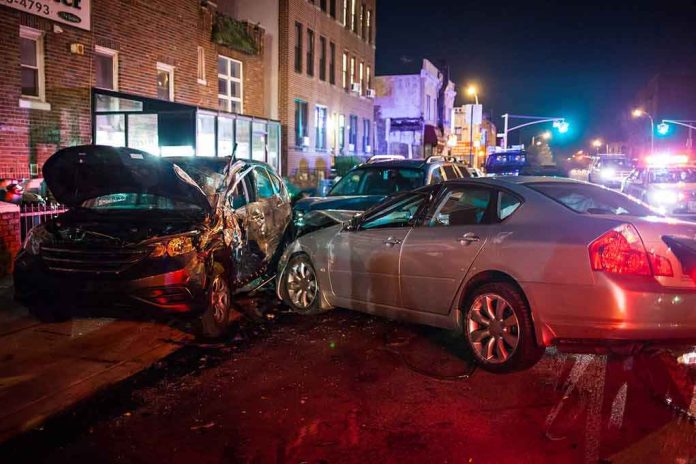
When a high-speed crash kills two teenagers at a suburban intersection on an ordinary Friday night, the headline is grief; the enduring lesson is how speed and split-second decisions turn familiar streets into corridors of extreme risk.
At a Glance
- Two teens died in a fiery three-vehicle collision at Ridgecrest Road and Elmwood Drive in Victorville on Aug. 14, 2026; the crash occurred around 8:30 p.m.
- CHP-based reports say a yellow Chevrolet Camaro and a black Dodge Charger were speeding northbound when an Acura entered from Elmwood Drive and was struck.
- The Dodge driver remained on scene and was arrested for vehicular manslaughter; the Camaro driver fled on foot and had not been located according to early reports.
- The San Bernardino County Coroner identified 17-year-old Maddalyn Dailey and a 16-year-old Hesperia resident as the deceased; the investigation continued after the crash.
What happened on Ridgecrest and Elmwood
On Friday, Aug. 14, 2026, just after 8:30 p.m., a violent collision at Ridgecrest Road and Elmwood Drive in Victorville tore apart two vehicles and ignited a third. California Highway Patrol (CHP) logs and contemporaneous local reporting place two northbound cars—a yellow Chevrolet Camaro and a black Dodge Charger—traveling at a high rate of speed when an Acura entered from Elmwood Drive, initiating the impact sequence. The Acura sustained catastrophic, disintegrating damage; the Camaro burned; first responders pronounced two people dead at the scene. Accounts are aligned on the basics: speed, multiple vehicles, and a sudden conflict at the side-street approach. The Dodge driver stayed and was arrested on suspicion of vehicular manslaughter, while the Camaro driver fled on foot and remained unaccounted for in the immediate aftermath.
The San Bernardino County Coroner subsequently identified one victim as 17-year-old Maddalyn Dailey of Victorville; a 16-year-old passenger from Hesperia was also pronounced dead at the scene. Both decedents are listed in coroner case records tied to the crash date and location, confirming identity and time of death from the primary public record. Witnesses and CHP incident notes referenced the possibility of racing between the Camaro and Charger—an allegation that often appears early in speed-related fatalities—though authorities had not formally confirmed that point in the immediate reporting window.
Mechanics of a deadly conflict: speed, approach, and line of sight
High-speed, same-direction traffic colliding with a vehicle emerging from a side street is a classic severe-injury geometry. Two factors do most of the damage. First, kinetic energy rises with the square of velocity; at 70 mph, a vehicle carries roughly double the energy of the same car at 50 mph, leaving occupants, structures, and fire loads little margin for survivability. Second, the emerging vehicle’s decision window compresses dramatically as approaching vehicles close distance faster than drivers intuit. If two fast-moving vehicles are staggered or offset in lanes, a side-street driver may perceive an opening that disappears in an instant when one car changes lane or arrives sooner than expected. That dynamic is consistent with the reports: two northbound cars at high speed, an Acura turning into or across their path, and catastrophic outcomes when mass and momentum meet limited time-to-collision.
Fire is tragically common in very-high-energy impacts. Fuel system breaches, hot surfaces, and energized wiring combine with shattered structures that expose ignition points; once flame takes hold, occupant egress becomes a race against heat and smoke. The descriptions of the Camaro engulfed and the Acura torn into multiple pieces match the physics of an impact sequence that exceeds conventional passenger-compartment protection envelopes.
The official actions and what they signify
Post-crash decisions by authorities signal the immediate evidentiary picture. NBC Los Angeles and CBS Los Angeles, citing CHP, reported that the Dodge driver remained on scene, cooperated, and was arrested for vehicular manslaughter—a charge that, at this stage, typically reflects evidence of gross negligence tied to speed or conduct contributing to a death. In parallel, the Camaro driver’s flight raises distinct legal exposure: leaving the scene of a fatal collision is its own crime, and if investigators later connect pre-impact behavior (e.g., engaged speeding in tandem) to causation, prosecutors can charge on theories that do not require direct contact with the victim vehicle. That is why early frameworks sometimes mention both vehicular manslaughter and hit-and-run in the same incident; they address different elements of conduct surrounding the crash.
Coroner identification anchors the human stakes. The agency’s press listings tie names and ages to time and place, building the chain of public record that supports everything that follows—memorials, school responses, and, if filed, court cases. Here, the primary coroner records list Maddalyn Dailey, 17, and a 16-year-old Hesperia resident, both pronounced dead at the scene on Aug. 14, 2026. That is the definitive confirmation of loss beyond on-scene reporting.
Where “racing” fits—and why it often remains provisional
In early traffic-fatality coverage, “street racing” is a frequent narrative hook; it captures a pattern many communities recognize: pairs or packs of performance-oriented cars accelerating aggressively on arterial roads. But formally proving racing is narrower than observing parallel speeding. Investigators look for synchronized acceleration data from event data recorders, matched witness accounts, roadway markings, and sometimes social media posts or prior contacts that suggest coordination. As reporting noted, CHP logs and witnesses raised racing as a possibility, but authorities had not confirmed that element at the time—a common and responsible distinction when a case is in its initial phase.
Even absent a formal racing finding, speed itself is a dominant fatality factor. In California, roughly one-third of motor vehicle deaths in 2023 were speeding-related, according to UC Berkeley SafeTREC’s statewide compendium of traffic safety facts. Young drivers are statistically overrepresented in severe collisions relative to their share of licensed drivers, a pattern documented across multiple California and federal datasets; that overinvolvement is a function of inexperience, risk perception gaps, and higher risk-taking propensity in peer contexts.
The setting: an arterial “death trap” problem communities know too well
Residents who live along fast suburban arterials can recite the ingredients: wide lanes, long sight lines that invite acceleration, intermittent lighting, and side-street feeders where turning drivers must judge closing gaps against elevated speeds. Add evening hours when traffic thins just enough to embolden heavy throttle, and you have a corridor where one misread or one impulsive move causes outsized harm. Families near Ridgecrest and Elmwood have publicly called the area dangerous; those claims reflect a well-known mismatch between the posted rule set and the speeds drivers actually choose on wide suburban roads after dusk. While enforcement and engineering are the obvious levers—targeted patrols, signalization where warranted, lane narrowing, and speed feedback signs—the deterrent effect is strongest when drivers understand the physics: speed is not a linear risk; it’s exponential.
Two Best Friends, 16 and 17, Killed in Victorville Crash Days After Starting Their Senior Year
Two teenage best friends who had recently started their senior year together lost their lives in a devastating multi-vehicle crash in Victorville, California.
The girls were… pic.twitter.com/5RDrgnLQLk
— raw culture media (@rawculturenews) August 19, 2026
What the data say—and what responsibility looks like
Zoom out, and this crash sits squarely within California’s traffic safety picture. National Highway Traffic Safety Administration data show California recorded 4,061 traffic fatalities in 2023, with 428 involving young drivers aged 15–20; while trends fluctuate year to year, the overinvolvement of young drivers is persistent, and the evening period from late afternoon to late night carries elevated risk. Speeding’s role in fatal crashes—about 32 percent statewide in 2023—explains why prosecutors, judges, and communities treat high-speed conduct, whether solo or in tandem with other drivers, as more than a mere infraction; it is the single largest controllable input into crash severity.
Responsibility in these cases breaks across three lines. The law addresses conduct—speeding, racing, hit-and-run, and the mens rea attached to manslaughter theories. Engineering addresses environment—how a corridor’s design cues either suppress or invite speed. Culture addresses norms—what friends, families, and local leaders define as acceptable behind the wheel, particularly for teenagers and young adults. None is sufficient alone; together, they are the only durable answer to recurring memorials at the side of fast roads.
One necessary caveat
Investigators typically take weeks to finalize a reconstruction and any toxicology; early reporting here accurately reflects what authorities said and did on scene, but a final CHP collision report is the document that will lock in sequencing and contributing factors.
Sources:
nypost.com, nbclosangeles.com, vvng.com, youtube.com, cbsnews.com, latimes.com, maisonlaw.com, dmv.ca.gov, cdph.ca.gov